AI Tech News
Artificial intelligence remains the fastest-moving story in technology. Here you will find news on model releases and research, the labs and companies competing for the frontier, enterprise adoption, and the debates over safety, jobs, and regulation that AI continues to raise.
Typical stories include new model launches and benchmark claims, massive infrastructure and chip investments, AI features arriving in mainstream products, research papers that shift the field's direction, and enterprise deals that show where adoption is real rather than experimental.
AI now sets the agenda for the rest of the technology industry, steering capital, talent, and strategy at nearly every major company. Developers, executives, policymakers, and workers wondering how their jobs will change all have reasons to follow it closely.
2026-07-12

A recent comparison of AI coding assistants reveals that Claude Code incurs significant token overhead, sending 33,000 tokens to the API before even processing the user prompt. In contrast, OpenCode sends only 7,000 tokens in its default configuration. This hidden cost disparity is primarily driven by differences in instruction files, MCP schema weights, and subagent multipliers.
CommentsA developer recovering from health issues is leveraging AI coding tools to build a 2D roguelite game, prompting a broader Hacker News discussion on AI's role in game development. While participants praise AI for handling complex architecture and logic, they note it currently struggles with timing-based mechanics due to its inability to process real-time movement. However, commenters remain optimistic that rapid advancements in specialized inference hardware will soon overcome these temporal limitations.
Comments
Mesh LLM utilizes the iroh network to pool GPU resources across multiple machines, creating a unified distributed AI computing system. This allows developers to access a single OpenAI-compatible API using their existing hardware, offering a scalable solution for running large language models without relying on centralized servers.
Comments
A development team recently migrated their production AI agent to GPT-5.6, ending a four-month streak where Claude Opus dominated their performance evaluations. This transition delivered significant improvements, including a 2.2x increase in speed and a 27% reduction in costs. The article outlines the key technical lessons and practical insights gained during the migration process.
Comments
A new technical analysis reveals the exact data transmitted by the Grok Build command-line tool back to xAI servers. By inspecting the wire-level network traffic, the report provides developers with rare transparency into the privacy implications and telemetry practices of the AI development environment.
Comments
Tracing a journey that began with Java 1.0 applets in 1999, this article explores the author's long-standing interest in machine-assisted mathematics education. It highlights how modern coding agents are now being utilized to revamp and recreate these legacy educational tools.
CommentsI love LLMs, I hate hype
2026-07-12The author expresses profound enthusiasm for genuine artificial intelligence progress while actively rejecting the surrounding industry hype. Having dedicated their career to the field, they celebrate recent breakthroughs in large language models and coding agents. They highlight a seamlessly working local AI setup as proof that the long-awaited Year of the Linux Desktop has finally arrived.
Comments
A newly published arXiv paper leverages a dataset of billions of user-generated sketches to uncover hidden cultural variations in human conceptualization. By analyzing this massive visual dataset, researchers demonstrate how diverse cultural backgrounds significantly influence the fundamental ways people draw everyday objects. These findings offer valuable new insights into the intersection of cognitive science and large-scale data analysis.
Comments
An agent in 100 lines of Lisp
2026-07-12The author reflects on taking an artificial intelligence course at the University of Guelph around the year 2000, long before the rise of modern deep learning frameworks. They recall that the early curriculum focused heavily on writing algorithms in Lisp rather than the transformers and neural networks that dominate the field today.
CommentsAutomation Without Understanding
2026-07-12A recent arXiv paper titled Automation Without Understanding explores the current landscape of artificial intelligence, where systems perform complex automated tasks without genuine comprehension. The study highlights the potential risks of deploying models that lack true reasoning capabilities. Consequently, the authors urge developers to prioritize interpretability and safety in future AI designs.
CommentsResearchers in mechanistic interpretability are applying causality theory to large language models to determine if their internal operations reflect genuine reasoning or mere pattern memorization. By tweaking specific weights and activations, scientists aim to uncover how these networks process information, recently identifying shared underlying methodologies for tasks like calculating time and calendar dates. Although some argue that the immense complexity of neural networks makes them impossible to fully reverse-engineer, this approach seeks to translate encoded knowledge into human-understandable cognitive concepts.
Comments2026-07-11

Apple has filed a lawsuit against OpenAI, accusing the AI company of stealing its trade secrets. The legal action specifically targets former Apple employees who allegedly transferred proprietary information to OpenAI. The tech giant claims these ex-workers illegally obtained and shared confidential data to benefit OpenAI's development efforts.
Comments
AI neoclouds like CoreWeave and Nebius are experiencing soaring revenues and stock prices due to massive demand for GPU infrastructure. However, lacking the deep cash reserves of Big Tech, these companies are relying on complex, circular financing structures to fund their rapid expansion. This unconventional approach to securing capital has raised red flags regarding the long-term sustainability of their business models.
Comments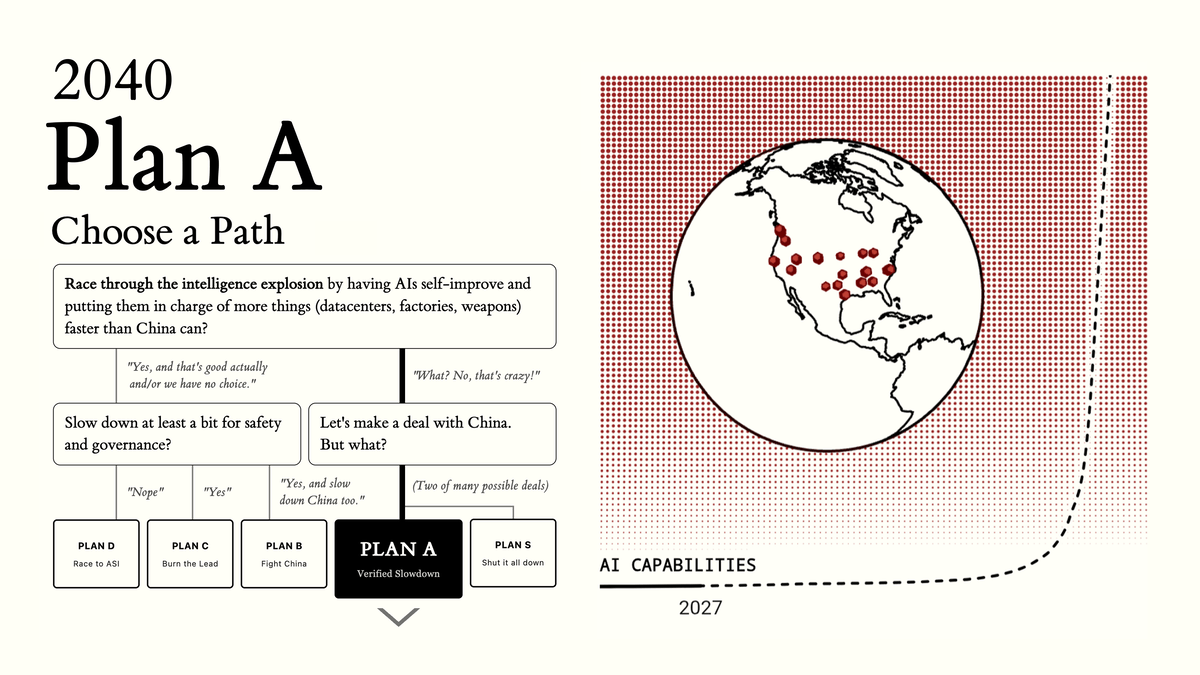
AI 2040: Plan A
2026-07-11The new report AI 2040: Plan A offers a detailed forecast and strategic recommendations for the United States, China, and the global community to navigate the impending era of artificial superintelligence. It outlines critical steps for international collaboration to manage the complex geopolitical and technological challenges associated with this transformative milestone.
CommentsSilent speech with ultrasound
2026-07-11Researchers have developed a machine learning model that enables silent speech by predicting words from ultrasound video of the tongue without requiring the user to vocalize. The system generalizes across different individuals to decode open-vocabulary text, achieving a 15.6% word error rate.
CommentsReflecting on the 1984 book Digital Deli, readers discussed the extreme hardware constraints of early personal computing, noting how one contributor hand-coded the bestselling Apple Writer word processor using just 8KB of memory. The discussion contrasted these tight historical limitations with modern software bloat and today's massive GPU memory requirements. Participants also observed a cyclical trend in the industry, suggesting that modern AI tools are ushering in a new era of independent cottage programmers reminiscent of the early PC days.
CommentsHow to hide from killer drones
2026-07-11Online discussions about hiding military assets from killer drones reveal that visual countermeasures like dazzle camouflage and strobe lights fail against multi-sensor machine vision. Instead, readers argue that attempting to confuse AI targeting simply makes vehicles more visible to secondary systems, making a 360-degree close-in weapon system the only viable defense against swarming drones.
Comments2026-07-10
Although GPT 5.6 Sol Ultra successfully generated a proof for the Cycle Double Cover Conjecture, readers observe that the feat required extensive prompt engineering and explicit strategy guidance rather than independent reasoning. Discussants highlight that current large language models lack true volition, relying heavily on human direction and extended thinking modes to navigate complex mathematical tasks. Ultimately, they emphasize that these systems remain statistical predictors prone to hallucination, resolving complex logic through probability rather than genuine understanding.
CommentsFollowing an early 2025 report on the AI scraper bot scourge, this update examines the evolving tactics used by automated bots to bypass website security. It specifically focuses on the continued exploitation of residential proxies and highlights the ongoing technological arms race between content publishers and sophisticated scraping operations.
CommentsThe MiMo-V2.5 series introduces a comprehensive end-to-end inference optimization strategy designed to maximize Hybrid Sliding Window Attention efficiency. By implementing advanced techniques like tiered caching, SWA-aware prefix trees, and optimized processing pipelines, this engineering update significantly streamlines memory management and scheduling to deliver faster multimodal model inference.
Comments
Apple is experiencing incredible demand for its Mac mini and Mac Studio desktops as they become the preferred machines for running AI agents. Apple silicon executive Doug Brooks highlighted this trend in a recent interview ahead of WWDC 2026, noting the growing reliance on the company's custom chips for on-device AI workloads.
Comments
Developers have built a real-time AI tutor designed to teach math and reading to children aged four to nine. Because young learners require immediate feedback and cannot read text interfaces, the team integrated early childhood pedagogy directly into the system's engineering. The article details the key architectural decisions and technical lessons learned from creating a fast and highly accurate educational model for young children.
CommentsWrite code like a human will maintain it
2026-07-10Large language models enable rapid code generation, tempting developers to bypass traditional best practices like the DRY principle. However, because humans ultimately maintain the software, relying on endless AI output creates significant long-term technical debt. Developers must therefore prioritize clean, readable code over the sheer volume of AI generation to ensure future maintainability.
CommentsRecent advancements in AI enable the generation of highly optimized videos designed to maximally stimulate specific target brain regions. Readers warn that tech companies could exploit this capability to create surgically targeted, hyper-addictive content. This development raises severe concerns about unprecedented psychological manipulation and the evolution of digital media into perfectly engineered behavioral triggers.
Comments
A new report from the Cambridge Programme on AI Science and Policy examines how the terrorist group Boko Haram is leveraging frontier artificial intelligence. The research highlights an emerging security threat as extremist organizations increasingly gain access to advanced AI tools to enhance their operations.
Comments2026-07-09
A developer has introduced Colibri, a lightweight engine that runs the massive 744-billion parameter GLM-5.2 AI model on consumer machines with just 25GB of RAM. Written in pure C with zero dependencies, the project achieves this feat by streaming model experts directly from disk instead of loading them entirely into memory. This innovation dramatically lowers the hardware requirements for running immensely large language models locally.
CommentsGPT-5.6
2026-07-09OpenAI's developer guide for GPT-5.6 highlights improvements in intent understanding and image processing, emphasizing that shorter prompts now yield better performance and lower costs. Readers discuss the model's reduced default verbosity and compare its output to competitors like Claude, while also debating the technical distinction between context curation and actual machine learning.
CommentsHy3
2026-07-09Simon Willison's recent blog post evaluates AI image generation using his pelican test, prompting readers to question the benchmark's validity as models may be over-trained on his specific SVG examples. The community discussion also reflects on the broader impact of AI on software development, with some developers expressing a preference for hand-coding despite the industry's rapid shifts. Additionally, readers debated the current capabilities of local models, noting that Gemma4 and Deepseek 4 currently outperform GPT-OSS for coding tasks.
Comments
Muse Spark 1.1
2026-07-09Meta is facing criticism over the benchmark performance of its new Muse Spark 1.1 model after it was discovered that evaluations exceeded strict CPU and RAM limits. Critics argue that overriding these resource constraints on the Terminal-bench-2.1 leaderboard invalidates the results and fails to measure real-world agent behavior. However, some defenders downplay the controversy, suggesting that relaxing limits is common industry practice aimed at preventing task timeouts rather than outright cheating.
CommentsY Combinator S26 startup Context.dev has launched a new web scraping API specifically designed to help AI agents extract structured data from the internet. The platform allows developers to scrape individual URLs into clean markdown or HTML, crawl entire websites, and process the information using a single REST API. This tool aims to streamline data collection and formatting for developers building AI-driven applications.
Comments