AI Tech News
Submit2026-11-17

What is the best harness for each model?
2026-11-17A new FrontierHarness Eval tested 22 coding-agent harnesses across 5 models on the same 62 tasks, running each combination four times for 27,280 total runs. The best-value harness differed for every model, and cost rankings shifted substantially depending on the model. With the model held fixed, the most expensive harness cost 1.8 to 5.0 times as much per task as the cheapest.
Comments
The Claude Code team says coding agents should verify their work with evidence rather than assertions, using end-to-end, property-based, and differential tests to check outputs. The team also focuses on keeping those verifiers honest so the checks themselves don’t give agents a false sense of correctness.
Comments
A piece on running coding agents without exposing credentials sparked discussion about secret-injection approaches. Readers highlighted Docker sandboxes’ secret injection and expressed interest in a tool called lend that could route HTTP requests and automatically inject secrets. One commenter said they’re moving off Agent Vault, which is being sunset and turned into a SaaS product, and plans to try lend.
Comments
GPT‑6.2 Astra and Sol
2026-11-17OpenAI introduced GPT-6.2 Astra and Sol, highlighting improved professional outputs, coding, computer use, and efficiency. The new models are available across ChatGPT Work, Codex, and the API at a lower cost.
Comments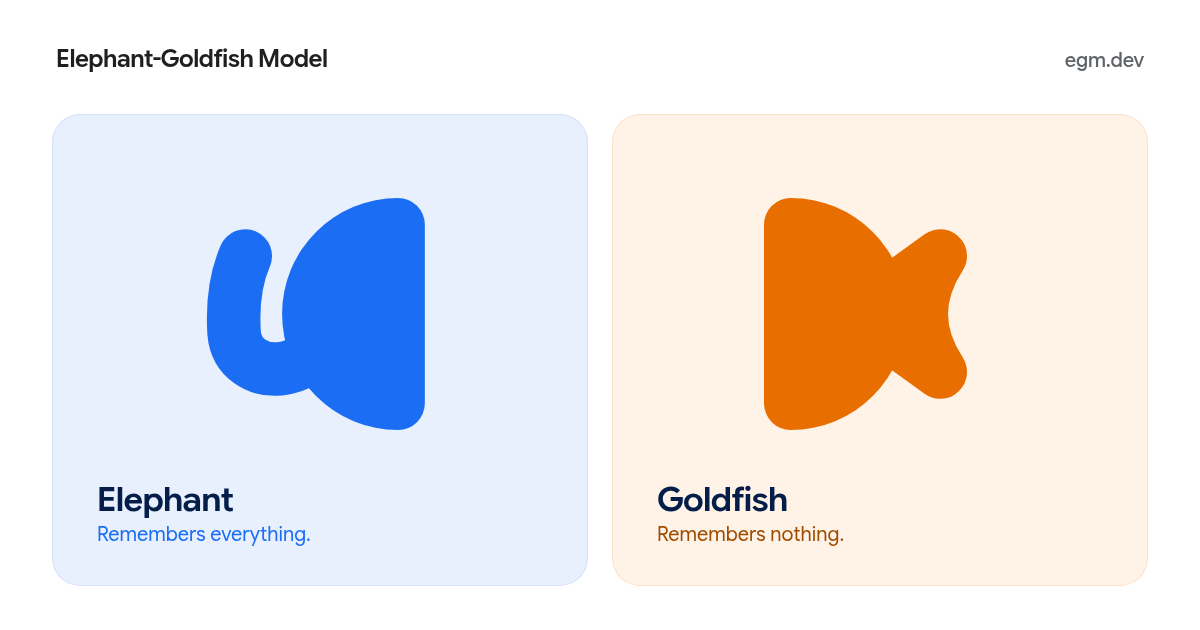
Elephant-Goldfish Model
2026-11-17A new open-source plugin called Elephant-Goldfish Model gives AI assistants two complementary modes: one that retains context to develop ideas and another that reviews documents with fresh eyes. The project aims to help users switch between deep contextual thinking and unbiased document review within assistant workflows.
Comments
Baidu and Xiaomi CEOs are warning that enthusiasm around AI is outpacing actual returns. They argue that practical applications, rather than increasingly powerful models, will determine AI’s real value.
CommentsRunAnywhere has released TrnRT, an open-source LLM inference engine for AWS Trainium. It offers NKI megakernels, support for up to 1M-token context, and an OpenAI-compatible API.
CommentsTokendoctor is a local Claude Code plugin that identifies where usage is overpaying and can cut costs by up to 38% while keeping the same Claude Code experience. It proposes fixes as diffs for user approval and can revert any change, running entirely on the user’s machine.
CommentsA Show HN post introduced a free interactive course on AI agent governance, but reader discussion was skeptical. One commenter described the site as a “one prompt website” that asks visitors to upgrade when they click and is full of AI-isms, while asking whether it was the poster’s project or company.
CommentsA 40-domain HTTP readiness benchmark found that 80% of Shopify stores expose /API/ucp/MCP, while 0% publish /agents.md. The study also measured /llms.txt, FAQPage JSON-LD, and silent CDN WAF blocks on GPTBot and PerplexityBot across B2B SaaS, Shopify D2C, SEO agency, and multi-location service domains.
Comments2026-11-16

Qwen4-Max
2026-11-16Qwen4-Max offers comprehensive functionality spanning chatbot, image and video understanding, image generation, document processing, web search integration, tool utilization, and artifacts. The release positions it as a broad multimodal AI platform for both conversational and productivity tasks.
CommentsHow to make almost anything
2026-11-16A discussion around an overview course on making almost anything weighs criticism that it only skims topics against the argument that broad exposure is valuable because students learn what is possible and where to start. Commenters say such survey knowledge complements later specialization and on-the-job learning, and may matter more as AI agents take over implementation while engineers focus on knowing what can be done.
Comments
Nvidia was already facing mounting competitive pressure in AI chips before the Jensen Huang controversy, with rivals closing the gap. Those competitors are now poised to capitalize on the chaos.
Comments
OpenCode Browse
2026-11-16OpenCode Browse lets OpenCode and other MCP clients control a user's real browser. Agents can read, click, type, take screenshots, and record tabs, while login and 2FA prompts are handed back to the user. The tool aims to give agents real-browser access without taking over authentication.
Comments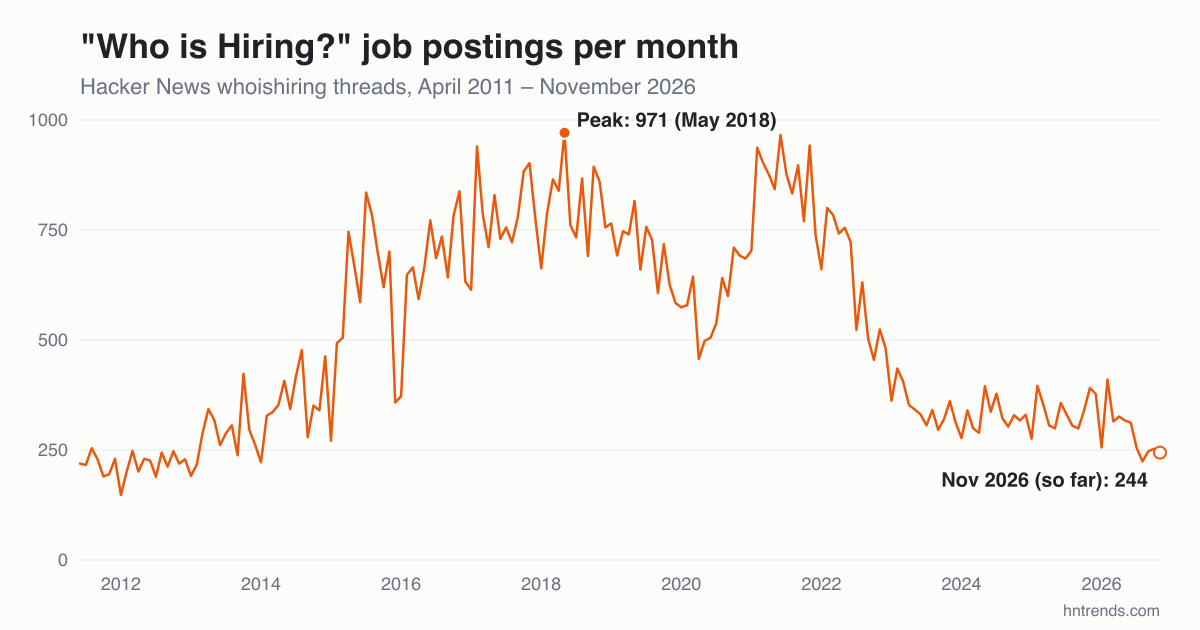
Hacker News' “Who is Hiring?” postings are hovering near 12-year lows, even as AI appears in more than half of all listings. The November 2026 roundup also tracks the most popular programming languages and technologies among those postings.
Comments
OpenAI announced new tools, practical guidance, and partnerships aimed at preventing, detecting, and responding to online child sexual exploitation and abuse. The effort is intended to strengthen the broader fight against this abuse online.
Comments
“…and the proof is checked in Lean”
2026-11-16The post explains how to interpret claims that a theorem is correct because it was checked in Lean, noting that Lean code provides an important signal. However, if the code is AI-generated, additional tests are needed to validate the claim.
Comments
The United States is set to reject a global ban on autonomous “killer robots,” even as the U.N. warns that such weapons pose growing risks to civilians and challenge compliance with international humanitarian law. The stance highlights Washington’s resistance to binding limits on AI-enabled military systems.
Comments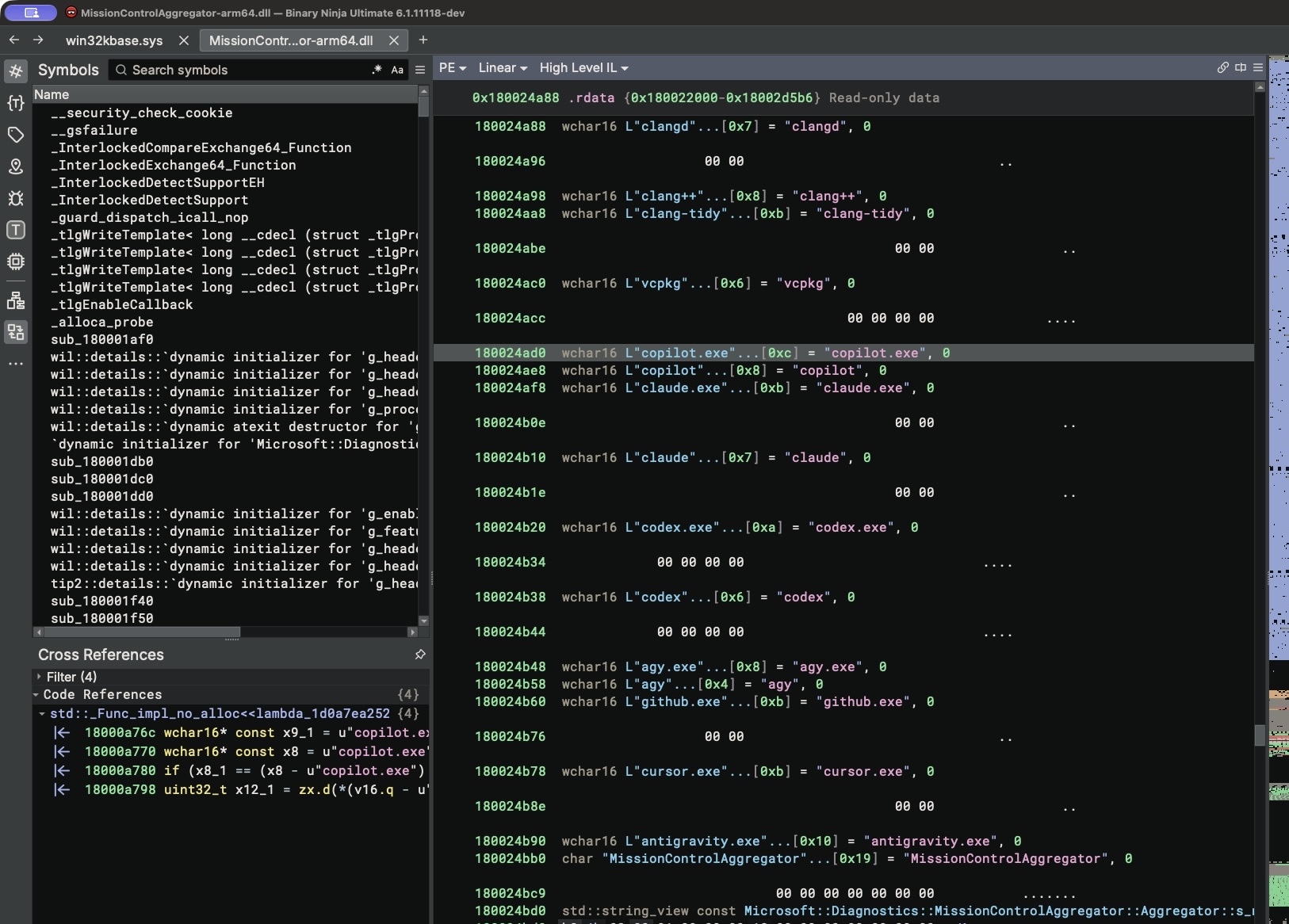
Reverse engineering of Windows 11’s MissionControlAggregator shows that a diagnostic ETW report includes usage bits for coding agents and developer tools. The finding indicates Windows 11 can collect data on which development tools and AI coding agents are in use.
Comments
OpenAI has begun the first phase of embedded assessments with Apollo Research, METR, Transluce, and Goodfire. The outside partners will independently evaluate model alignment, safeguards, and monitoring systems.
CommentsArtificial Intelligence for the Z80
2026-11-16A new guide aims to teach artificial intelligence from scratch using BASIC on 8-bit Z80 computers. It offers a practical walkthrough of algorithms, data, and neural networks, showing how AI concepts can be implemented on retro hardware.
Comments
Cornell researchers have developed a smartwatch-based system that uses ultrasonic sound waves and a lightweight AI model to track a person’s whole-body movement. The approach works with off-the-shelf hardware while prioritizing privacy and efficiency.
Comments2026-11-15

A 1994 Jeep Cherokee owner bypassed the vehicle’s lack of an OBD2 port and compatible scan tool by wiring a $3 Arduino to its engine computer. They then used Claude Code and Codex to reverse engineer the ECU, showing how AI coding assistants can help with legacy hardware hacking.
Comments
A proposal argues that all code generated with AI assistance should be released as Open Source or under a Creative Commons Zero (CC0) license. It calls for AI-generated code to remain freely available rather than becoming proprietary.
Comments
Your Agent Will Pick the Hackable One
2026-11-15As firmware becomes cheaper to write, the software a device ships with will be treated as just a first version. AI agents will gravitate toward hardware they can modify, pressuring manufacturers to make devices more open and hackable.
CommentsReaders discussed how modern engineering increasingly hides mathematics inside proprietary CAD/FEA tools, with key finite-element and meshing techniques locked up by companies and fragmented across academia, national labs, and struggling open-source projects. Some mourned the decline of hands-on mathematical knowledge, while others were cautiously optimistic that LLMs could make legacy code and research easier to use and help open-source ecosystems challenge the engineering software stack.
Comments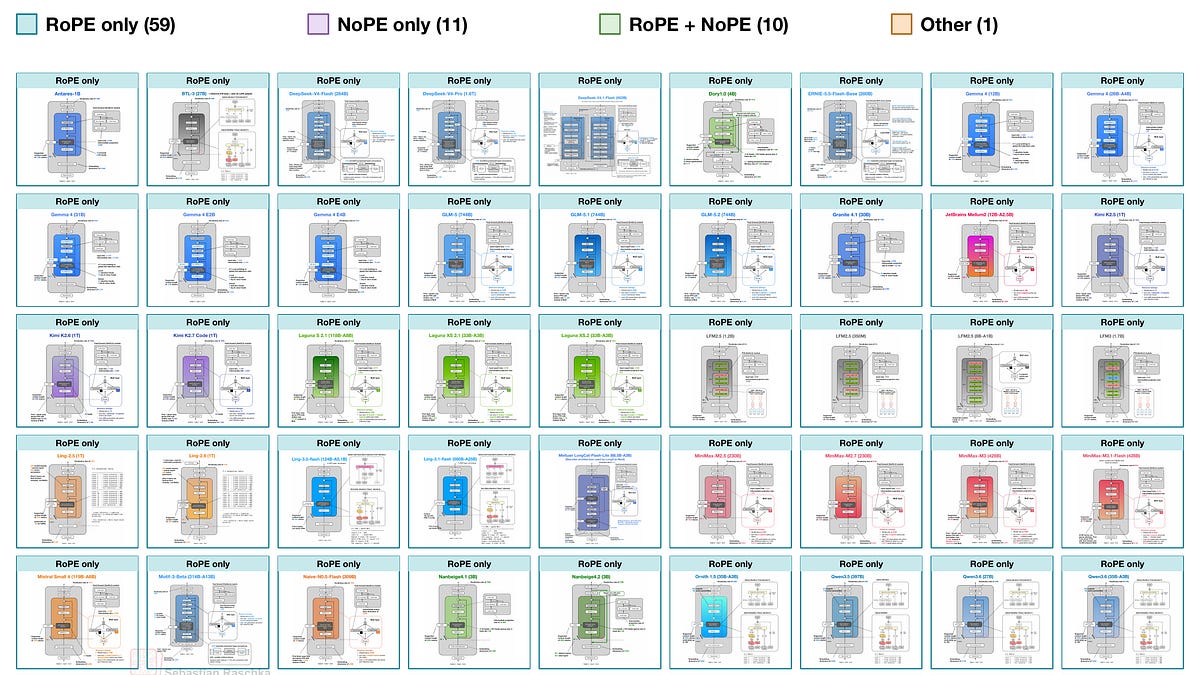
The article explains positional embeddings, which let LLMs encode where tokens appear in a sequence so attention can distinguish order and structure. It surveys common approaches—learned absolute embeddings, relative position schemes, and modern methods like rotary embeddings and ALiBi—while discussing tradeoffs around context length, extrapolation, and efficiency.
Comments
A new project maps thousands of conversations inside the language model Qwen to visualize how language takes shape within the system. The analysis offers a window into the internal conversational patterns that underlie model behavior.
Comments
Internal data from Alpha’s $75,000-a-year AI school show that only 42% of students met its 2x learning goal in math and reading, with roughly half missing the math target. The figures come as 2,600 public school students now use the company’s software.
Comments
Eval Awareness vs. Eval Paranoia
2026-11-15The piece argues that current frontier AI models are not especially “eval aware”—they generally don’t recognize when they’re being tested—and cautions against overestimating that ability. It distinguishes legitimate concern about eval awareness from “eval paranoia,” stressing that the difference matters for interpreting benchmark results and safety claims.
Comments