Software Tech News
2026-10-27


CSS-Tricks has a new owner
2026-10-27The popular web development website CSS-Tricks has officially transitioned to a new owner. After twelve years of working on the platform, the incoming leader expressed feeling both nervous and overwhelmed by the responsibility of taking full control.
Comments

Wikipedia is utilizing automated cleanup tools alongside human editors to combat the influx of AI-generated content. This joint effort focuses on identifying and removing subtle machine-written biases and fabricated citations. Ultimately, the initiative aims to protect the platform's integrity and ensure the encyclopedia remains a human-curated resource.
CommentsA tech blogger recently documented their quest to discover the oldest Windows graphical user interface application that still functions on Windows 11. After testing various legacy programs, the author successfully identified a surprisingly old piece of software that remains fully compatible with Microsoft's modern operating system.
Comments
Ghostty 1.4.0
2026-10-27Ghostty 1.4.0 was released on October 27, 2026, introducing the latest updates to the software. The official release notes provide a detailed breakdown of the new features, enhancements, and fixes included in this version.
CommentsWebsites Should Be Printable
2026-10-27In a recent post on his personal blog, Brennen Puth argues that modern websites should be designed to be easily printable. The piece explores the enduring value of maintaining print-friendly web layouts for offline reading and archiving.
CommentsSoftware quality is declining as massive increases in code production have outpaced improvements in error rates, resulting in buggier applications. However, the author argues that despite these current frustrations, software used to be horrible.
CommentsPharo 14
2026-10-27The release of Pharo 14 has prompted developers to reflect on the unique benefits of Smalltalk's image-based workflows and its continued relevance in the AI era. While many note that AI coding tools have made them less particular about which programming languages they use, enthusiasts still champion environments like Pharo, Squeak, and Cuis for recreational programming and practical deployment.
CommentsType Server Protocol
2026-10-27Microsoft hosts the official documentation and issue tracker for Pylance, its Python language server, on GitHub. Developers can contribute to the project's development and report bugs directly through the microsoft/pylance-release repository.
CommentsIs my data used for model training?
2026-10-27Paying subscribers are raising concerns about Anthropic's privacy practices after discovering that dismissing feedback prompts in Claude Code might inadvertently be logged as training data. While some users suspect this is a deliberate loophole to bypass explicit data privacy promises, others argue it could simply be a sloppy implementation detail. The discussion highlights broader frustrations regarding corporate transparency, data surveillance, and the potential exposure of user intellectual property in AI models.
Comments
Wiz researchers report that while PHP2Shell exploitation attempts are ongoing, none have succeeded to date. Their latest analysis breaks down the specific attack techniques, the defenses that blocked them, and how system exposure has evolved since the vulnerability was first disclosed.
CommentsNietzschian Debugger
2026-10-27A new open-source tool called the Nietzschian Debugger offers an anti-AI approach to troubleshooting by using confrontational questioning to challenge developers. Instead of providing automated fixes, the project forces programmers to rigorously defend their logic based on the philosophy that what doesn't kill your code makes it stronger.
CommentsThis tech profile examines Johnny, a developer whose addiction to deep thinking drives his relentless compulsion to abstract software systems. By contrasting his intense intellectual focus with the general tendency to avoid complex thought, the piece explores the psychological motivations behind his constant over-engineering and abstraction.
CommentsGforth 1.0
2026-10-27Gforth has reached version 1.0, solidifying its position as a fast, portable, and minimalist implementation of the Forth 2012 language. Community discussions highlight its ultra-thin architecture while exploring ways to improve its standard library and native executable compilation capabilities. Enthusiasts continue to champion Forth and its variants as engaging, logic-focused languages that preserve the art of programming in the age of AI.
CommentsFrigadeHQ has launched Hob, a free and open-source desktop application that serves as a local alternative to cloud-based AI tools like ChatGPT and Claude. The software allows users to run open-weight models directly on their Mac, Windows, or Linux computers. By processing data on-device, Hob ensures complete user privacy and functions entirely offline.
Comments
Tailscale has released an update regarding its ongoing security investigation into the Tailscale SSH feature. The company outlined its current remediation progress and provided actionable steps for customers to secure their environments. Users are advised to review the official guidance to ensure their systems remain protected.
CommentsPrivate equity-backed software companies are confronting a $300 billion debt wall driven by high interest rates and floating-rate loans, undermining the aggressive pricing strategies that fueled their recent growth. This financial pressure is compounded by the rise of generative AI, which threatens to dismantle the niche monopolies these firms rely on by making custom software easier to replicate. Consequently, this combination of looming debt and shifting technological paradigms is widely seen as a major driver behind the current slowdown in software engineering hiring.
Comments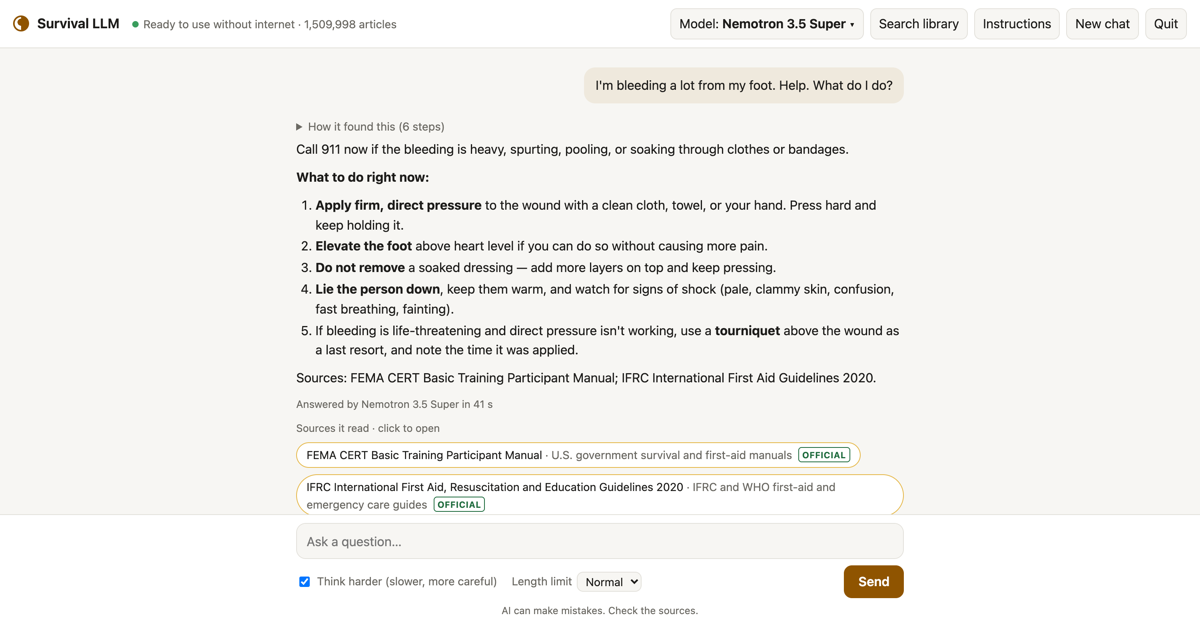
Survival LLM is a free, open-source AI assistant and emergency knowledge base that operates entirely offline on a local computer. By running without an internet connection, it provides users with reliable access to critical survival information and AI assistance during network outages.
Comments
A configuration mismatch in the GLM-5.3 model on Workers AI triggered an SGLang bug that exposed KV cache pages across different requests. The issue has since been resolved by the engineering team to prevent further cross-request data leakage.
Comments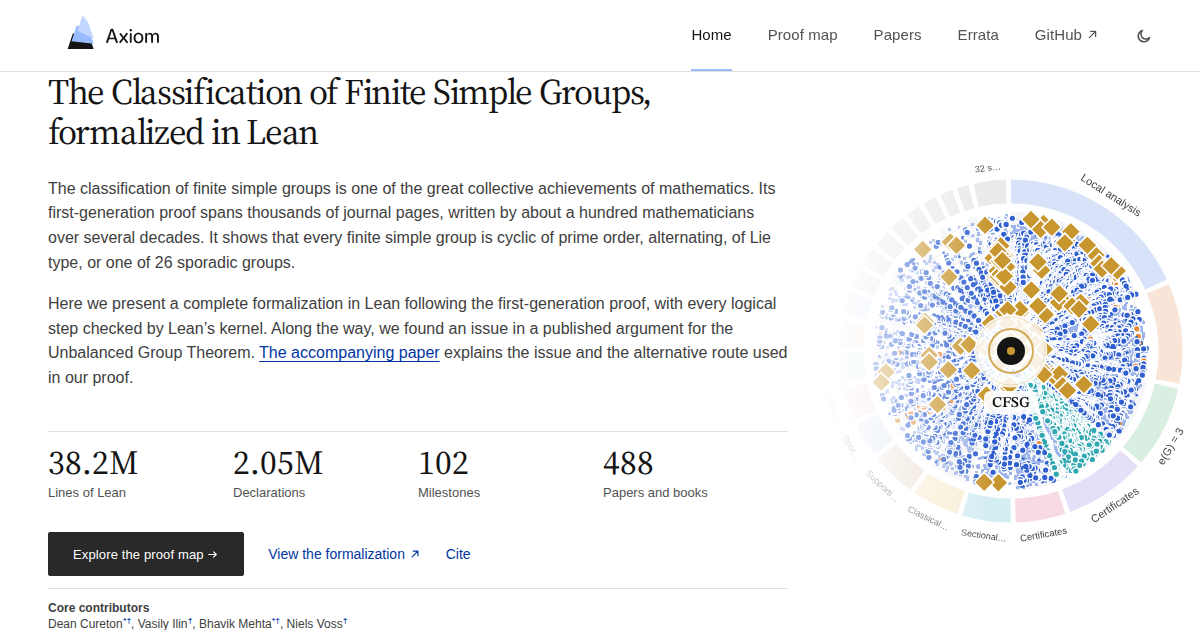
The first-generation proof of the classification of finite simple groups has been completely formalized using the Lean theorem prover. Every logical step of this monumental mathematical achievement was rigorously verified by Lean's kernel, highlighting the growing power of automated proof assistants.
CommentsOpenLDK integrates the Java ecosystem into Common Lisp by transforming Java classes into CLOS classes and allowing seven JVM languages to share a single Lisp expression. This integration also delivers significant performance benefits, enabling a saved Spring Boot application to launch in just 84 milliseconds.
CommentsNative Prometheus Integration with Nginx
2026-10-27Nginx is introducing native Prometheus integration, a long-awaited feature that will provide significant monitoring benefits for DevOps teams. The announcement has also sparked community debate over the efficiency of Prometheus exports and the growing trend of developers building custom reverse proxies instead of relying on battle-tested solutions like Nginx and Envoy.
CommentsThe open-source project winevdm allows users to run legacy 16-bit Windows operating systems and applications directly on modern 64-bit Windows machines. By translating older system calls, this tool provides a seamless way to access historic software environments without the need for complex virtual machine setups.
Comments
Starting November 16, 2026, Discord will allow Google and other web search engines to index messages from public Discoverable Servers. Server admins will retain control over which specific channels are made searchable on the web. Private servers, direct messages, and group chats will remain completely excluded from this new feature.
CommentsA Stackless Floodfill Automaton
2026-10-27Developers are discussing a memory-efficient stackless flood fill algorithm that repurposes 16 reserved colors in an 8-bit image to store traversal states, effectively turning the pixels into a linked list. While praised as a clever trick for constrained environments, some readers note the method functions similarly to a bounded heap and critique the original paper's explanation of its backtracking mechanics. Others suggest alternative approaches like the union-find algorithm for specific use cases such as identifying connected regions on a map.
Comments
This guide explains how to detect and safely remove hidden PHP installations on ColdFusion servers to protect against automated bot attacks. It also details a recent incident where a PHP2Shell security mitigation unexpectedly disrupted user sign-ins.
Comments
Five inference providers now support abliterated DeepSeek language models. This expansion allows developers to route models with automatic fallbacks and modality-aware selection. It also provides a centralized platform to easily compare availability and token pricing across all supported services.
Comments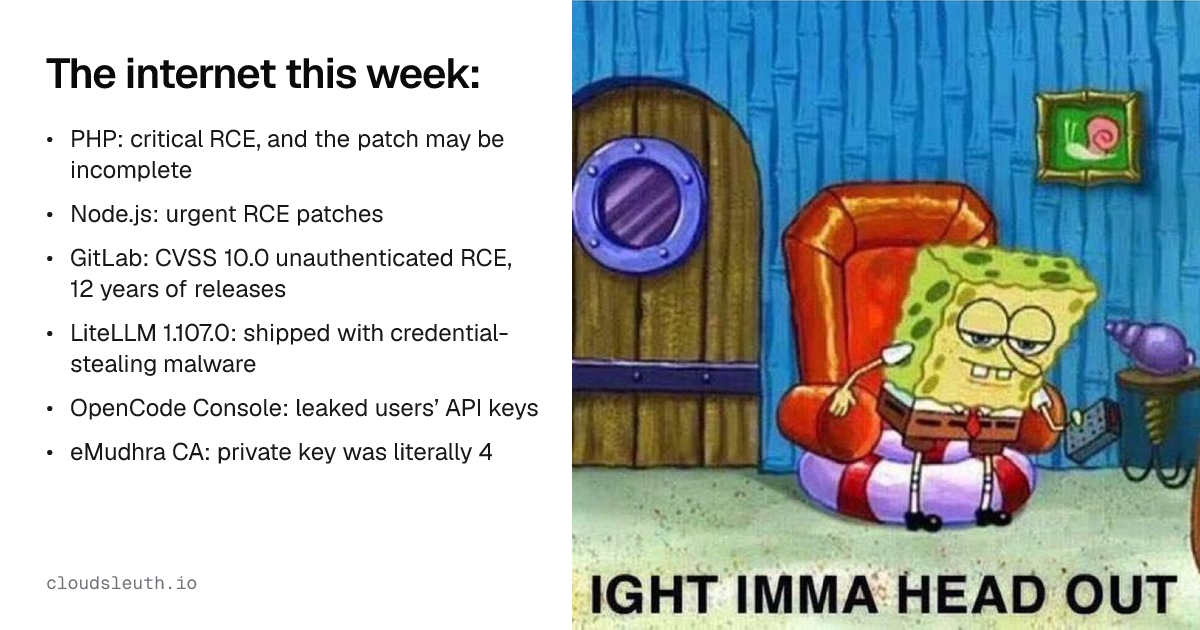
Critical patches have been released to address several severe security flaws across multiple platforms. These updates fix a maximum-severity GitLab vulnerability, a Node.js remote code execution issue, a compromised LiteLLM package, and a dangerously weak certificate authority key. Administrators are urged to quickly identify all affected resources and apply the available fixes to secure their systems.
CommentsI still teach OpenGL ES 3.0
2026-10-27Despite the industry transition to modern graphics APIs like Vulkan and WebGPU, the author defends the continued use of OpenGL ES 3.0 in educational settings. The article argues that the older API's simplicity, broad platform support, and wealth of existing learning resources make it the most practical choice for teaching computer graphics fundamentals to students.
Comments
In Context [video]
2026-10-27A new video explores strategies for building flexible software systems by embracing the constantly changing shape of data as it flows through complex architectures. It discusses practical methods for documenting and enforcing data expectations, enabling developers to maintain system integrity while adapting to evolving information structures.
Comments