Programming Tech News
Submit2026-11-09
A discussion around Herb Sutter’s piece on the rift between C++’s creator and its stewards highlights growing doubts about C++’s future, with commenters citing memory safety, AI-assisted rewrites, and weak safe-concurrency support as reasons legacy C++ may be increasingly hard to defend. Others credit Sutter and the C++ committee for foundational work on concurrency and memory models, while debating whether those efforts made parallel programming meaningfully easier.
Comments
Zebkit is a new project that packages Chromium as an embeddable library, offering a slim cross-platform browser engine for applications. It aims to let developers integrate web rendering into their apps without shipping a full browser. The project is available at ikey4u/zebkit.
Comments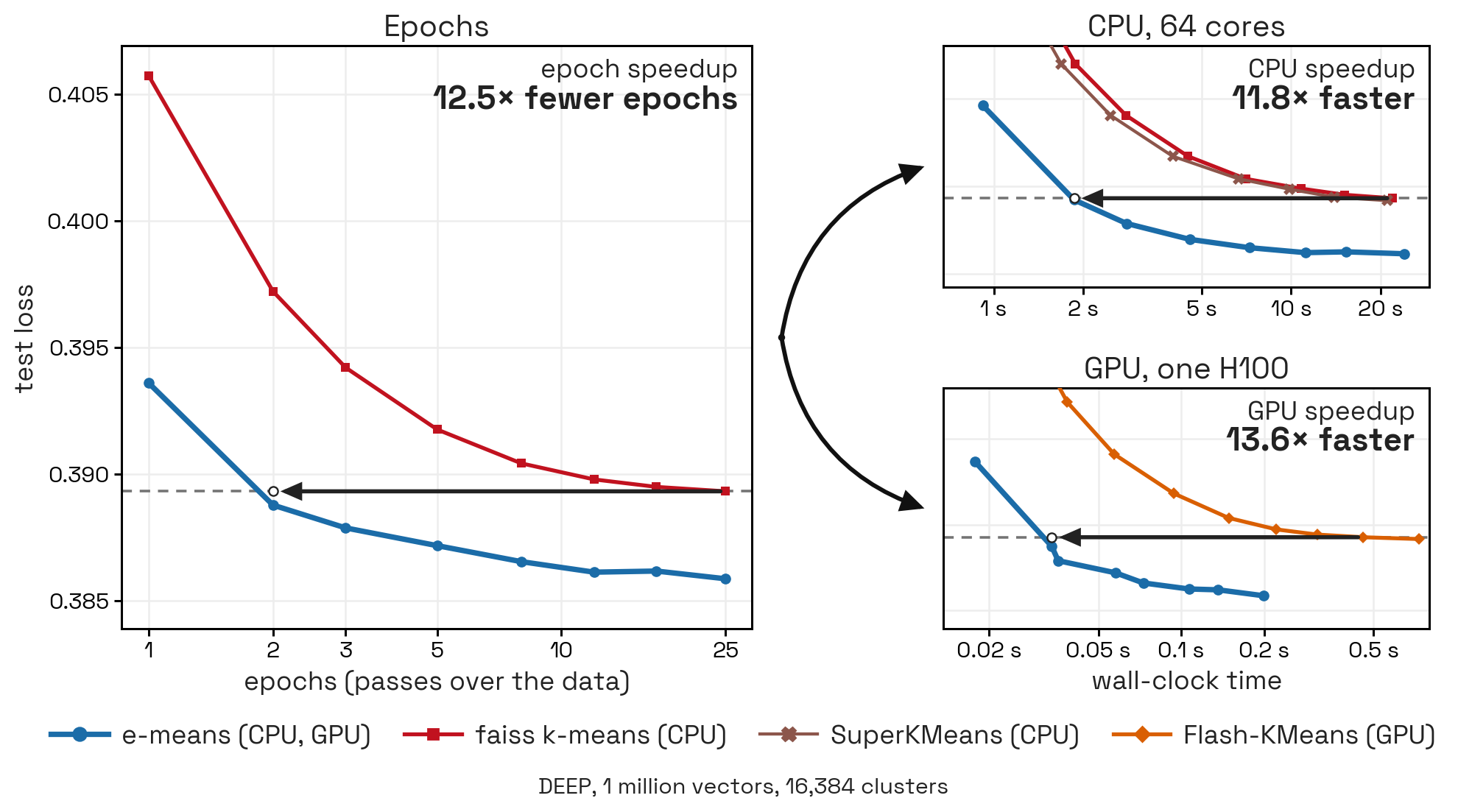
Researchers introduced E-means, a new k-means clustering method that achieves equal loss while running 10x faster. The approach applies modern optimization techniques and scaling laws to improve clustering efficiency.
CommentsA new GitHub project offers a small LLM inference engine built from scratch, accompanied by more than six hours of YouTube tutorials and 85+ pages of handwritten notes. The resource aims to help developers learn LLM inference fundamentals through hands-on implementation and detailed study materials.
Comments
What is malloc doing, anyway?
2026-11-09The piece explores the hidden mechanics behind malloc’s deceptively simple interface. Callers request a contiguous block of memory and receive a void pointer, then release it with free, but the article examines what is really happening beneath that abstraction.
CommentsCUI – Native UI components for C
2026-11-09CUI is a new library of native UI components for C, offering about 170 components with spring-based motion and keyboard support. The components are available to run live.
CommentsChatGPT Desktop is reportedly forwarding users' SSH agents to remote machines as a convenience feature, prompting criticism that it removes important security friction. Commenters argue auto-forwarding should require per-request approval or filtering, and recommend hardware-backed keys such as Secure Enclave or YubiKey with fingerprint or touch confirmation. The discussion also highlights broader concerns that local agent guardrails rely on leaky blacklists and broad permissions.
Comments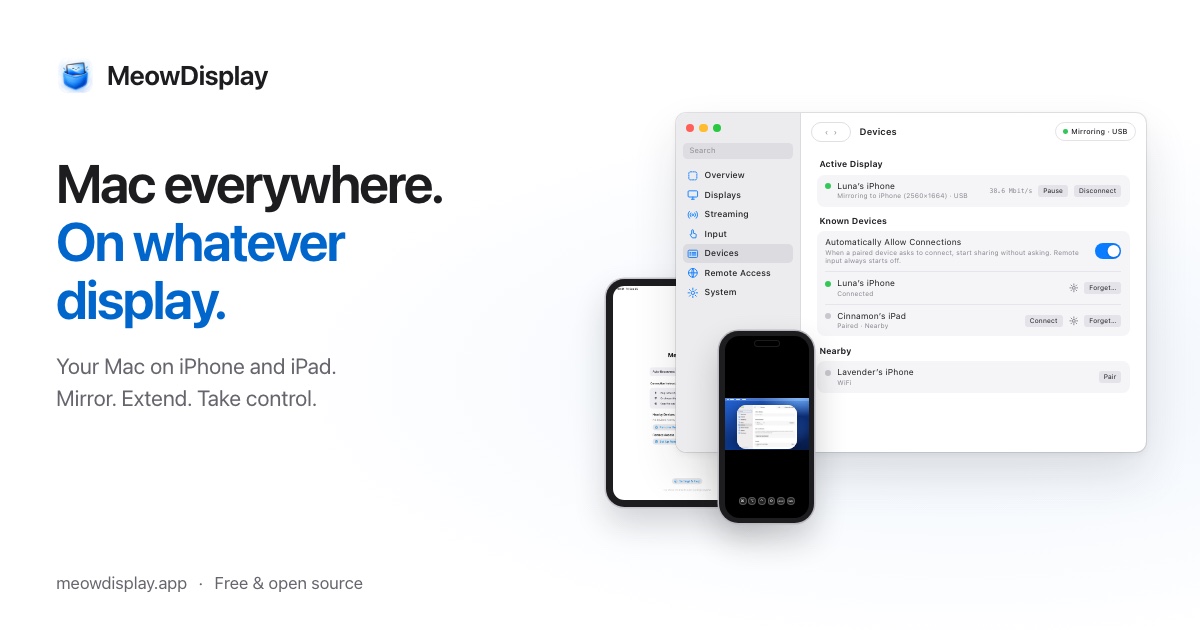
MeowDisplay is a free, open-source tool that reverses iPhone mirroring by letting you use your Mac on an iPhone, iPad, or another display. It supports arranging windows into panes, switching via Stage Peek, touch and keyboard controls, and file access.
CommentsThe STE80 Humanizer is a new Show HN agent skill designed to remove AI tells from text by rewriting it 80% of the way toward ASD-STE100 Simplified Technical English. It follows a method shared by Andrej Karpathy for making generated writing sound less AI-like.
CommentsA Critique of GPUI
2026-11-09A personal-notes piece offers a critique of GPUI, examining the framework's shortcomings from the author's perspective. It is framed as informal observations rather than a formal review, with no broader news context supplied.
Comments
Psalm 7 has been released, bringing a large set of new features and bug fixes to the PHP security and static analysis tool. The update is detailed in Daniil Gentili’s announcement blog post.
CommentsReaders discussing how to manage AI-agent context across clients and projects largely recommend building custom lightweight harnesses and workflows rather than relying on one tool. Suggested practices include gatekeeper scripts that force wiki/documentation updates, semantic search over project knowledge, commit-linked chats, issue trackers and write-only ledgers for coordination, plus sandboxing agents and keeping granular usage data. Commenters also stress managing one's own attention and mental load, and staying ready to ditch tools as the fast-changing ecosystem evolves.
Comments
A primer on GPUs and kernel optimization
2026-11-09This primer covers GPU fundamentals, profiling tools, distributed computation, and kernel optimization for readers seeking a foundation in accelerated computing. It explains the basics needed to understand and improve performance across GPU workloads.
CommentsActive Benchmarking
2026-11-09Readers argue that benchmarks should run long enough to reach steady state and be actively monitored during execution, since observing a workload in progress often reveals anomalies that invalidate isolated results and can even produce useful production observability tooling. They note that real fleet workloads offer the most realistic insights but are hard to replicate, especially as cache behavior and cloud workload patterns shift over time.
Comments
On Being an Engineer in 2026
2026-11-09The piece explores what it will mean to be an engineer in 2026, focusing on how AI-assisted tools, automation, and rapidly changing technical stacks are reshaping day-to-day work. It argues that future engineers will need stronger systems thinking, cross-disciplinary collaboration, and continuous learning as routine tasks are increasingly automated.
CommentsThe article explores liveness analysis over block-local SSA IR and how a lightweight register allocator can translate that representation into register assignments. It applies the approach to both a virtual machine and an x86 JIT, showing how SSA-to-register conversion works in practice.
CommentsReaders discussing whether they still enjoy C++ report mixed feelings: many still value its power, performance, control, and RAII, while others cite decades of cruft, missing features like pattern matching, and slow committee progress. Some longtime C++ developers have migrated to Rust, praising its traits, tooling, and ecosystem, and say returning to C++ is difficult except for maintaining old projects.
Comments
The arXiv paper “Next-Concept Modeling” introduces a coarse-to-fine text generation method designed to be fast and parallel. It aims to speed up generation by modeling concepts rather than relying solely on sequential token-by-token output. The work is presented as a new approach for efficient text generation.
CommentsFlide launched as an inference engine for Jev-like decision models, claiming up to 9.5x faster performance. It is pitched as the fastest inference engine for OmniJev/Flide decision models.
CommentsA Show HN project demonstrates JavaScript web apps using WASM layout and GPU rendering in just 280 KB. Commenters warn that bypassing the DOM discards browser/OS features like password-manager autofill, user dictionaries, IME support, and selectable content, creating inconsistent UX, while others are excited about the approach despite demo performance and WebGPU compatibility concerns.
Comments
Quasi-Logarithmic Kitchen Timer
2026-11-09A DIY quasi-logarithmic kitchen timer aims to simplify cooking timing for households that already own several appliances with built-in digital timers. The project focuses on a dedicated timer with a non-linear control scheme for quickly selecting common cooking intervals.
CommentsRecalc is a new open-source spreadsheet tool where every cell can hold a value, formula, terminal command, or a running Claude Code or Codex agent. The project, shared on Hacker News, is pitched as a spreadsheet you share with your AI agents, letting them work directly inside the grid. It's available on GitHub under sshah03/recalc.
CommentsThe Qlobe: Rotating Quine (2010)
2026-11-09The Qlobe is a rotating Ruby quine created for RubyConf as a “global” alternative to quines specialized for Japanese. It uses self-referential code and string manipulation to output a rotated version of itself.
CommentsA new Show HN project introduces HACI, a compact, bio-inspired fully distributed algorithm for extracting edges from RGB images. The implementation is available on GitHub under RenderBear/haci.
CommentsSultanC is an Arabic-first, self-hosting systems programming language with an English surface, ownership safety, and pattern matching. It targets native ARM64/x86-64, supports LLVM cross-compilation and WebAssembly, and can be tried in the browser.
Comments
Pigshell: Unix the Web
2026-11-09Pigshell is a web-based Unix-like shell that explores bringing Plan 9’s 9p file model to the browser, letting users manipulate web resources through shell commands and small interoperable files. Commenters compare it to named-pipe projects like mkfifo.com and praise the vision of fine-grained file-based interoperability for apps and scripting, while noting that relying on many kernel syscalls could hurt performance.
CommentsTaco: The Tensor Algebra Compiler
2026-11-09TACO is an open-source tensor algebra compiler that generates efficient code for dense and sparse tensor computations across a variety of storage formats. The project’s website serves as a hub for documentation, source code, and resources for using the compiler.
Comments
A new comparison examines pointer provenance in Rust and C++, using LLVM IR to show why pointers carry more semantic information than plain integers. It contrasts how the two languages model provenance and the implications for optimization and undefined behavior.
CommentsDBDelve is an open-source database client built in Rust with GPUI, shared via Hacker News’ Show HN. No further details about its features or availability were provided.
Comments