YC SAFE News
The Simple Agreement for Future Equity, or SAFE, has become a standard way for early-stage startups to raise money. Here you will find articles about how SAFEs work in practice, changes to common terms, and debates among founders and investors about early-stage fundraising.
Typical stories explain valuation caps, discounts, and dilution in plain language, or report on how market conditions push standard terms up or down. Cautionary tales appear as well, often about founders who stacked too many SAFEs and only discovered the ownership consequences at their priced round.
Fundraising mechanics may sound dry, but they decide who owns how much of a company when the stakes get high. First-time founders, angel investors, and startup lawyers all follow this topic because a single misunderstood clause can be worth millions later on.

The Disappearance of the Public Bench
2026-05-08The disappearance of public benches and the trend of making remaining ones uninviting highlights a broader societal debate regarding who belongs in urban public spaces. By eliminating these resting spots, cities are losing crucial communal infrastructure and marginalizing the populations that rely on them.
A polynomial autoencoder beats PCA on transformer embeddings
2026-05-08Researchers have developed a closed-form polynomial autoencoder that achieves fourfold compression of transformer embeddings while outperforming traditional PCA. By pairing a PCA encoder with a quadratic Ridge decoder, the method delivers superior accuracy without requiring neural networks or iterative training.

The map that keeps Burning Man honest
2026-05-07Burning Man utilizes mapping technology to measure and track its environmental footprint, transforming its Leave No Trace principle into a data-driven commitment. The resulting maps are made publicly available to ensure the event maintains strict accountability for its cleanup standards.
Dirty Frag: Universal Linux LPE
2026-05-07A newly disclosed Universal Linux Local Privilege Escalation vulnerability named Dirty Frag shares the same root cause in the kernel IPsec module as the previously discovered Copy Fail bug. The overlapping flaws have sparked a debate among security researchers about whether relying heavily on AI for vulnerability discovery hinders the manual code exploration needed to uncover related issues.

Agents need control flow, not more prompts
2026-05-07Reliable AI agents handling complex tasks require deterministic control flow encoded directly in software rather than relying on increasingly elaborate prompt chains. Shifting the focus from complex prompting to structured software design will ultimately result in more stable and predictable agent performance.
SQLite Is a Library of Congress Recommended Storage Format
2026-05-07SQLite has been designated as a recommended storage format by the Library of Congress, affirming its reliability despite some corporate bans driven by file-based security and tracking concerns. Although enterprise teams sometimes restrict the lightweight database in favor of traditional servers, advocates argue it is a far superior and safer alternative to the widespread misuse of Excel as a shadow database.

AI slop is killing online communities
2026-05-07Online community managers are struggling to combat the influx of AI-generated content and deceptive bot accounts, which adds significant administrative and financial burdens. To protect their platforms, moderators are deploying rigorous verification methods, including third-party AI detection tools and manual authorship checks. Despite these measures, many community leaders fear that the endless battle against automated AI slop may eventually become unsustainable.
DeepSeek 4 Flash local inference engine for Metal
2026-05-07A new local inference engine for DeepSeek 4 Flash and PRO models has been introduced via the antirez/ds4 project. It allows users to run these advanced AI models locally across multiple hardware platforms by providing native support for Apple's Metal, Nvidia's CUDA, and AMD's ROCm.

AlphaEvolve: Gemini-powered coding agent scaling impact across fields
2026-05-07AlphaEvolve is a coding agent powered by Gemini that optimizes algorithms to accelerate scientific progress across multiple disciplines. By applying this technology to complex challenges in genomics, quantum physics, and global infrastructure, the tool aims to solve critical real-world problems at scale.

Natural Language Autoencoders: Turning Claude's Thoughts into Text
2026-05-07Researchers have introduced Natural Language Autoencoders to translate the internal numerical computations of AI models like Claude into human-readable text. This breakthrough allows developers to observe the system's underlying thought processes, offering greater transparency into how these models generate their final word-based outputs.
Programming Still Sucks
2026-05-07A recent tech commentary highlights the tiresome, repetitive questions programmers face from non-tech individuals about AI replacing their jobs. Through a brief social anecdote, the author illustrates how this specific inquiry has become an exhausting cliché, proving that the social annoyances and public misconceptions surrounding the programming profession remain unchanged.
Chrome removes claim of On-device Al not sending data to Google Servers
2026-05-07Google has removed a privacy statement from the Chrome browser assuring users that its on-device AI features do not send data to company servers. This retraction has prompted immediate privacy concerns regarding how local AI interactions might still be transmitting user information to the cloud.

I want to live like Costco people
2026-05-07An online culinary magazine recently published a cultural piece exploring the lifestyle and grocery habits of dedicated Costco shoppers. The article reports directly from the front lines of modern meal preparation. It highlights how everyday home cooks navigate daily dinner routines by adopting the bulk-buying strategies of warehouse club patrons.
Permacomputing Principles
2026-05-07The Permacomputing movement advocates for the sustainable and ecological use of technology, drawing parallels to agricultural permaculture. However, its explicit alignment with anti-capitalist and progressive political ideologies has sparked debate, with some critics arguing this broad framing alienates potential supporters. Proponents counter that addressing systemic societal and environmental challenges is an inherently political act that is fundamental to the practice.

ProgramBench: Can language models rebuild programs from scratch?
2026-05-07A new study introduces ProgramBench, a benchmark designed to evaluate whether large language models can reconstruct software programs entirely from scratch. The evaluation tests fundamental code logic and architecture comprehension rather than relying on simple pattern matching or partial code completion. Ultimately, this research provides critical insights into the true programming capabilities and structural limitations of current generative AI models.
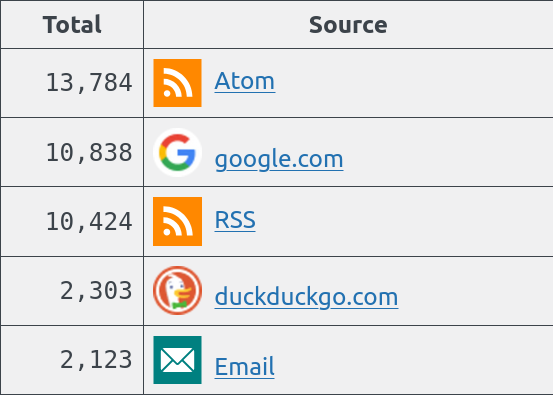
RSS feeds send me more traffic than Google
2026-05-07After analyzing their website traffic, a blogger discovered that RSS feeds generate more visitors than Google search. The author attributes this trend to focusing on semantic HTML and metadata rather than pursuing aggressive search engine optimization.
Show HN: TRUST – Coding Rust like it's 1989
2026-05-07A new open-source project named TRUST has been shared on Hacker News for its unique approach to coding in Rust like it is 1989. Developers interested in this unconventional programming style can explore the code and contribute to the repository on GitHub.
Boris Cherny: TI-83 Plus Basic Programming Tutorial (2004)
2026-05-07A discussion surrounding a 2004 tutorial on TI-83 Plus Basic programming has prompted readers to share how secretly coding on graphing calculators during math classes launched their tech careers. Many current software developers credit their early experiences writing games, chat programs, and math solvers on devices like the TI-83 and TI-85 as the foundational spark for their professional journeys in computer science and engineering.
OurCar: What I learned making an app for my family
2026-05-07The author shares their experience and key takeaways from developing OurCar, a custom utility app designed specifically for their family. This personal project highlights the unique challenges and rewards of building a tailored software solution for everyday household needs from scratch.
Community firmware for the Xteink X4 e-paper reader
2026-05-07A new community-driven firmware project has been launched for the Xteink X3 and X4 e-paper readers. The open-source software, named crosspoint-reader, is now available on GitHub. Users and developers can create an account to contribute to the project and help enhance the functionality of these devices.