YC News
SubmitFrom new batch announcements to alumni raising major rounds, Y Combinator remains a bellwether for early-stage tech. This section collects news involving the accelerator, the startups that pass through it, and the ideas and trends its community is betting on.
Stories here range from changes to the program itself, its deal terms, batch sizes, and leadership, to the successes and stumbles of companies it funded years ago. Batch composition gets particular attention, since the categories founders cluster around tend to foreshadow broader trends.
For anyone working in or around startups, following this accelerator is an efficient habit: it condenses signals about talent, ideas, and capital into one observable community. Founders weighing an application also use this coverage to understand what the program has become.
2026-10-30

Jules Verne's Lost Novel
2026-10-30A rediscovered lost novel by Jules Verne accurately anticipated the machines of the 1960s, but it failed to foresee that Paris would still have its poets. The piece highlights both the novel’s technological prescience and its cultural blind spot.
Comments
Glacial archaeologists report that melting ice is rapidly reshaping the archaeological record, with Viking Age finds becoming scarce as much older artifacts surface. In particular, 6,000-year-old arrowheads are now emerging from receding ice, revealing evidence of Stone Age activity. The researchers describe themselves as witnesses to a fast-changing archaeological landscape at the edge of the ice.
Comments

Vandi Verma describes how NASA’s Perseverance rover completed a record-setting drive on Mars, covering the longest single-sol distance yet achieved by a rover on another world. The piece explains the autonomous navigation and team planning behind the drive and the tracks it left across the terrain.
Comments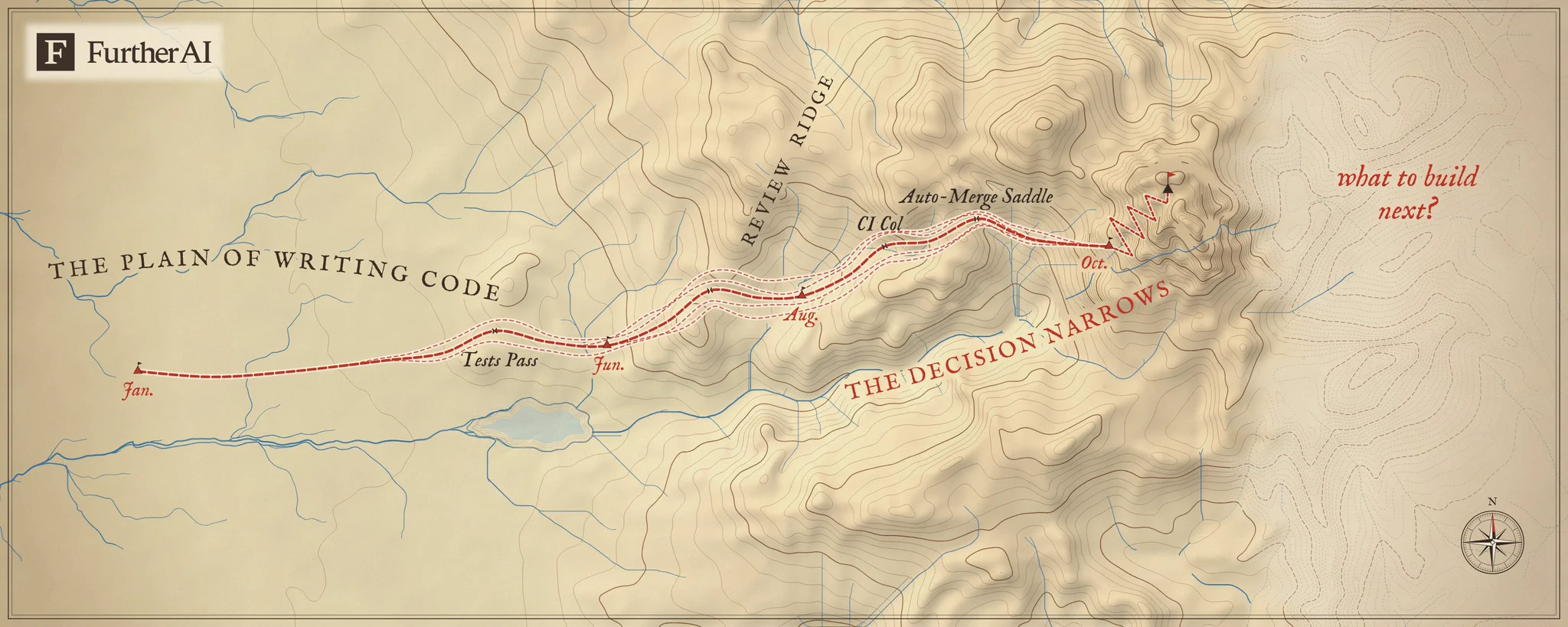
Building an AI-native engineering org
2026-10-30The article explores how engineering organizations can become AI-native by embedding AI across planning, coding, review, and operations rather than treating it as a bolt-on tool. It outlines the cultural, process, and platform changes needed to make AI a default part of how teams build and ship software.
CommentsAstroterm is a terminal-based planetarium that lets users explore stars, planets, constellations, and more directly in the command line. It renders celestial objects in the terminal, offering a telescope-free way to browse the night sky.
CommentsA developer has built “doomformer,” a project that compiles an integer neural network—specifically a transformer—into a DOOM map, using voodoo dolls for arithmetic and light levels and plane heights to store values. The implementation checks every computed value against NumPy with zero tolerance.
CommentsCuis: The Modern Smalltalk-80
2026-10-30Cuis is a modern Smalltalk-80 environment that aims to preserve the original Smalltalk philosophy while updating it for contemporary use. It offers a compact, self-contained system for developers interested in live programming and object-oriented computing.
Comments
Blockchain intelligence firms have linked North Korea to an apparent $6.3 billion hack affecting Binance, the world's largest cryptocurrency exchange. Binance reported Thursday that approximately $6.3 billion was impacted in the incident.
Comments
A Pickpocket's Guide to New York
2026-10-30John Turturro prepared to play a petty thief in a new movie by learning pickpocket moves like “reefing the kick” from Apollo Robbins. He observed that stealing has much in common with acting. Michael Schulman reports.
Comments
This piece offers scattered reflections on what doing math feels like today, describing the experience as confusing. Rather than a focused argument, it captures a fragmented sense of modern mathematical work.
Comments
A new video turns the creator’s lack of ordinary billiards skill into a playful exploration of billiards in the hyperbolic plane, where non-Euclidean geometry changes how shots and trajectories behave. It uses the virtual pool-table experiment to show how familiar rules break down in curved space.
Comments
Polymarket paused trading on its international platform for about an hour after a third-party vendor was compromised. The prediction markets platform said affected users will be made whole.
Comments
ElementaryUI – Swift, in the Browser
2026-10-30ElementaryUI is a new Swift frontend framework designed to run in the browser. It enables developers to build web frontends using Swift.
Comments
Commodore 1600 VICmodem
2026-10-30The Commodore 1600 VICmodem, introduced in 1982, was the first truly affordable modem for the home market. It helped bring dial-up connectivity to everyday users and invites readers to recall whether it was their first modem.
Comments
The Federated Code Forge
2026-10-30Tangled, a Git collaboration platform built on the AT Protocol, has relaunched with stabilized lexicons, an overhauled architecture and UI, easier self-hosting, and support for organizations, with private repositories coming soon. Its federated “knot” model lets users host repos themselves while contributors use a portable AT Protocol account to open issues or send pull requests without registering on each server.
Comments
CVE-2026-98432 is a Linux IPv4 TCP use-after-free whose severity is disputed, rated 9.8 versus 5.9. The report covers lab evidence of MPTCP remote code execution, exposure checks, patches, and guidance for safe validation.
Comments
Geist Serif
2026-10-30Geist Serif has been introduced as a high-contrast display serif built on the same foundations as Geist Sans, Geist Mono, and Geist Pixel. It expands the Geist type family with a serif option intended for display use.
CommentsOvertone is a new Show HN project that transcribes audio into word-timed captions and lets users correct and cut them for any screen shape from a single file. It includes a caption format, a video.js plugin, and a CLI.
CommentsSanstun is a new sans-IO WireGuard implementation written in Rust, designed to be parallel-friendly and idiomatic. It aims to combine ease of use, security, and performance through its API.
CommentsSylphide OS is a general-purpose operating system designed for microcontroller-based computers. It aims to bring broader OS functionality to resource-constrained MCU hardware. The project targets systems that typically rely on bare-metal firmware or real-time operating systems.
CommentsA Show HN project demonstrates automatically deducing a FlashAttention kernel from about 25 lines of SQL. It stems from an experiment in querying Xarray datasets with SQL, developed in the xarray-sql GitHub repository.
CommentsIterating Backwards in C
2026-10-30Readers discuss the C idiom "while (i --> 0)" for backward iteration, including unsigned-safe variants like "while (i-- != 0)" and comparisons to conventional for-loops. The discussion frames the trick as clever but potentially useful, linking it to a classic Stack Overflow post and noting its long-standing use despite readability tradeoffs.
CommentsLasm is a new Show HN project that lets developers write formally verified web apps in Lean and run them on JavaScript and WebAssembly runtimes, including Node, serverless, and edge environments. The tool aims to bring Lean’s verification capabilities to mainstream web deployment targets.
Comments
A new solar power plant design lets the system act as its own backup by running on either stored solar heat or combustion. This dual-mode operation could improve reliability without requiring a separate backup power source.
Comments
Embraer’s Atech aims to double in size by 2030, betting on drone traffic control and other civil-market technologies. The company is developing solutions to support safe coexistence in airspace, CEO Rodrigo Persico told Bloomberg Línea.
CommentsCompile-Time Dependent Types
2026-10-30A reader discussion on compile-time dependent types notes that mainstream systems-language features—C++ templates/constexpr, Rust const generics, Zig comptime, and C _Generic—are often restricted or lack a proper type system and are not true dependent types. It highlights Syl as an example of compile-time dependent typing with runtime simply typed code and type erasure, linked to staged compilation and two-level type theory, while questioning how well LTO and compiler optimization handle the resulting polymorphic code.
Comments
An Arrogant Way of Killing (2016)
2026-10-30A 2016 feature traces how a real-estate agent in the Philippines became the target of a criminal mastermind, following the events that turned an ordinary life into a deadly plot. It examines the investigation and the killer’s overconfidence that ultimately helped expose the scheme.
Comments
Mark Twain’s The Adventures of Tom Sawyer marks its 150th anniversary, prompting a retrospective on the novel’s enduring mischievous hero. The piece explores how Tom Sawyer’s rascal persona helped shape American literary and cultural identity.
CommentsShow HN: Sketch Stadium lets users watch an AI agent play Pictionary through a remote MCP server with account-free OAuth; its developer says it exposes only game tools and marks server communication as untrusted to reduce prompt-injection risks from other players’ guesses. Commenters called the idea neat but warned against pasting HN prompts into agents or blindly installing MCP servers, while the creator noted related adversarial games like poker and mafia and said Pictionary clues tend to be either quickly guessed or too abstract.
Comments
Historical Scientific Instruments
2026-10-30The article surveys historical scientific instruments, with particular attention to a notable cube-shaped device. It examines the object’s significance within the broader history of scientific tools.
Comments