Software Tech News
SubmitSoftware is where most of the technology industry's ideas take shape. This section collects news about applications, platforms, open-source projects, and online services, along with the teams and companies that design, ship, and maintain them.
Typical stories include major releases and redesigns, open-source projects gaining traction, creators presenting tools they built, SaaS companies changing pricing or features, and post-mortems explaining why a product failed or an outage happened. Critical takes on bloat, reliability, and user experience are common too.
Knowing which software is improving, stagnating, or being abandoned helps people pick better tools and avoid costly migrations later. Developers, product teams, IT buyers, and everyday users follow this coverage to keep their stack current and discover useful alternatives.
2026-11-09
Readers push back on the claim that no one will again build a Wikipedia-like project, citing OpenStreetMap, TV Tropes, fandom wikis and other volunteer crowdsourced efforts that continue and could evolve toward more semantic knowledge systems. They also warn that such projects face long-term strain from younger users’ reliance on corporate app stores, suspicion of libre/altruistic efforts, fewer obvious gaps for newcomers to fill, corporate free-riding and API abuse, and licensing barriers.
CommentsRIP, Harvest
2026-11-09Harvest users are reacting to steep new Bending Spoons pricing, with some reporting 8–10x increases or large renewal jumps tied to usage-based charges for users, projects, clients, and billings. Readers describe cancelling and replacing the time-tracking and invoicing tool with self-hosted or custom alternatives, citing broken trust and easier-than-expected SaaS switching.
Comments

A new Show HN tool lets users enter any place on Earth to see every satellite that passed over it this week, along with the actual photos those satellites captured. It makes satellite overpass data and imagery accessible by location and time.
CommentsA new analysis finds the same Nvidia H100 GPU rents for anywhere from $2.69 to $12.29 per hour depending on the provider. The wide price gap highlights how much cloud rental costs vary for the in-demand AI accelerator.
CommentsZebkit is a new project that packages Chromium as an embeddable library, offering a slim cross-platform browser engine for applications. It aims to let developers integrate web rendering into their apps without shipping a full browser. The project is available at ikey4u/zebkit.
CommentsCUI – Native UI components for C
2026-11-09CUI is a new library of native UI components for C, offering about 170 components with spring-based motion and keyboard support. The components are available to run live.
CommentsChatGPT Desktop is reportedly forwarding users' SSH agents to remote machines as a convenience feature, prompting criticism that it removes important security friction. Commenters argue auto-forwarding should require per-request approval or filtering, and recommend hardware-backed keys such as Secure Enclave or YubiKey with fingerprint or touch confirmation. The discussion also highlights broader concerns that local agent guardrails rely on leaky blacklists and broad permissions.
CommentsA survey of parking-app convenience fees across 312 U.S. cities found a median charge of $0.35 per session. The data covers fees from ParkMobile, PayByPhone, Passport, Flowbird and city-run apps, based on official help and city pages.
Comments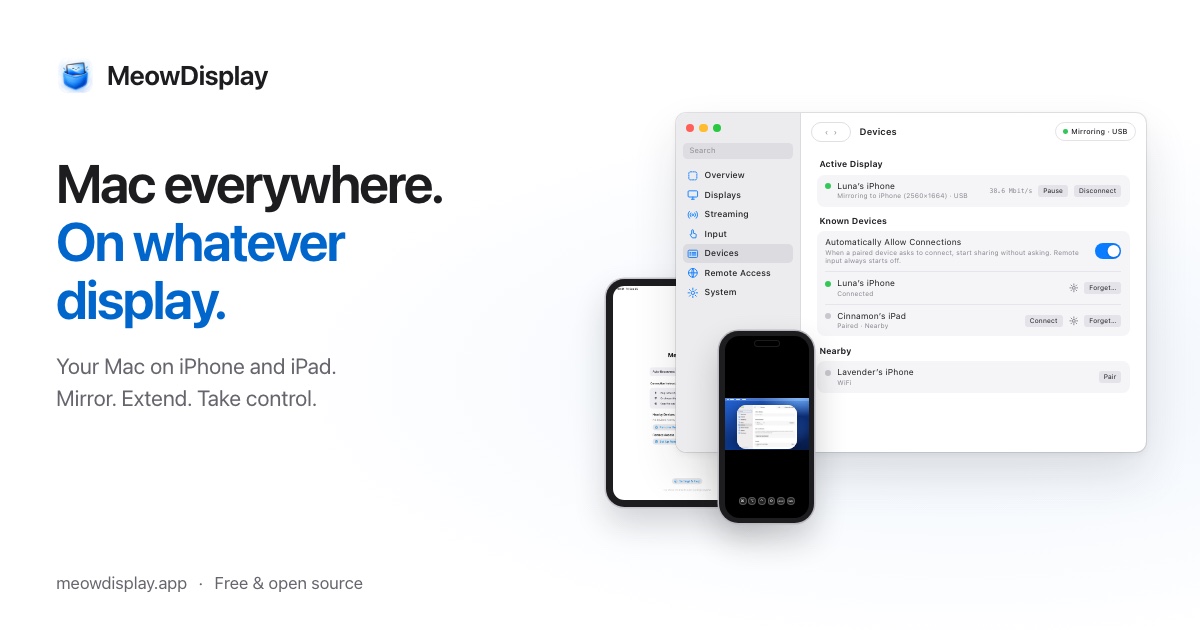
MeowDisplay is a free, open-source tool that reverses iPhone mirroring by letting you use your Mac on an iPhone, iPad, or another display. It supports arranging windows into panes, switching via Stage Peek, touch and keyboard controls, and file access.
Comments
A new Show HN Mac app captures a photo of anyone who uses your computer while you're away and sends it to your phone. It recognizes your face so it stays silent when you're the one using the Mac.
CommentsThe STE80 Humanizer is a new Show HN agent skill designed to remove AI tells from text by rewriting it 80% of the way toward ASD-STE100 Simplified Technical English. It follows a method shared by Andrej Karpathy for making generated writing sound less AI-like.
Comments
Psalm 7 has been released, bringing a large set of new features and bug fixes to the PHP security and static analysis tool. The update is detailed in Daniil Gentili’s announcement blog post.
CommentsIsn't It Time for AVIF Everywhere?
2026-11-09As storage prices for HDDs, SSDs, and NVMe drives continue to rise, the case for adopting AVIF image compression everywhere is becoming stronger. The article argues that broader AVIF support could significantly cut storage and bandwidth demands.
CommentsA new guide highlights playful projects for VM/370 Community Edition, the classic IBM mainframe operating system running in emulation. It explores hands-on ways to experiment with big-computer concepts and have fun with a vintage VM/370 system.
CommentsActive Benchmarking
2026-11-09Readers argue that benchmarks should run long enough to reach steady state and be actively monitored during execution, since observing a workload in progress often reveals anomalies that invalidate isolated results and can even produce useful production observability tooling. They note that real fleet workloads offer the most realistic insights but are hard to replicate, especially as cache behavior and cloud workload patterns shift over time.
CommentsThe article explores liveness analysis over block-local SSA IR and how a lightweight register allocator can translate that representation into register assignments. It applies the approach to both a virtual machine and an x86 JIT, showing how SSA-to-register conversion works in practice.
CommentsFlide launched as an inference engine for Jev-like decision models, claiming up to 9.5x faster performance. It is pitched as the fastest inference engine for OmniJev/Flide decision models.
CommentsA Show HN project demonstrates JavaScript web apps using WASM layout and GPU rendering in just 280 KB. Commenters warn that bypassing the DOM discards browser/OS features like password-manager autofill, user dictionaries, IME support, and selectable content, creating inconsistent UX, while others are excited about the approach despite demo performance and WebGPU compatibility concerns.
CommentsA security researcher has documented how a Microsoft-signed shim can be borrowed to abuse Secure Boot protections on corporate hardware, potentially enabling boot-level attacks. The write-up details the technique and its implications for organizations relying on Secure Boot to lock down devices.
CommentsA Bit about Email
2026-11-09A discussion around a piece on email spun into a broader reflection on the internet as a collection of human edge cases. Readers expressed anxiety that undisclosed AI-generated text is converging online writing toward an average of pre-2023 thought and style, diminishing the idiosyncratic voice that makes personal sites feel magical.
CommentsDocumentation published on GitHub alleges that Google Gemini routes personal Drive files and emails to human annotators, flagging a “Gemini File Leaking Behavior.” The repository is collecting evidence of the alleged data exposure.
CommentsRecalc is a new open-source spreadsheet tool where every cell can hold a value, formula, terminal command, or a running Claude Code or Codex agent. The project, shared on Hacker News, is pitched as a spreadsheet you share with your AI agents, letting them work directly inside the grid. It's available on GitHub under sshah03/recalc.
CommentsA new Show HN project introduces HACI, a compact, bio-inspired fully distributed algorithm for extracting edges from RGB images. The implementation is available on GitHub under RenderBear/haci.
Comments
Supply chain attack on Qubole customers
2026-11-09Sentra uncovered a supply chain attack in which attackers used a trusted vendor’s keys to access data at multiple Qubole customers. The incident highlights third-party key risks, and Sentra outlines measures to prevent similar attacks.
CommentsSultanC is an Arabic-first, self-hosting systems programming language with an English surface, ownership safety, and pattern matching. It targets native ARM64/x86-64, supports LLVM cross-compilation and WebAssembly, and can be tried in the browser.
Comments
Pigshell: Unix the Web
2026-11-09Pigshell is a web-based Unix-like shell that explores bringing Plan 9’s 9p file model to the browser, letting users manipulate web resources through shell commands and small interoperable files. Commenters compare it to named-pipe projects like mkfifo.com and praise the vision of fine-grained file-based interoperability for apps and scripting, while noting that relying on many kernel syscalls could hurt performance.
CommentsTaco: The Tensor Algebra Compiler
2026-11-09TACO is an open-source tensor algebra compiler that generates efficient code for dense and sparse tensor computations across a variety of storage formats. The project’s website serves as a hub for documentation, source code, and resources for using the compiler.
Comments
A new comparison examines pointer provenance in Rust and C++, using LLVM IR to show why pointers carry more semantic information than plain integers. It contrasts how the two languages model provenance and the implications for optimization and undefined behavior.
CommentsA reader criticized the daily word puzzle Jointter for feedback that is confusing and unhelpful, citing shifting red lines and a misleading green letter that made solving feel like guesswork. The developer acknowledged the drawbacks and asked for suggestions on how to improve the game.
Comments