Programming Tech News
Writing software is a craft that keeps reinventing itself. This section gathers news and articles for people who program, covering language releases, compilers and runtimes, frameworks, development workflows, and the ideas that change how code gets written and reviewed.
Typical stories include new versions of Rust, Python, Java, JavaScript, and TypeScript, performance and debugging investigations, essays on architecture and code quality, and discussions of how AI coding assistants are changing day-to-day development. Hands-on tutorials and lessons from long-running projects show up often.
The tools and practices developers choose affect how fast teams ship and how well their software holds up over time. Working engineers, students learning to code, and engineering leaders follow this coverage to sharpen their skills and make better technical decisions.
2026-10-27
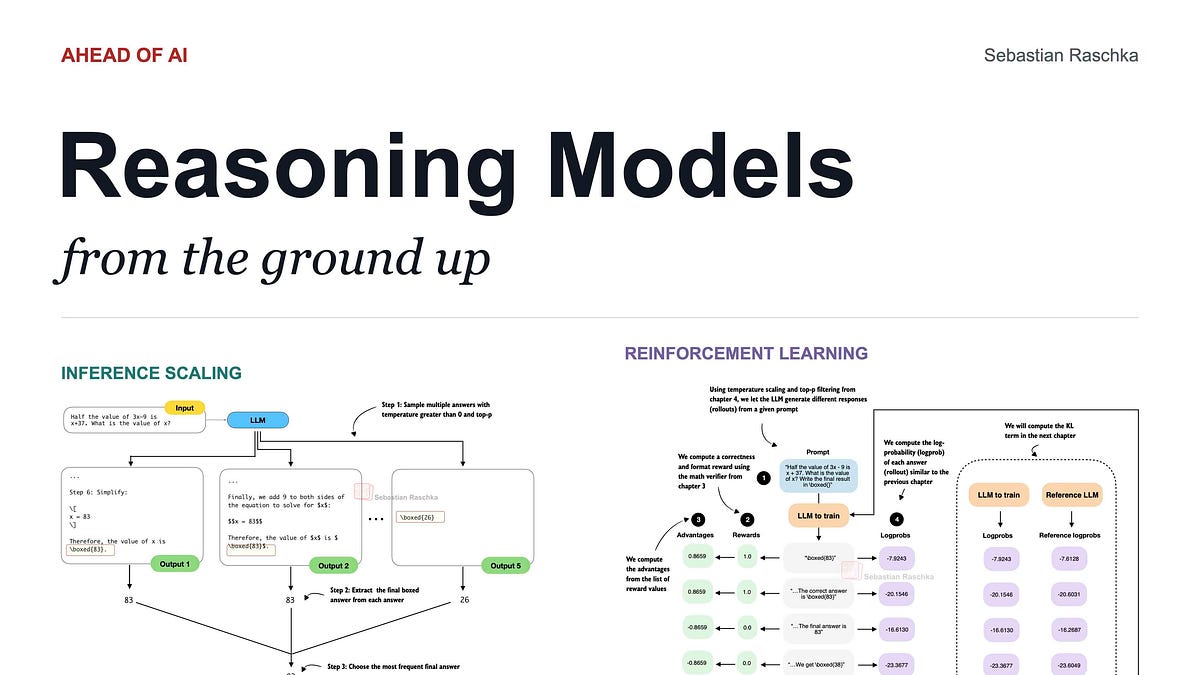
Sebastian Raschka has launched an extensive 11-hour video course teaching developers how to build reasoning models from scratch. Utilizing Python and PyTorch, the curriculum covers critical techniques including evaluation, inference-time scaling, reinforcement learning, and model distillation.
CommentsResearchers have published a paper claiming to disprove the Exponential Time Hypothesis, a major conjecture in computer science regarding the computational complexity of NP-hard problems. The mathematical development and proofs for this claim are being hosted on GitHub within OpenAI's dedicated math repository.
Comments

CSS-Tricks has a new owner
2026-10-27The popular web development website CSS-Tricks has officially transitioned to a new owner. After twelve years of working on the platform, the incoming leader expressed feeling both nervous and overwhelmed by the responsibility of taking full control.
Comments
The Mythical Man-Month in the Age of AI
2026-10-27This article reevaluates Fred Brooks's classic software engineering principles to determine how artificial intelligence impacts modern development productivity. By examining whether Brooks's Law still holds true for developers augmented by AI, the piece offers an updated framework for managing software teams and estimating project timelines in the AI era.
CommentsPython's experimental JIT to be removed
2026-10-27Python developers are removing the experimental just-in-time compiler that was recently introduced in CPython after it failed to deliver significant performance improvements. The core team will now redirect its efforts toward alternative optimization strategies for future releases.
CommentsSoftware quality is declining as massive increases in code production have outpaced improvements in error rates, resulting in buggier applications. However, the author argues that despite these current frustrations, software used to be horrible.
CommentsPharo 14
2026-10-27The release of Pharo 14 has prompted developers to reflect on the unique benefits of Smalltalk's image-based workflows and its continued relevance in the AI era. While many note that AI coding tools have made them less particular about which programming languages they use, enthusiasts still champion environments like Pharo, Squeak, and Cuis for recreational programming and practical deployment.
CommentsType Server Protocol
2026-10-27Microsoft hosts the official documentation and issue tracker for Pylance, its Python language server, on GitHub. Developers can contribute to the project's development and report bugs directly through the microsoft/pylance-release repository.
CommentsA newly optimized FAST feature detector brings accelerated computer vision to the low-cost ESP32-S3 microcontroller by leveraging 128-bit SIMD instructions. This optimization achieves roughly double the performance of the standard reference implementation, making advanced image processing highly viable on two-dollar hardware.
Comments
Wiz researchers report that while PHP2Shell exploitation attempts are ongoing, none have succeeded to date. Their latest analysis breaks down the specific attack techniques, the defenses that blocked them, and how system exposure has evolved since the vulnerability was first disclosed.
CommentsNietzschian Debugger
2026-10-27A new open-source tool called the Nietzschian Debugger offers an anti-AI approach to troubleshooting by using confrontational questioning to challenge developers. Instead of providing automated fixes, the project forces programmers to rigorously defend their logic based on the philosophy that what doesn't kill your code makes it stronger.
CommentsThis tech profile examines Johnny, a developer whose addiction to deep thinking drives his relentless compulsion to abstract software systems. By contrasting his intense intellectual focus with the general tendency to avoid complex thought, the piece explores the psychological motivations behind his constant over-engineering and abstraction.
CommentsGforth 1.0
2026-10-27Gforth has reached version 1.0, solidifying its position as a fast, portable, and minimalist implementation of the Forth 2012 language. Community discussions highlight its ultra-thin architecture while exploring ways to improve its standard library and native executable compilation capabilities. Enthusiasts continue to champion Forth and its variants as engaging, logic-focused languages that preserve the art of programming in the age of AI.
Comments
As AI agents generate code faster than humans can review it, the role of software engineers is evolving rather than disappearing. Developers must maintain strong programming fundamentals, broad technical knowledge, and a readiness to troubleshoot complex errors when AI-generated systems inevitably break.
CommentsPrivate equity-backed software companies are confronting a $300 billion debt wall driven by high interest rates and floating-rate loans, undermining the aggressive pricing strategies that fueled their recent growth. This financial pressure is compounded by the rise of generative AI, which threatens to dismantle the niche monopolies these firms rely on by making custom software easier to replicate. Consequently, this combination of looming debt and shifting technological paradigms is widely seen as a major driver behind the current slowdown in software engineering hiring.
Comments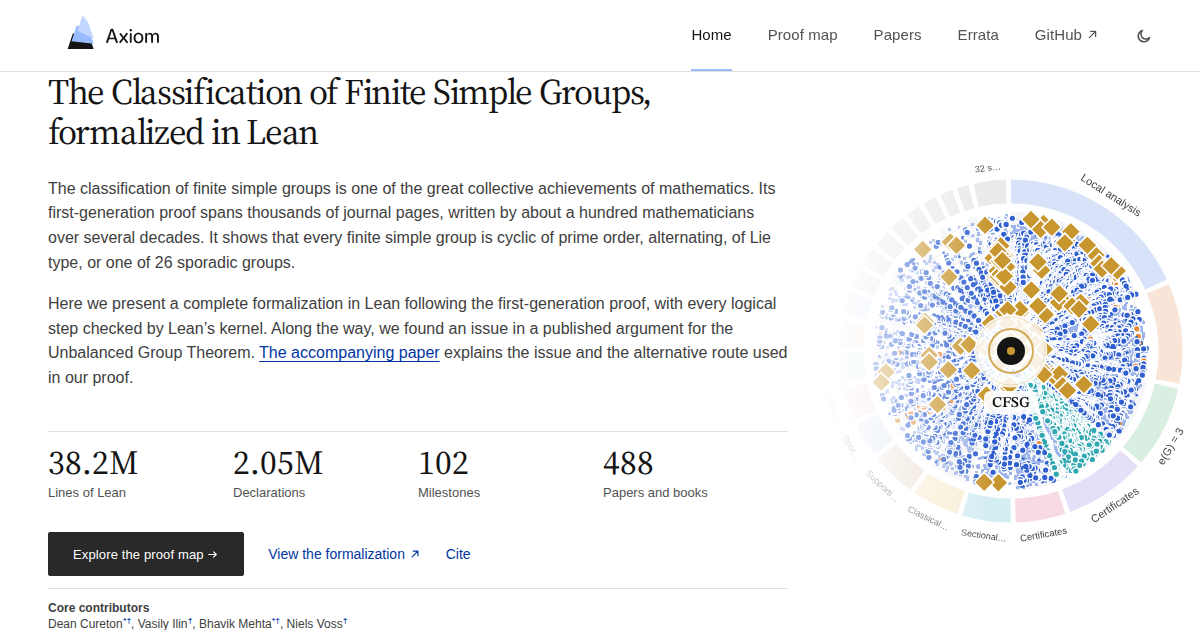
The first-generation proof of the classification of finite simple groups has been completely formalized using the Lean theorem prover. Every logical step of this monumental mathematical achievement was rigorously verified by Lean's kernel, highlighting the growing power of automated proof assistants.
CommentsOpenLDK integrates the Java ecosystem into Common Lisp by transforming Java classes into CLOS classes and allowing seven JVM languages to share a single Lisp expression. This integration also delivers significant performance benefits, enabling a saved Spring Boot application to launch in just 84 milliseconds.
CommentsA recent discussion surrounding a 2019 article on programming Lisp within 64K bytes of memory has shifted focus to the language's historical formatting quirks. Developers debated the origins of cramming closing parentheses together, suggesting it stemmed from the physical constraints of early punch cards and teletypes. The thread also highlighted modern frustrations with counting nested parentheses, prompting suggestions for alternative syntaxes and autocompletion tools to improve the developer experience.
CommentsA Stackless Floodfill Automaton
2026-10-27Developers are discussing a memory-efficient stackless flood fill algorithm that repurposes 16 reserved colors in an 8-bit image to store traversal states, effectively turning the pixels into a linked list. While praised as a clever trick for constrained environments, some readers note the method functions similarly to a bounded heap and critique the original paper's explanation of its backtracking mechanics. Others suggest alternative approaches like the union-find algorithm for specific use cases such as identifying connected regions on a map.
Comments
This guide explains how to detect and safely remove hidden PHP installations on ColdFusion servers to protect against automated bot attacks. It also details a recent incident where a PHP2Shell security mitigation unexpectedly disrupted user sign-ins.
Comments
Four Months of Zig
2026-10-27After a multi-year absence, a developer shares their reflections on returning to the Zig programming language, detailing recent software projects, community interactions, and personal preferences. The article also provides direct comparisons between Zig and Rust to help developers evaluate the language against their previous language of choice.
Comments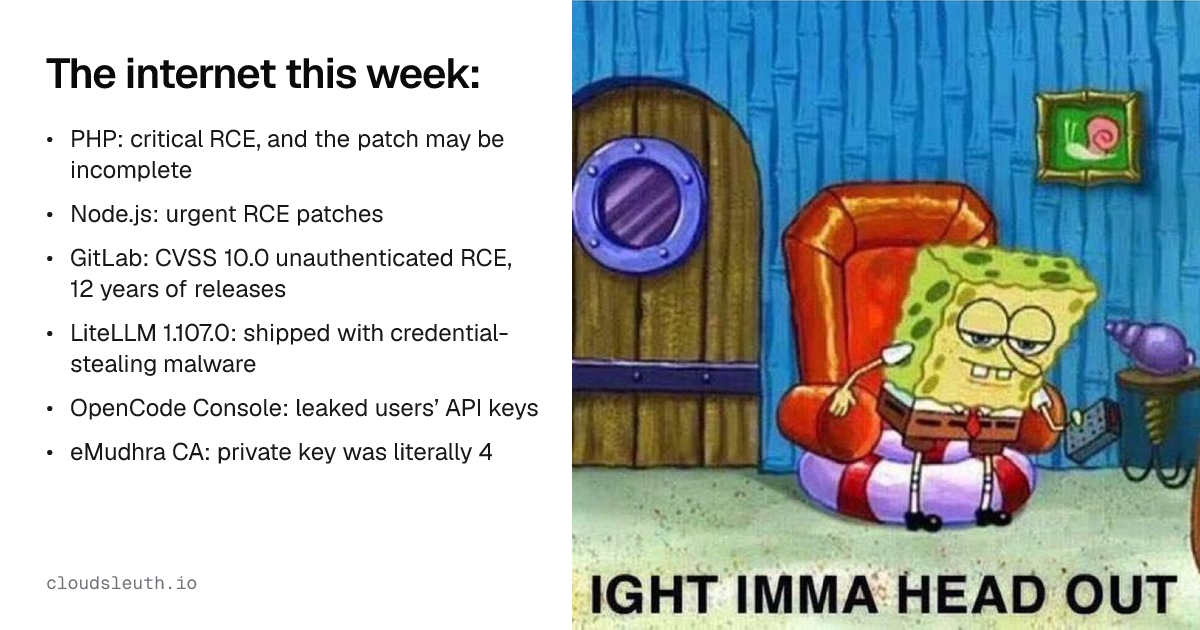
Critical patches have been released to address several severe security flaws across multiple platforms. These updates fix a maximum-severity GitLab vulnerability, a Node.js remote code execution issue, a compromised LiteLLM package, and a dangerously weak certificate authority key. Administrators are urged to quickly identify all affected resources and apply the available fixes to secure their systems.
CommentsI still teach OpenGL ES 3.0
2026-10-27Despite the industry transition to modern graphics APIs like Vulkan and WebGPU, the author defends the continued use of OpenGL ES 3.0 in educational settings. The article argues that the older API's simplicity, broad platform support, and wealth of existing learning resources make it the most practical choice for teaching computer graphics fundamentals to students.
Comments
In Context [video]
2026-10-27A new video explores strategies for building flexible software systems by embracing the constantly changing shape of data as it flows through complex architectures. It discusses practical methods for documenting and enforcing data expectations, enabling developers to maintain system integrity while adapting to evolving information structures.
Comments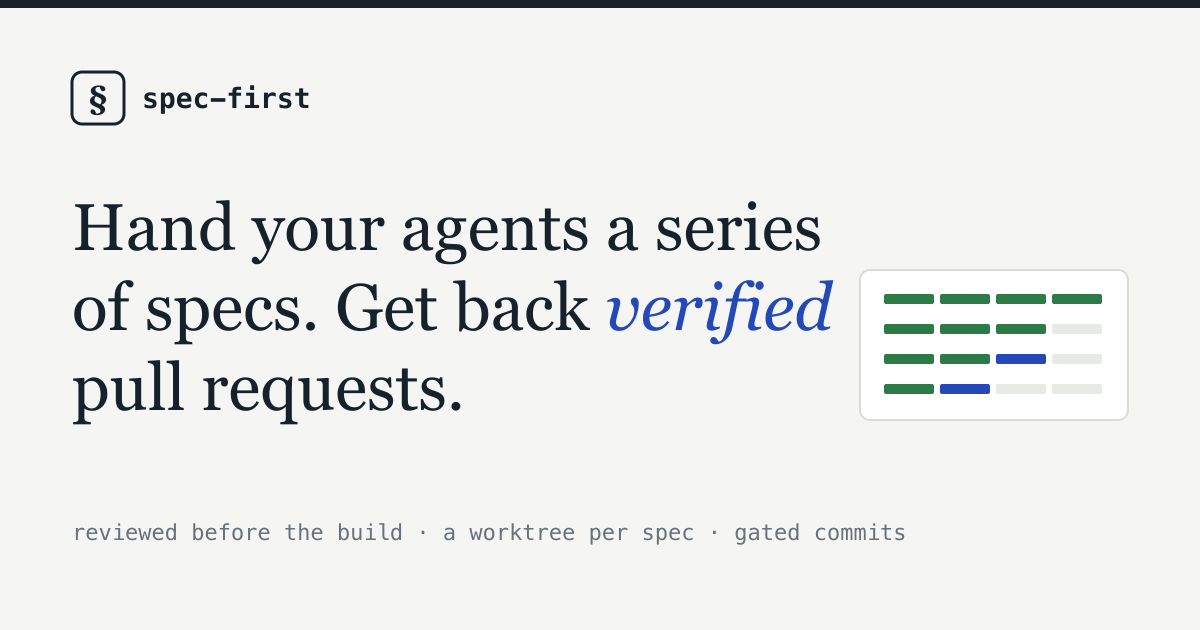
A new project introduces Prove, a plugin designed to bring specification-first agentic development to AI coding agents. This approach improves autonomous code generation by requiring reviewed specifications, utilizing isolated worktrees, and enforcing gated commits.
Comments
After a year of using Dioxus fullstack in production, a developer reports that the Rust code is remarkably stable and uneventful. Conversely, the continuous integration pipeline has emerged as a major pain point, causing frequent and frustrating deployment challenges.
Comments2026-10-26
While AI tools like LLMs can significantly accelerate software development, developers warn they often generate fragile, messy, or suboptimal code if not carefully managed. Industry professionals compare these AI models to power tools that require strong human expertise and rigorous code review to prevent technical debt and poor architectural decisions. Ultimately, to build truly ambitious and robust software, engineering teams must balance the speed of AI-generated code with a strict commitment to maintainability and performance best practices.
CommentsAn upcoming FOSDEM 27 presentation will address strategies for resisting internet censorship and maintaining communication during state-mandated network blackouts. Reader discussions surrounding the topic highlight the technical challenges of bypassing corporate and government infrastructure control using decentralized alternatives like wireless mesh networks and radio transmissions. Ultimately, participants conclude that while circumvention is possible, overcoming physical limitations such as signal triangulation and bandwidth constraints remains highly complex.
CommentsWhy I Am a Programmer
2026-10-26A reader discussion surrounding the article "Why I Am a Programmer" highlights the enduring appeal of software development through nostalgic reflections on early computing and retro gaming. Commenters emphasize the creative freedom of building digital worlds from scratch, noting that despite vast technological advancements since the early internet days, the core excitement of engineering with nothing but time and imagination remains unchanged.
Comments
The State of Context Engineering
2026-10-26Advancing AI models are introducing unexpected complexities for developers building applications and harnesses. In response, the practice of context engineering has evolved significantly this year, with new methodologies shaping its future trajectory.
Comments