Programming Tech News
Writing software is a craft that keeps reinventing itself. This section gathers news and articles for people who program, covering language releases, compilers and runtimes, frameworks, development workflows, and the ideas that change how code gets written and reviewed.
Typical stories include new versions of Rust, Python, Java, JavaScript, and TypeScript, performance and debugging investigations, essays on architecture and code quality, and discussions of how AI coding assistants are changing day-to-day development. Hands-on tutorials and lessons from long-running projects show up often.
The tools and practices developers choose affect how fast teams ship and how well their software holds up over time. Working engineers, students learning to code, and engineering leaders follow this coverage to sharpen their skills and make better technical decisions.
2026-08-03

Qwen3.8-Max establishes a new benchmark for coding and collaborative work through the comprehensive capabilities of Qwen Studio. The platform delivers a diverse suite of features, including chatbot interactions, multimodal understanding, and image generation. Additionally, it enhances user productivity with advanced tools for document processing, web search integration, and artifact creation.
CommentsA new GitHub project called CP/M-386 ports the classic CP/M operating system to run in 386 protected mode. Derived from the historic CP/M-68K codebase, the release offers retro computing enthusiasts a novel way to experience the legacy OS on x86 architecture.
Comments
Show HN: ssh ssh.place
2026-08-03A new project called ssh.place provides a collaborative drawing canvas that users can access directly through a terminal. The tool requires no account creation or software installation, allowing anyone to start drawing instantly by simply connecting via SSH. This minimalist approach offers a unique, frictionless way for terminal enthusiasts to create digital art together.
CommentsRFC 9851: TLS 1.2 is in Feature Freeze
2026-08-03RFC 9851 places TLS 1.2 into a feature freeze as adoption of the newer TLS 1.3 continues to grow. Moving forward, no new features will be approved for TLS 1.2 except for urgent security fixes, new exporter labels, and new ALPN protocol IDs. This freeze applies strictly to TLS and does not affect any version of DTLS.
CommentsA tiny Mamba-based language model has been successfully deployed on a vintage 1975 MOS 6502 processor. Using a custom 8-bit ternary inference engine, the system generates text directly on a 1980s BBC Micro. This achievement demonstrates how modern AI architectures can be heavily optimized for severely constrained retro hardware.
CommentsA new project called Kakehashi introduces an experimental userspace translation layer designed to run macOS binaries on Linux ARM64 systems. The code is currently hosted on GitHub, where developers are invited to contribute to its ongoing development.
Comments
Developers form strong attachments to their software tools because consistent functionality builds essential trust in their daily workflows. When these tools constantly change their capabilities, it forces users to continually relearn them and disrupts their established processes. This instability highlights a critical flaw in tool design by undermining the reliable routines that developers depend on.
Comments
SwiftUI After 7 Years
2026-08-03Despite being introduced as the future of Apple development in 2019, SwiftUI still struggles with significant stability and performance issues seven years later. The framework continues to feel like a perpetual beta to many developers. A recent analysis explores the underlying flaws preventing the technology from reaching its full potential.
Comments
Show HN: A Handwritten Blogging Platform
2026-08-03A new Show HN project introduces a minimalist blogging platform designed for handwritten posts to encourage slower, more authentic thinking. The service intentionally omits algorithmic feeds and social metrics like likes, focusing purely on distraction-free publishing with native RSS support.
CommentsShow HN: Mu – Tools for Agents
2026-08-03The open-source project Mu was recently showcased on Hacker News as a new toolkit designed to help developers build and manage software agents. Contributors can access the codebase and collaborate on the project's ongoing development through the micro/mu GitHub repository.
CommentsA new open-source project named NixOS-DGX-Spark enables users to run the Nix package manager and NixOS Linux distribution on the DGX Spark. This integration brings Nix's reproducible package management to the desktop AI workstation. The developer is actively seeking community contributions on GitHub to help expand and refine the project.
CommentsA new Show HN project named creakwork12 lets users make their Framework 12 laptop hinge sound like a rusty, creaky door. Fittingly, the novelty software created by developer ArcaEge is written entirely in the Rust programming language.
CommentsTwenty Years of RISC OS Open
2026-08-03The tech community is marking the twentieth anniversary of RISC OS Open by reflecting on the enduring legacy of the Acorn operating system and the dedicated developers who kept it alive. Long-time users and programmers shared nostalgic memories of the platform's unique ARM assembly environment and its historical significance as the original home for notable software like the Sibelius music notation program.
CommentsAn article introducing the proof-oriented programming language F* has sparked a community discussion focused more on general language design than the specific tool. Readers debated the importance of showcasing syntax on project homepages and argued over the practical benefits and drawbacks of using indentation-based code formatting.
CommentsA new open-source terminal emulator named Shitty has been released on GitHub, intentionally sacrificing memory safety to achieve maximum processing speed. Despite its humorous moniker, the creator emphasizes that it is a serious project designed to outperform existing terminal alternatives.
CommentsPlaying with Georgia
2026-08-03A recent article exploring the Georgia typeface prompted readers to discuss its cross-platform availability, typographic characteristics, and personal preferences for alternative serif fonts. Commenters shared browser tricks for rendering web pages in specific typefaces and criticized the use of faux bolding. The discussion concluded with suggestions to modernize the classic font by converting it into a true variable axis font.
CommentsA new open-source tool named pytest-leak-finder helps developers pinpoint the root causes of unstable Python tests by detecting state leaks. Created by mgaitan, the utility identifies the specific test that leaks before the actual failure occurs. This approach significantly simplifies the debugging process for flaky test suites across Python projects.
Comments2026-08-02
Go 1.27 Interactive Tour
2026-08-02A new interactive tour is now available to explore the latest language, runtime, and standard library updates in Go 1.27. Developers can examine these notable changes firsthand through short, editable, and runnable code examples.
CommentsDiátaxis
2026-08-02Diátaxis is a widely-adopted framework in the software industry that provides a systematic approach to thinking about and creating technical documentation. This pragmatic methodology helps developers structure their documentation more effectively to meet the needs of their users.
CommentsLeonardo de Moura, creator of the Lean theorem prover and Z3 SMT solver, released a postmortem detailing the root causes and resolution of Kernel Soundness Bug 14576. The analysis provides critical insights into maintaining the integrity of formal verification systems and preventing similar vulnerabilities in future kernel updates.
Comments
AI infrastructure startup Morph, a YC S23 company, is hiring a Member of Technical Staff to optimize its inference stack for open models. The performance engineer will work directly with founders to improve system speed, cost-efficiency, and reliability by optimizing everything from individual GPU kernels to distributed execution. Ideal candidates will possess deep expertise in GPU performance and complex production systems to help scale frontier-level model serving.
Comments
A recent bug in the COLDCARD hardware wallet was traced to a flaw where the random.bytes() function executed without throwing errors but failed to produce secure randomness. The specifics of this silent failure were detailed in a revealing commit message, highlighting the hidden dangers of unverified execution in cryptographic code.
Comments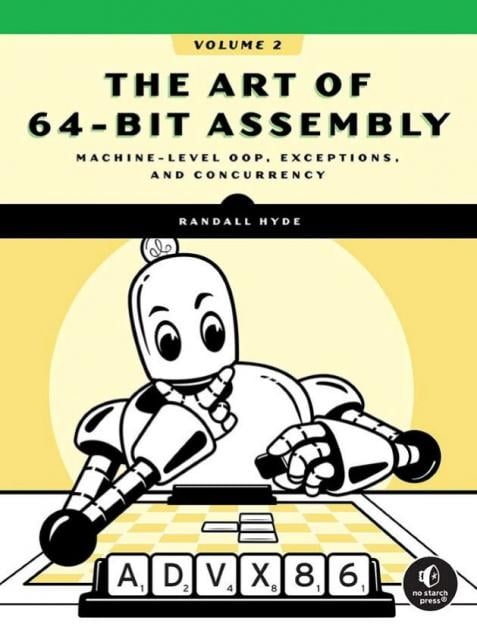
The Art of 64-bit Assembly
2026-08-02The article explores the rigorous discipline of 64-bit assembly programming, emphasizing the need for a deep, foundational understanding of hardware. It highlights that working at this low level leaves developers with no high-level abstractions, shortcuts, or runtime environments to hide behind when debugging.
Comments
While developing a quantum compiler named Catalyst, a software team accidentally created an LLVM compiler for the Jax machine learning framework. This unexpected tool emerged as a byproduct of extensive problem-solving and provides a novel way to optimize Jax programs.
CommentsUsers of the popular command-line search tool ripgrep have reported occasional segmentation faults when executing exceptionally large directory searches using musl binaries. These crashes disrupt the tool's recursive regex functionality during heavy workloads. The issue is currently being tracked on the project's GitHub repository as developers investigate a fix.
Comments2026-08-01
qm – Multiplayer agent harness for work
2026-08-01YC Software has released qm, an open-source multiplayer agent harness designed to streamline collaborative work. Developers can explore the framework and contribute to its ongoing development via the project's GitHub repository.
CommentsThe article introduces Flint, a new visualization language designed for the AI era. In the discussion section, readers recommend checking out Vega, an existing visualization grammar, as a point of comparison.
Comments
Progressive Web Components
2026-08-01A new lightweight library named Elena has been introduced to help developers easily build Progressive Web Components. This tiny framework is designed to streamline the development process and simplify the creation of modern web applications.
Comments
The June update for the Servo web engine introduces key improvements to real-world compatibility, media queries, and SharedWorker support. Furthermore, the developers have launched a new initiative inviting the community to help write future monthly progress reports.
CommentsA new dependency-free C inference engine called waste allows users to run the massive 2.78-trillion-parameter Kimi K3 model using only 29 GB of RAM. It achieves this feat by streaming activated weights directly from NVMe storage rather than loading the entire model into memory. While the inference speed is a slow 0.50 tokens per second, it demonstrates a novel approach to running extremely large AI models on limited hardware.
Comments