Programming Tech News
Writing software is a craft that keeps reinventing itself. This section gathers news and articles for people who program, covering language releases, compilers and runtimes, frameworks, development workflows, and the ideas that change how code gets written and reviewed.
Typical stories include new versions of Rust, Python, Java, JavaScript, and TypeScript, performance and debugging investigations, essays on architecture and code quality, and discussions of how AI coding assistants are changing day-to-day development. Hands-on tutorials and lessons from long-running projects show up often.
The tools and practices developers choose affect how fast teams ship and how well their software holds up over time. Working engineers, students learning to code, and engineering leaders follow this coverage to sharpen their skills and make better technical decisions.
2026-08-04

LLMs reward expertise
2026-08-04Recent reader discussions highlight that large language models heavily favor users with existing technical expertise, as novices often lack the specific vocabulary needed to prompt effective code generation. While programming experts can build simple applications in a single prompt, non-technical users frequently get trapped in endless brainstorming loops or struggle with basic developer interfaces. This reveals a significant gap between the promised democratization of software creation and the reality of using AI tools without foundational domain knowledge.
CommentsAlthough the original article highlights ten recent advances in mathematics and theoretical computer science, reader discussions primarily focus on the societal and political implications of exponential technological growth driven by large language models. Commenters express concern over the unprecedented ability of AI to scalably manipulate individuals through highly personalized, real-time conversational engagement. The debate also explores how these computational breakthroughs will impact experimental fields like biology and potentially exacerbate political polarization through advanced digital manipulation.
Comments
A new open-source project called Swiftlet enables users to run massive large language models on Apple devices with remarkably low memory requirements. The tool successfully demonstrates running an 80-billion parameter Qwen model using just 4.3 GB of RAM on a Mac, alongside a 35-billion parameter model on an iPhone. This advancement significantly lowers the hardware barrier for running powerful local AI inference on everyday consumer devices.
Comments
Devtools must be open source
2026-08-04The article argues that developer tools must remain open source to support the industry's rapid shift toward highly personalized software. Open-source devtools provide the necessary flexibility and community-driven innovation required to build these customized applications. Ultimately, keeping these tools open is essential for developers to thrive in this new era of personalized technology.
Comments
A developer reflects on their unsuccessful 2015 Microsoft internship interview, which they pursued during their computer science degree after gaining confidence from open-source contributions. The author recalls targeting the tech giant specifically because of its impressive work on TypeScript and the open-source rewrite of the C# compiler.
CommentsThe August 2026 Hacker News hiring thread features numerous software engineers and infrastructure specialists showcasing their technical expertise to potential employers. Candidates highlight extensive backgrounds in AI infrastructure, distributed computing, and full-stack development using languages like Rust, Go, and TypeScript. While the majority of applicants are seeking remote opportunities, several remain open to relocation for the right roles.
Comments
ComfyUI now features day-zero support for MiniMax H3, an open-weights omni-modal video model that generates 2K resolution video with native stereo audio. Thanks to significant optimizations, this powerful model can be run locally on accessible consumer hardware like a 3060.
CommentsDevelopers are debating the practice of manually retyping LLM-generated code to prevent cognitive debt and ensure a deeper understanding of the software being built. While some argue this meticulous workflow negates AI efficiency gains and reduces engineers to mindless typists, others find value in using AI as a collaborative design tool rather than a direct code generator. The discussion reflects broader industry anxieties about the future of software engineering, with many anticipating a shift away from manual coding toward high-level visual architecture.
Comments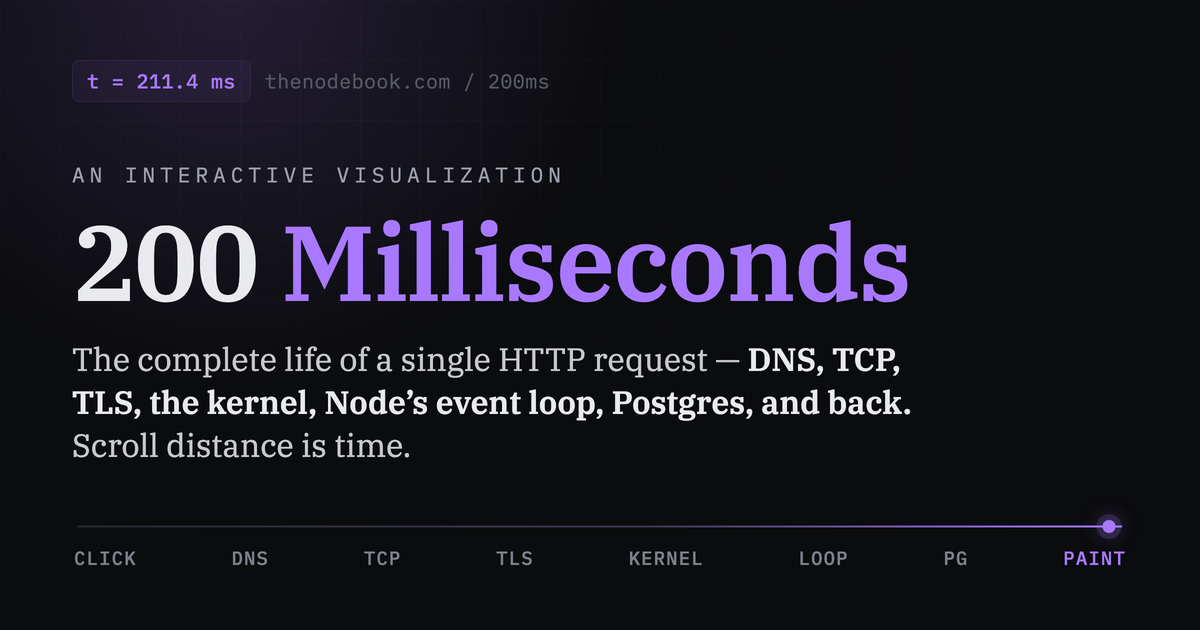
200 Milliseconds
2026-08-04A new interactive visualization traces the entire lifecycle of a single HTTP request during the 200 milliseconds after a user presses Enter. The project maps the data journey through DNS, TCP, TLS, the Linux kernel, Node's event loop, and Postgres back to the user interface, using scroll distance to represent elapsed time.
Comments
ZX Spectrum System Tour: Text Mode
2026-08-04Moving beyond the hardware control offered by BASIC, this installment of the ZX Spectrum System Tour dives into machine language to explore the system's text mode. The article begins a multi-part deep dive into the lower-level capabilities of the classic computer's text rendering.
Comments
Y Combinator S26 startup Hoplite has launched to offer developers an effortless way to deploy cloud coding agents. The platform focuses on streamlining the setup process while delivering a highly intuitive and enjoyable user experience.
CommentsBonsai: Janestreet's UI Library
2026-08-04Jane Street has introduced Bonsai, a new UI library designed for building dynamic web applications using the OCaml programming language and the Js_of_ocaml compiler. This release provides a robust framework that allows developers to seamlessly translate their front-end code into JavaScript for efficient browser execution.
CommentsTwenty Years of Pandoc
2026-08-04The open-source universal document converter Pandoc is celebrating a major milestone by marking its twentieth anniversary. Over the past two decades, the software has become an indispensable utility for developers and academics to seamlessly convert between various markup formats. This occasion highlights the enduring impact and continued relevance of the foundational project within the modern tech ecosystem.
CommentsAirLLM 70B inference with single 4GB GPU
2026-08-04A new open-source project called AirLLM enables the inference of 70B parameter large language models using only a single 4GB GPU. This dramatic reduction in hardware requirements makes running advanced AI models highly accessible to users with limited computing resources. Developers can view the code and contribute to the project's ongoing development on GitHub.
Comments
Massively Parallel Postgres Backups
2026-08-04PlanetScale has significantly reduced backup times for petabyte-scale sharded Postgres databases by completing the process in just a few hours. The company achieves this efficiency by leveraging massively parallel infrastructure, object storage, and WAL replay technologies to handle the massive data loads.
CommentsA new open-source project named KisakCOD aims to reimplement the multiplayer experience of the classic game Call of Duty 4. Hosted by SwagSoftware on GitHub, the initiative is actively seeking community contributions to help develop and refine the codebase.
Comments2026-08-03

Qwen3.8-Max establishes a new benchmark for coding and collaborative work through the comprehensive capabilities of Qwen Studio. The platform delivers a diverse suite of features, including chatbot interactions, multimodal understanding, and image generation. Additionally, it enhances user productivity with advanced tools for document processing, web search integration, and artifact creation.
CommentsA new GitHub project called CP/M-386 ports the classic CP/M operating system to run in 386 protected mode. Derived from the historic CP/M-68K codebase, the release offers retro computing enthusiasts a novel way to experience the legacy OS on x86 architecture.
CommentsShow HN: ssh ssh.place
2026-08-03A new project called ssh.place provides a collaborative drawing canvas that users can access directly through a terminal. The tool requires no account creation or software installation, allowing anyone to start drawing instantly by simply connecting via SSH. This minimalist approach offers a unique, frictionless way for terminal enthusiasts to create digital art together.
CommentsRFC 9851: TLS 1.2 is in Feature Freeze
2026-08-03RFC 9851 places TLS 1.2 into a feature freeze as adoption of the newer TLS 1.3 continues to grow. Moving forward, no new features will be approved for TLS 1.2 except for urgent security fixes, new exporter labels, and new ALPN protocol IDs. This freeze applies strictly to TLS and does not affect any version of DTLS.
CommentsA tiny Mamba-based language model has been successfully deployed on a vintage 1975 MOS 6502 processor. Using a custom 8-bit ternary inference engine, the system generates text directly on a 1980s BBC Micro. This achievement demonstrates how modern AI architectures can be heavily optimized for severely constrained retro hardware.
CommentsA new project called Kakehashi introduces an experimental userspace translation layer designed to run macOS binaries on Linux ARM64 systems. The code is currently hosted on GitHub, where developers are invited to contribute to its ongoing development.
Comments
Developers form strong attachments to their software tools because consistent functionality builds essential trust in their daily workflows. When these tools constantly change their capabilities, it forces users to continually relearn them and disrupts their established processes. This instability highlights a critical flaw in tool design by undermining the reliable routines that developers depend on.
Comments
SwiftUI After 7 Years
2026-08-03Despite being introduced as the future of Apple development in 2019, SwiftUI still struggles with significant stability and performance issues seven years later. The framework continues to feel like a perpetual beta to many developers. A recent analysis explores the underlying flaws preventing the technology from reaching its full potential.
Comments
Show HN: A Handwritten Blogging Platform
2026-08-03A new Show HN project introduces a minimalist blogging platform designed for handwritten posts to encourage slower, more authentic thinking. The service intentionally omits algorithmic feeds and social metrics like likes, focusing purely on distraction-free publishing with native RSS support.
CommentsShow HN: Mu – Tools for Agents
2026-08-03The open-source project Mu was recently showcased on Hacker News as a new toolkit designed to help developers build and manage software agents. Contributors can access the codebase and collaborate on the project's ongoing development through the micro/mu GitHub repository.
CommentsA new open-source project named NixOS-DGX-Spark enables users to run the Nix package manager and NixOS Linux distribution on the DGX Spark. This integration brings Nix's reproducible package management to the desktop AI workstation. The developer is actively seeking community contributions on GitHub to help expand and refine the project.
CommentsA new Show HN project named creakwork12 lets users make their Framework 12 laptop hinge sound like a rusty, creaky door. Fittingly, the novelty software created by developer ArcaEge is written entirely in the Rust programming language.
CommentsTwenty Years of RISC OS Open
2026-08-03The tech community is marking the twentieth anniversary of RISC OS Open by reflecting on the enduring legacy of the Acorn operating system and the dedicated developers who kept it alive. Long-time users and programmers shared nostalgic memories of the platform's unique ARM assembly environment and its historical significance as the original home for notable software like the Sibelius music notation program.
CommentsAn article introducing the proof-oriented programming language F* has sparked a community discussion focused more on general language design than the specific tool. Readers debated the importance of showcasing syntax on project homepages and argued over the practical benefits and drawbacks of using indentation-based code formatting.
Comments