Programming News
SubmitProgramming keeps evolving as languages mature, tooling improves, and teams rethink how software should be written. This section follows that change, gathering news and articles about programming languages, compilers, development practices, and the craft of writing reliable, maintainable code.
Typical stories include language releases and proposals, deep dives into compiler and runtime internals, performance investigations, debates about coding style and architecture, and essays from experienced engineers on lessons learned. Popular ecosystems such as Rust, Python, JavaScript, and TypeScript appear regularly.
Keeping up with these topics helps developers choose the right tools, avoid known pitfalls, and grow their skills. Working engineers, students, and technical leaders follow this coverage to stay current with the ideas shaping how software gets built.
2026-11-11

Hyper-Realistic Sand with WebGL2
2026-11-11A new browser-based sand simulator delivers hyper-realistic sand physics using WebGL2 and JavaScript. It supports touch controls and device motion on phones and tablets, letting users play directly in their browser.
CommentsEmacs in the Age of Magic
2026-11-11A group of Emacs users and developers is pushing for an LLM-free version of Emacs, vowing to continue it even if GNU adopts a different policy and urging GNU to reject LLM-generated contributions. The debate around the effort highlights broader concerns about AI dependency, software freedom, and whether coding agents make programming more accessible or undermine understanding.
Comments
MIT CSAIL’s recent “Sparks of Weight-Space Programming” paper showed that GPT-6 Astra could identify which game a small network had been trained on directly from its raw weights. The new piece asks whether a linear program can perform comparable weight-space programming, probing whether such capabilities require large models or can be replicated with simpler linear methods.
CommentsA new Show HN project introduces Micron, a programming language described as Oberon with the power of C. It includes a compiler and IDE, with source available in the rochus-keller/Micron repository.
Comments$30M Raised to Redo the CPU
2026-11-11A startup has raised $30M to develop a parallel-first CPU with thousands of cores that abandons shared mutable memory and linear instruction sequences, paired with its open-source Vine language. Commenters are skeptical, comparing the approach to GPUs and long-standing superscalar optimizations while stressing that the real challenge is building compilers and software for a new architecture.
Comments
Tim Peters has died
2026-11-11Tim Peters, a highly influential Python developer best known for writing the Zen of Python (PEP 20), died on July 15 earlier this year. His contributions had a profound impact on Python and its community.
CommentsKlad is a source-available paint app built for collaboration between coding agents and humans, allowing a coding agent to drive the drawing interface. The project is available on GitHub under klad-app/klad.
CommentsThis 2013 article revisits a clever, old-fashioned game-programming trick that exemplifies resourceful coding from earlier eras. It highlights a notable hack used in classic game development, though further details are not provided.
Comments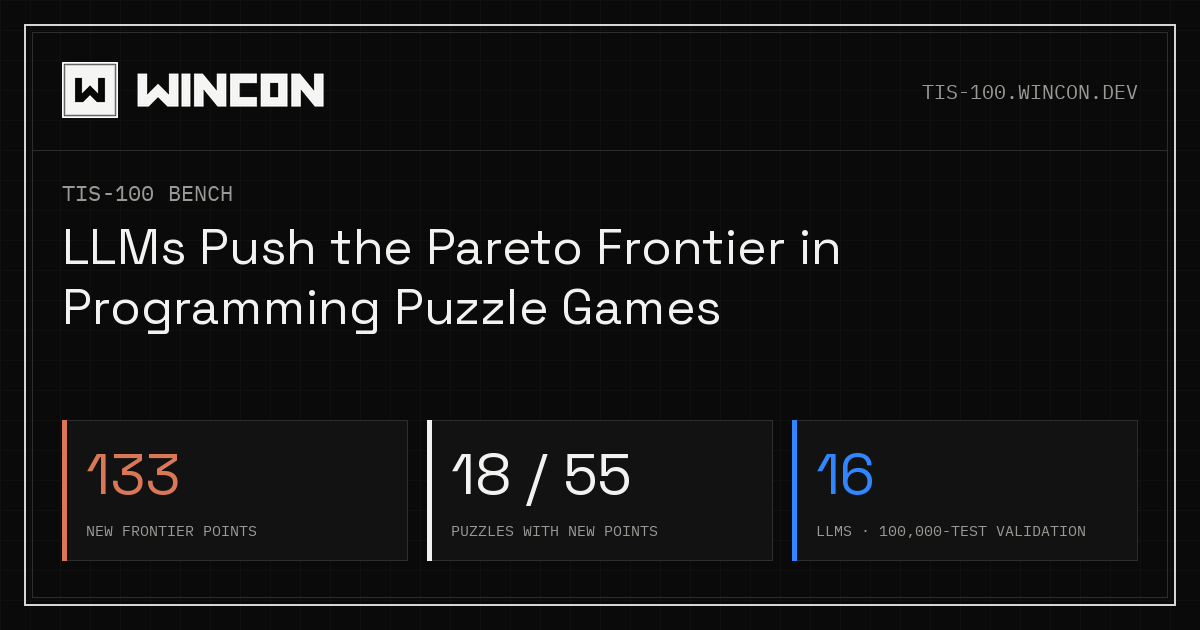
LLMs Play Zachtronics' TIS-100
2026-11-11Sixteen LLMs took on TIS-100’s community leaderboard, finding 133 new frontier points across 18 of 55 puzzles. Their runs included three outright cycle records, showing LLMs can produce competitive solutions to the programming puzzle.
CommentsAtuin Threads introduces a searchable, synced history for AI agent sessions across all machines. It lets users start a task in one coding agent, such as Claude Code, and resume it in another, like Codex.
CommentsA new Lua script brings Godbolt-style inline assembly to Neovim in a floating window for C, C++, and Rust. It supports x64 and aarch64 architectures and is available from the 0xdeadf1sh/AssemblyForNeovim repository.
Comments2026-11-10

Val Town is winding down
2026-11-10Val Town, a platform for building and deploying JavaScript functions, is winding down. The company announced the closure with a brief message thanking users for building with it.
CommentsGoogle Chrome has released modern-web-guidance, a resource designed to keep coding agents aligned with current web best practices instead of outdated ~2019 JavaScript. The Show HN project aims to steer AI coding assistants toward modern web primitives so generated code follows up-to-date standards.
Comments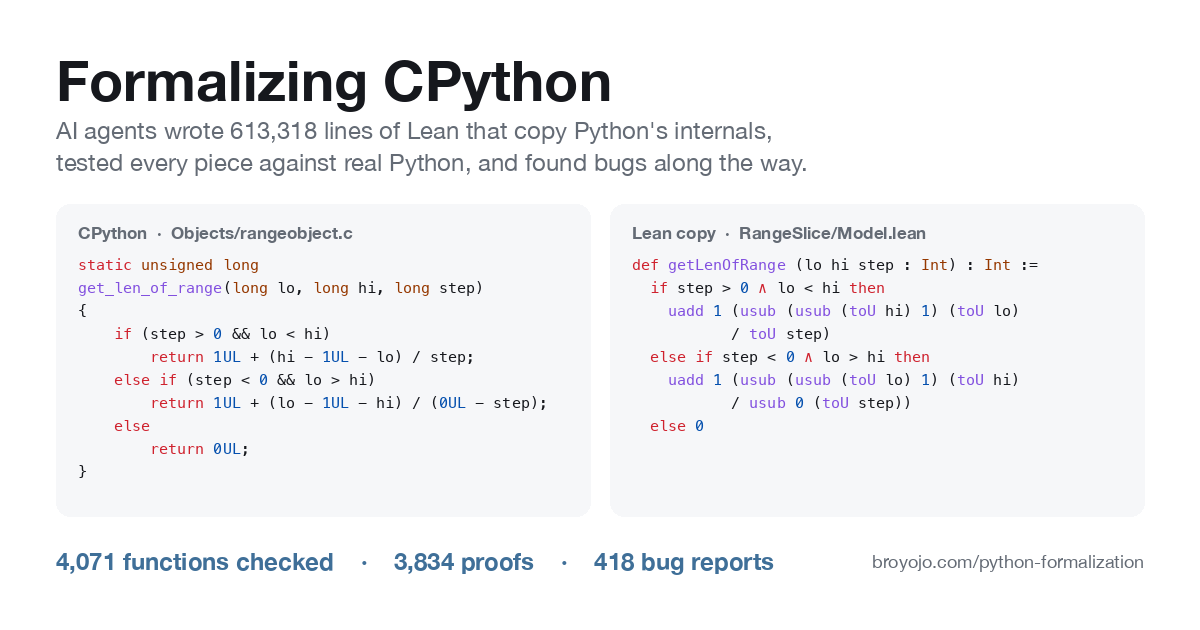
Formalizing CPython
2026-11-10AI agents formalized CPython’s internals in 613,318 lines of Lean, validating each component against real Python behavior. The effort surfaced 418 bug reports along the way.
Comments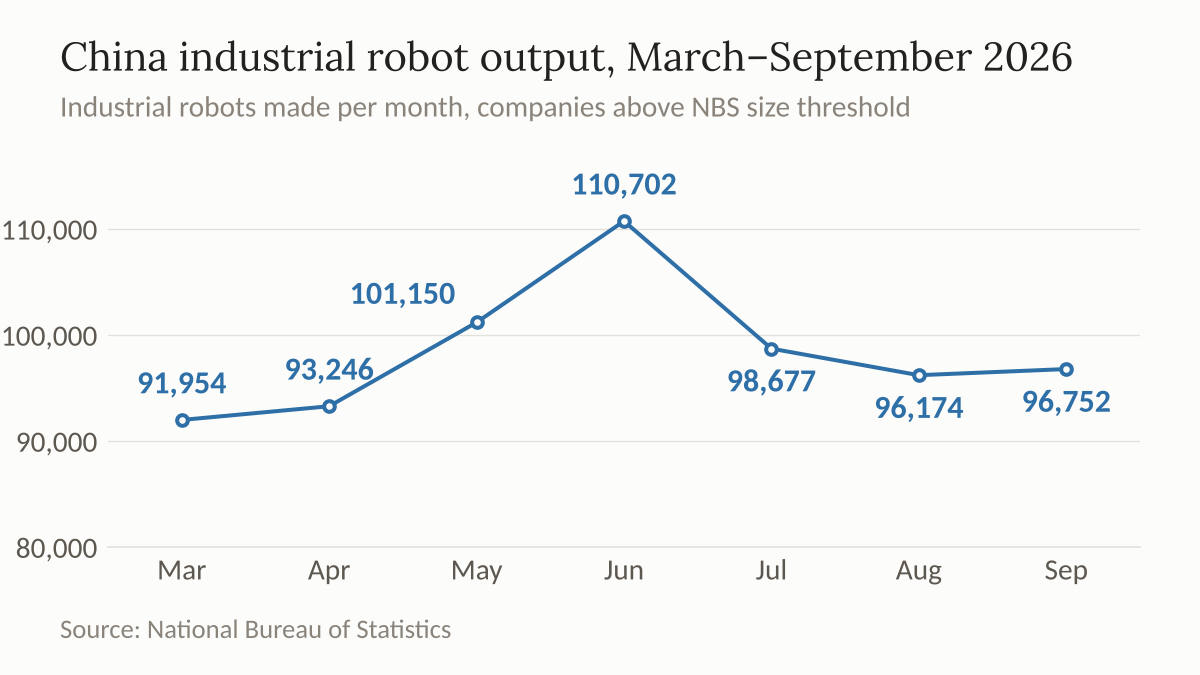
China has drafted rules requiring every robot it makes—not just humanoids—to carry a lifetime ID code, with manufacturers coding each unit before it leaves the factory. The draft leaves the start date blank.
CommentsLet over Lambda–50 Years of Lisp
2026-11-10The piece marks 50 years of Lisp, reflecting on the programming language’s history and lasting influence. Its title nods to Lisp’s lambda-based traditions and enduring ideas about closures and functional programming.
CommentsColor bars became TV’s most common test pattern because they let broadcasters and technicians quickly check signal, color, and alignment across the chain. The piece traces their history and explains what the bars actually reveal, while noting that Netflix has offered some unusual test programming of its own.
Comments2026-11-09

Claude Fable 5.2 and Mythos 5.2
2026-11-09Claude has introduced Fable 5.2 and Mythos 5.2, new models aimed at the hardest technical challenges. Fable 5.2 sets a new benchmark in coding, finance, and the sciences.
CommentsA discussion around Herb Sutter’s piece on the rift between C++’s creator and its stewards highlights growing doubts about C++’s future, with commenters citing memory safety, AI-assisted rewrites, and weak safe-concurrency support as reasons legacy C++ may be increasingly hard to defend. Others credit Sutter and the C++ committee for foundational work on concurrency and memory models, while debating whether those efforts made parallel programming meaningfully easier.
CommentsReaders discussing whether they still enjoy C++ report mixed feelings: many still value its power, performance, control, and RAII, while others cite decades of cruft, missing features like pattern matching, and slow committee progress. Some longtime C++ developers have migrated to Rust, praising its traits, tooling, and ecosystem, and say returning to C++ is difficult except for maintaining old projects.
CommentsA Show HN project demonstrates JavaScript web apps using WASM layout and GPU rendering in just 280 KB. Commenters warn that bypassing the DOM discards browser/OS features like password-manager autofill, user dictionaries, IME support, and selectable content, creating inconsistent UX, while others are excited about the approach despite demo performance and WebGPU compatibility concerns.
CommentsSultanC is an Arabic-first, self-hosting systems programming language with an English surface, ownership safety, and pattern matching. It targets native ARM64/x86-64, supports LLVM cross-compilation and WebAssembly, and can be tried in the browser.
CommentsTaco: The Tensor Algebra Compiler
2026-11-09TACO is an open-source tensor algebra compiler that generates efficient code for dense and sparse tensor computations across a variety of storage formats. The project’s website serves as a hub for documentation, source code, and resources for using the compiler.
Comments
A new comparison examines pointer provenance in Rust and C++, using LLVM IR to show why pointers carry more semantic information than plain integers. It contrasts how the two languages model provenance and the implications for optimization and undefined behavior.
CommentsDBDelve is an open-source database client built in Rust with GPUI, shared via Hacker News’ Show HN. No further details about its features or availability were provided.
Comments2026-11-08

Goldman Sachs is withdrawing Claude Code from its bankers and traders and handing AI coding agents back to its engineers under new internal guidance. The reversal comes after its tech chief praised trader-built AI tools in July and just weeks before Goldman takes Anthropic public.
CommentsMizu introduces zero-copy parallel and asynchronous execution between R and Python over shared memory, aiming for thread-speed performance. The shikokuchuo/pymizu project provides tooling for running Python workloads alongside R without copying data across process boundaries.
CommentsGoodbye Claude, Hello Pi
2026-11-08The “Goodbye Claude, Hello Pi” post centers on a developer moving from Claude Code to Pi, a coding-agent harness that supports OpenAI Codex out of the box with basic integration and optional extensions for usage tracking. Discussion around it covers frustrations with Claude Code, such as errors tied to simple shell aliases, and comparisons between Pi, opencode, and local-model workflows. The author is identified as a Salesforce developer, suggesting the piece is a personal migration account rather than a formal product announcement.
CommentsThe History of Djgpp
2026-11-08A reader discussion of DJGPP’s history highlights how the free DOS-based 32-bit C/C++ toolchain was foundational for many developers in the 1990s, especially when compilers were expensive and most people had only DOS PCs. Commenters credit DJGPP and the Allegro game library with early C/C++ experience and as a gateway to Linux and Emacs, with one noting it was used in 1992 for a photon-counting imaging system. The thread also touches on the project’s capitalization and author DJ Delorie’s naming preferences.
Comments