Programming Tech News
2026-10-06
A new technique called Dust enables the pretraining of transformer models without backpropagation by utilizing local, asynchronous optimization methods that are more biologically plausible. This approach bypasses certain mathematical limitations of traditional backpropagation, such as the conditioning of the Hessian matrix. However, researchers caution that it may currently suffer from lower computational and sample efficiency on modern GPU hardware compared to standard methods.
Comments
A developer recounts their experience migrating to Deno and the subsequent decision to return to Node.js. The article details the practical limitations and ecosystem challenges that made the initial switch unsustainable. Ultimately, the piece reaffirms Node as the preferred runtime for their daily workflow.
Comments

Web Search API
2026-10-06A new Web Search API allows developers to integrate real-time internet search capabilities directly into their AI agents and applications. By leveraging an AI Gateway, the tool seamlessly connects with providers like Ceramic.ai, Exa, and Linkup to enhance autonomous system functionality.
CommentsThe Competitive Programmer's Handbook remains a dense but highly regarded resource for mastering algorithms and preparing for technical coding interviews. Although some developers argue its focus on rapid, throwaway code is losing relevance in the era of AI-assisted software engineering, it continues to be an essential tool for passing rigorous live-coding assessments and sharpening core problem-solving skills.
Comments
Ephemeral Testing
2026-10-06Ephemeral testing is a previously unthinkable approach to software quality assurance that relies on temporary, throwaway tests. This method enables developers or AI agents to rapidly build and evaluate software components within disposable environments.
CommentsThe open-source DEDA toolkit, now available on GitHub, allows users to extract, decode, and anonymize hidden printer tracking dots. These identification codes are typically embedded in printed documents by manufacturers to trace the origin of the pages. Developers interested in privacy-enhancing technologies can contribute to the project's ongoing development through its public repository.
CommentsA new open-source project called Photoc has been introduced on Hacker News, providing a suite of command-line tools tailored specifically for photographers. The GitHub repository is currently open for community contributions to help expand its feature set and improve photo management workflows.
Comments
Floréal Technologies has published the first part of a tutorial series on building GTK applications using the Haskell programming language. The guide aims to assist developers in creating open-source software with broad international reach.
CommentsA newly published research paper introduces novel techniques to optimize the space-time trade-offs in Log-Structured Merge tree-based key-value stores. These proposed improvements aim to enhance the overall storage efficiency and processing performance of database systems relying on LSM-tree architectures.
Comments2026-10-05
Quantitative Finance with OCaml
2026-10-05Readers of a recent article on applying OCaml to quantitative finance are raising concerns over missing authorship details. Additionally, the companion GitHub repository linked in the text is currently returning a 404 error, leaving the source code inaccessible.
CommentsInfidel goes wild
2026-10-05Despite the recent release of Planetfall, the developer has spent the past few weeks focusing on the Infocom title Infidel. During this time, they uncovered a highly severe and elusive bug within the project. The team is now working to identify and fix this difficult-to-detect issue before the final release.
CommentsA new independent project has introduced a browser-native IDE that recreates the classic Visual Basic 6 development environment. The comprehensive tool includes a runtime, a form designer, and a unique compiler that packages applications into single-file HTML.
Comments
Developers can create secure, self-hosted HTTP tunnels without installing third-party software by combining OpenSSH remote forwarding with Nginx's secure_link module. This lightweight setup generates shareable HTTPS URLs protected by expiring tokens, providing a practical alternative to commercial tunneling services.
CommentsFixed Points and Strike Mandates
2026-10-05Paul Khuong's latest blog post titled Fixed Points and Strike Mandates explores a variety of mathematical and computational topics. The entry specifically focuses on Lisp programming and optimisation techniques, reflecting the author's ongoing research in computer science.
CommentsA new Show HN project features a 30-minute pendulum clock built from trash, but the accompanying community discussion largely pivoted to the upcoming 2035 abolition of the leap second. Developers debated the technical challenges of synchronizing civil and atomic time in distributed systems and proposed alternative solutions for handling astronomical time discrepancies.
CommentsDemystifying Tufte's data-ink ratio
2026-10-05A new interactive guide demystifies Edward Tufte's data-ink ratio by allowing users to visually deconstruct a cluttered bar chart. By watching the remaining ink get counted pixel by pixel, readers can clearly see how eliminating unnecessary visual elements improves overall data presentation.
Comments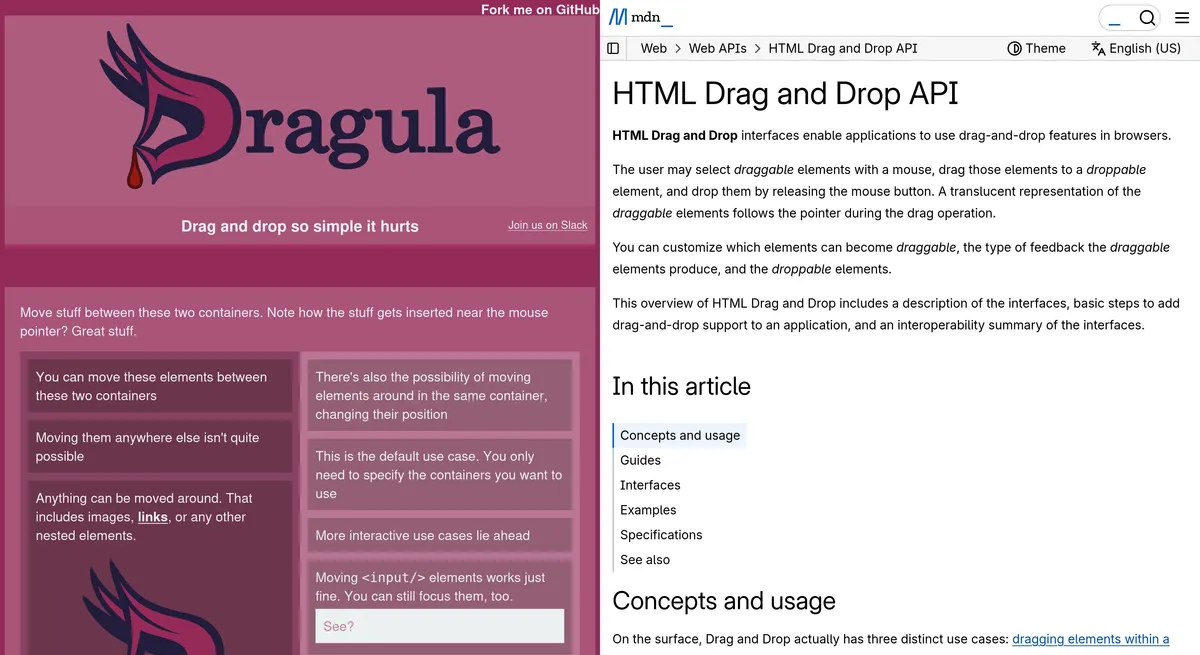
Web advocates have long urged developers to rely on native web standards for better performance and accessibility, but many continue to favor heavier JavaScript frameworks. This article explores the practical and cultural reasons behind this resistance, highlighting the ongoing disconnect between theoretical best practices and the everyday realities of modern web development.
CommentsPage Table Memory Consumption
2026-10-05A recent discussion on page table memory consumption debates the merits of traditional tree-based structures versus proposed PowerPC-style hashed page tables, with critics arguing that hashed alternatives fail to resolve existing memory bloat and may worsen bandwidth issues. Commenters also highlight that extreme memory overhead from page tables is increasingly driven by modern scaling demands, randomized virtual address allocations, and specific software bugs.
CommentsThis week's developer interview features Peter Bex, the lead maintainer of the Chicken Scheme programming language and a skilled optimizer. During the conversation, Bex shares insights into his development process and explains his strong enthusiasm for PostgreSQL.
Commentscp: -r or -R?
2026-10-05A recent discussion clarifies the critical differences between the -r and -R recursive copy flags of the cp command. The historic -r flag is strongly discouraged because it dereferences symbolic links and treats special files as regular files, which can cause system hangs or fill up disk space. In contrast, the POSIX-compliant -R flag correctly preserves symbolic links and special files, making it the recommended standard for recursive directory copying.
Comments2026-10-04

A new guide details how to maximize the capabilities of the Opus 5.5 model within both the standard Claude interface and Claude Code. The resource outlines essential techniques for effective prompting, steering extended execution runs, and accurately verifying final outputs.
CommentsA new perspective on AI agent design argues that structured project documentation is far more effective than conversational memory for maintaining context. By prioritizing comprehensive documentation over retrieval from past interactions, developers can ensure more accurate and reliable autonomous task execution.
CommentsThoreau BASIC 3.2 is a free 64-bit interpreter that modernizes classic GW-BASIC syntax for Windows and bootable UEFI environments with a native x64 JIT compiler and multicore processing. The software aims to revive the nostalgic programming language by adding contemporary features like 24-bit graphics, networking, and extensive multimedia playback capabilities.
CommentsA new tool called Pi pod enables developers to run their Pi coding agent in secure, isolated sandboxes directly on their own servers. The platform uses cloud pods to provide a self-hosted environment for safely executing and managing coding sessions.
Comments
Cloudflare has launched a developer competition to build a next-generation Git platform designed for the era of AI agents. The initiative encourages the use of Cloudflare's newly open-beta Artifacts, which includes Workers bindings, data jurisdiction controls, and event subscriptions for repository changes.
Comments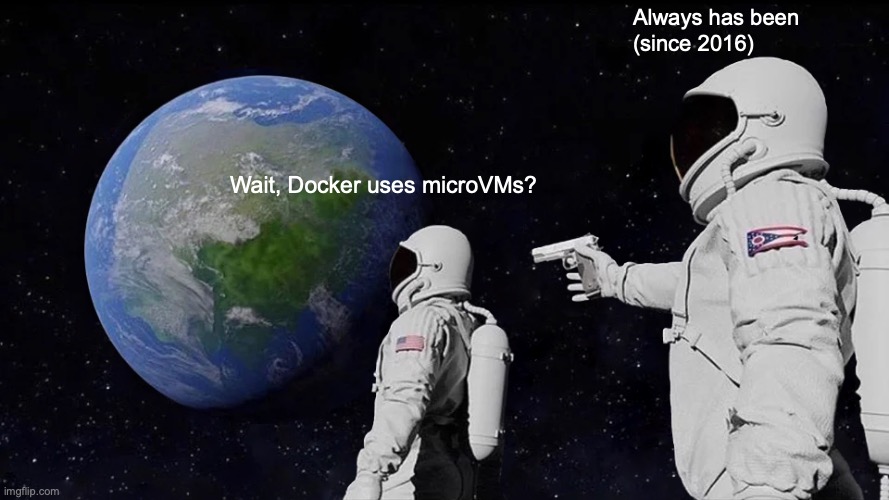
A recent article clarifies that Docker Desktop has been running containers inside minimal, purpose-built microVMs since 2016. The piece explores the technical reasoning behind this long-standing architectural decision and outlines the key benefits it has delivered to the platform.
CommentsRSS Feed Best Practices (2022)
2026-10-04A community discussion surrounding RSS feed best practices clarifies the limited support for complex styling across readers, recommending publishers rely on inline CSS, semantic HTML, and whitelisted iframes while strictly avoiding JavaScript. Participants also emphasize the importance of maintaining reliable feeds, adopting the Atom 1.0 standard, and using tag URIs for entry IDs to ensure maximum compatibility. Ultimately, the consensus encourages developers to keep their feeds intact and functional despite major platforms frequently violating these technical standards.
Comments
Memory-Safe WebP Decoding
2026-10-04A new memory-safe approach to WebP decoding has been introduced to significantly enhance both performance and security. This update ensures faster and safer image processing for all users across different platforms. By prioritizing memory safety, the improvement also helps mitigate potential vulnerabilities in web rendering.
Comments2026-10-03

Muse Gadgets
2026-10-03Muse introduces open-source, DIY gadgets that allow makers to build custom devices using standard ESP32 boards or a Raspberry Pi. Users can leverage the provided SDKs to easily connect these microcontrollers to various workbench components like sensors, displays, and actuators.
Comments
Redis creator antirez has introduced ds4, a new C-based inference engine that enables developers to run large language models locally. The release includes comprehensive documentation, benchmarks, and setup notes for supporting DeepSeek, Qwen, and GLM models across Metal, CUDA, and ROCm backends.
Comments