Programming Tech News
2026-05-25
A recent article explores the surprising longevity of the Gnutella peer-to-peer protocol, which continues to operate decades after its launch. The piece provides a technical explanation of how the decentralized network functions in the modern internet landscape. It ultimately highlights how this pioneering technology has managed to outlive the original era of file sharing that created it.
CommentsDiscussions around C portability and alternative compilers reveal significant challenges in parsing non-standard, platform-specific code within header files. Developers continue to debate the trade-offs between strict POSIX compliance and leveraging OS-specific features like systemd, which frequently breaks compatibility for Windows and FreeBSD users. Ultimately, the discourse highlights that achieving true cross-platform compatibility in C remains difficult due to prevalent Linux-centric assumptions and inconsistent compiler support.
Comments

Firefox now supports the Web Serial API, allowing users to build and manage Adafruit hardware projects directly from their web browser. This integration enables developers to seamlessly connect, write code, and control compatible devices without relying on external native applications.
CommentsA new open-source tool named gobee enables developers to write BPF programs in Go rather than C by transpiling a subset of Go code into BPF C. The project also automatically generates typed cilium/ebpf bindings to streamline the development process for the Go community.
CommentsTraditional programming books are rapidly losing relevance as developers increasingly rely on digital documentation and online tutorials. This decline marks a melancholic shift in tech education, signaling the end of an era where programmers regularly cracked open physical coding manuals. Ultimately, the industry is moving away from static printed literature in favor of faster, dynamically updated online resources.
CommentsJira Is Turing-Complete
2026-05-25Reacting to an article about Jira's Turing-completeness, readers criticize the project management tool for its notorious complexity, sluggish interface, and alienating bureaucratic rules. Many express frustration that rival platforms like GitHub Issues are increasingly mimicking this feature bloat to secure corporate buy-in, despite heavy developer pushback. Ultimately, critics argue that Jira's underlying architecture is a poorly engineered accumulation of design cruft rather than a cohesive, well-architected system.
CommentsJensen–Shannon Divergence
2026-05-25Recent reader discussions highlight Jensen-Shannon Divergence as a valuable mathematical tool that offers a symmetric distance metric compared to traditional Kullback-Leibler divergence. In machine learning, it is praised for balancing diversity and fidelity in generative AI models and for effectively detecting dataset drift. Commenters also emphasized its versatile applications beyond AI, including dimensionality reduction, data clustering, and physics research.
CommentsBytecode VMs in surprising places (2024)
2026-05-25A recent discussion highlights how bytecode virtual machines are implemented in unexpected environments, ranging from GPU kernels and PDF exploits to hardware firmware like EFI and ACPI. By utilizing a virtual machine approach in GPU shaders, developers can effectively bypass execution divergence and memory stalls in applications like the Dolphin emulator, Blender, and modern machine learning frameworks. Other surprising use cases for these virtual machines include Bitcoin transactions, TrueType fonts, and even running the Linux operating system directly within a graphics shader.
Comments
Building Pi with Pi
2026-05-25The Building Pi with Pi project explores the evolving landscape of open-source development in the post-AI era. It shares the team's key learnings and outlines their current strategy for integrating artificial intelligence into their collaborative workflows.
CommentsOpenBrief is a new open-source tool introduced on Hacker News that provides local-first video downloading and summarization capabilities. Developers can explore the code and contribute to the tantara/openbrief repository on GitHub.
CommentsThe Eternal Sloptember
2026-05-25The article argues that adopting AI agents in software development will be a costly mistake because they are merely statistical models mimicking code rather than actual programmers. Consequently, the output they produce is fundamentally flawed, and these underlying errors are becoming increasingly difficult to detect as the models improve.
CommentsGeomatic is a newly launched command-driven geometry studio featuring a geometric editor equipped with slash command autocomplete. Powered by automatic differentiation, the tool enables users to efficiently create and manipulate complex geometric designs.
CommentsAI errno(2) values
2026-05-25A recent piece proposes updating classic Unix errno system error codes to address the unique challenges of the artificial intelligence era, such as model hallucinations and context limit overflows. This concept highlights the evolving intersection of low-level systems programming and modern AI development by demonstrating the need to rethink foundational error-handling standards for machine learning.
Comments2026-05-24
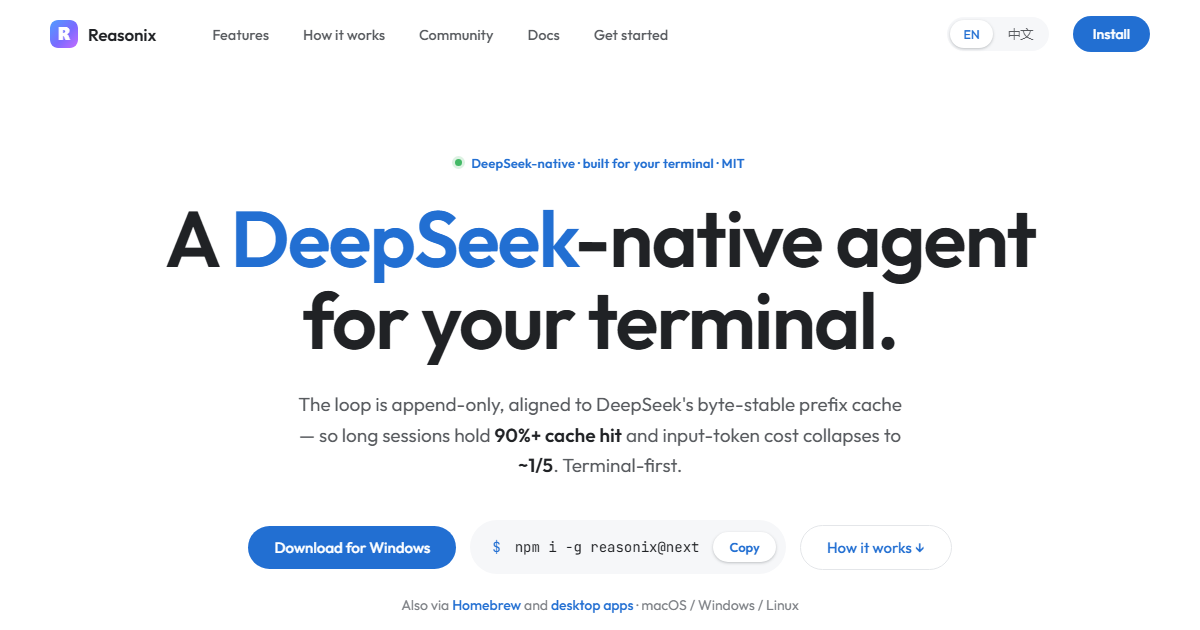
DeepSeek Reasonix is a new open-source AI coding agent designed for use across terminals, browsers, and compatible editors. By leveraging DeepSeek's byte-stable prefix cache, the tool maintains over a 90% cache hit rate during long sessions and reduces input-token costs to one fifth. The MIT-licensed project is distributed as a single Go binary, ensuring easy installation and seamless accessibility across desktop and web platforms.
Comments
Migrating from Go to Rust
2026-05-24Migrating from Go to Rust is considered a unique transition because it is not primarily driven by basic speed or static typing. Since Go already provides strong performance and type safety, teams adopting Rust are mainly motivated by its stricter correctness guarantees. This shift ultimately highlights a growing developer focus on runtime safety and absolute code reliability.
CommentsAMD is facing backlash from the developer community after removing Linux support from the free tier of Vivado 2026.1. Users argue this restriction alienates students and hobbyists, but company representatives failed to provide a substantive explanation for the change. Instead, the representatives threatened to ban users for expressing frustration and bluntly dismissed the controversial decision as a simple marketing choice.
CommentsWake up! 16b
2026-05-24A newly released 16-byte computer demo titled Wake Up has captivated the size coding community with its remarkable visual effects and cellular automaton tricks. Although the title initially led some readers to mistake the project for a 16-billion parameter language model, the tiny binary actually achieves stunning graphical results within an extremely constrained memory limit. Programmers and viewers alike are praising the tiny file as a masterpiece of extreme small-scale technical achievement.
CommentsChildhood Computing
2026-05-24Readers are sharing nostalgic reflections on their childhood computing experiences, highlighting how tinkering with early machines and accessing open school computer labs inspired their careers in technology. However, the discussion raises concerns that modern, heavily restricted ecosystems are depriving today's youth of the tinker-friendly environments necessary to foster the next generation of developers.
Comments
A recent study highlights the fragility of large language model agents in backend code generation by identifying a phenomenon termed constraint decay, where AI systems progressively forget or fail to adhere to initial instructions. This issue causes significant errors in longer code sequences, underscoring the critical need for improved methods to help models maintain strict operational constraints throughout complex programming tasks.
CommentsMastering Dyalog APL
2026-05-24Developers discussing Dyalog APL debate whether the language's terse syntax encourages clever puzzle-solving over clear problem modeling. While some critics highlight its proprietary licensing and reliance on toy examples, defenders emphasize that true mastery requires building full-scale applications. The conversation also explores modern open-source alternatives like BQN and formal methods like TLA+ for developers seeking different approaches to system design.
CommentsA new study explores the practical implementation of the Perceptual Image Codec, an AI-driven image compression method that prioritizes human visual perception over traditional pixel-level metrics. Researchers analyze the critical factors and computational trade-offs necessary to deploy these learned compression models efficiently in real-world applications. This work highlights the key requirements for bridging the gap between theoretical machine learning advancements and practical image compression standards.
Comments
I keep bouncing off the Scheme language
2026-05-24Despite a deep appreciation for the Scheme programming language, a developer shares their ongoing struggle to successfully learn and remember its core concepts. The author highlights the irony of this difficulty, as they named their blog after the iconic Scheme textbook, using this post as a candid public admission of their inability to make the language stick.
Comments
A recent tutorial outlines how to enable HTTP/2 cleartext in API servers using Go 1.24 and newer. This setup is especially useful for Cloud Run environments, enabling developers to leverage HTTP/2 capabilities while the platform manages TLS termination.
CommentsMy I3-Emacs Integration
2026-05-24An article detailing an integration between the i3 tiling window manager and Emacs addresses the common muscle memory conflicts caused by overlapping window management keybindings. Community discussion surrounding the post highlights various workarounds for navigating between Emacs buffers and i3 windows, including seamless navigation plugins, context-aware remapping tools, and custom scripts to unify the switching experience.
CommentsIke Saunders explores how the alternative version control system Jujutsu can help developers overcome the complexity and fatigue associated with Git. His recent website post highlights how the tool's simplified workflows offer a refreshing solution for engineers struggling with Git's rigorous commands.
Comments
A newly discovered exploit uses invisible text and Unicode tricks in legal contracts to manipulate large language models into providing incorrect advice to human reviewers. Although the attack targets AI systems rather than the humans signing the documents, legal experts warn it could constitute fraudulent misrepresentation, prompting discussions on mitigating the vulnerability using the Rust programming language.
Comments
Amazon Web Services – Four Years and Out
2026-05-24An Amazon Web Services employee is expressing relief after being let go from the company, concluding a four-year tenure marked by frustration over recent organizational shifts. The departure follows the staffer's growing dissatisfaction with the company's accelerated pivot to generative AI, which they felt negatively impacted their work with open source communities.
CommentsA new SIMD-accelerated algorithm leverages AVX-512 instructions to convert integers to decimal strings in under two nanoseconds. This highly efficient technique can resolve significant CPU bottlenecks during JSON serialization and deserialization in big data workflows. With AVX-512 support expanding across modern AMD and Intel processors, the low-overhead method is ready for practical, widespread adoption.
Comments
Usborne 1980s Computer Books
2026-05-24Usborne Publishing is reviving its classic 1980s computer books to introduce a new generation of children to the fundamentals of coding. These updated educational guides aim to make programming accessible to modern kids while retaining the nostalgic appeal of the original manuals.
CommentsClickHouse has released Silk, an open-source cooperative fiber scheduler designed to optimize high-performance computing tasks. It features fast stackful fibers and utilizes a NUMA-aware work-stealing scheduler to efficiently distribute workloads across multi-core systems.
Comments