YC Demo Day News
SubmitDemo Day is the moment each Y Combinator batch presents its startups to investors, and this section gathers reporting around it. Expect stories on notable pitches, standout companies, funding momentum, and the trends that emerge when a new cohort of founders steps on stage.
Typical coverage includes batch recaps, lists of the most talked-about companies, and interviews with founders fresh off their presentations. You will also find pieces examining which sectors dominated a given batch, from AI infrastructure to healthcare, and how those choices reflect where early-stage attention is flowing.
Investors, founders, and industry watchers follow Demo Day because it works as an early signal of what the next wave of technology companies will look like. Ideas that debut on that stage often reappear months later as funded, growing businesses, which makes each batch worth studying closely.
2026-11-09
Recalc is a new open-source spreadsheet tool where every cell can hold a value, formula, terminal command, or a running Claude Code or Codex agent. The project, shared on Hacker News, is pitched as a spreadsheet you share with your AI agents, letting them work directly inside the grid. It's available on GitHub under sshah03/recalc.
CommentsThe Qlobe: Rotating Quine (2010)
2026-11-09The Qlobe is a rotating Ruby quine created for RubyConf as a “global” alternative to quines specialized for Japanese. It uses self-referential code and string manipulation to output a rotated version of itself.
Comments
A new Show HN project introduces HACI, a compact, bio-inspired fully distributed algorithm for extracting edges from RGB images. The implementation is available on GitHub under RenderBear/haci.
Comments
Supply chain attack on Qubole customers
2026-11-09Sentra uncovered a supply chain attack in which attackers used a trusted vendor’s keys to access data at multiple Qubole customers. The incident highlights third-party key risks, and Sentra outlines measures to prevent similar attacks.
CommentsSultanC is an Arabic-first, self-hosting systems programming language with an English surface, ownership safety, and pattern matching. It targets native ARM64/x86-64, supports LLVM cross-compilation and WebAssembly, and can be tried in the browser.
Comments
A 2018 video profiles a brotherhood in the French Pyrenees that has preserved for centuries the tradition of cooking a sweet cake on a spit. It explores the community and culinary custom behind this long-running local practice.
Comments
The article recounts how Australia achieved the once-unthinkable feat of playing music on a computer, long before digital audio became routine. It highlights the technical difficulty and imaginative leap behind the milestone, which helped pave the way for today’s on-demand computer music.
CommentsDeuterium, a stable hydrogen isotope, is being used in OLED displays to improve brightness, power efficiency, and lifespan, especially for blue emitters that traditionally consume more power and degrade faster. Its ability to extend excited-state lifetimes and reduce nonradiative decay has led manufacturers to adopt deuterated compounds across red, green, yellow, and other OLED layers.
Comments
Archaeologists have uncovered the possible remains of a 19th-century castaway camp on Isla de los Estados, a desolate, wind-battered island off South America’s southern tip. The site may be linked to a renowned Argentine sailor and his shipwrecked crew. Further study is needed to confirm the connection.
Comments
Pigshell: Unix the Web
2026-11-09Pigshell is a web-based Unix-like shell that explores bringing Plan 9’s 9p file model to the browser, letting users manipulate web resources through shell commands and small interoperable files. Commenters compare it to named-pipe projects like mkfifo.com and praise the vision of fine-grained file-based interoperability for apps and scripting, while noting that relying on many kernel syscalls could hurt performance.
Comments
The piece examines how tree architecture theory has evolved beyond Leonardo da Vinci’s influential branching model, tracing shifting scientific understanding of how trees organize branches and trunks. It highlights the ongoing refinement of models that explain tree form and growth.
Comments
The Kekulé Problem – Cormac McCarthy
2026-11-09In Cormac McCarthy’s essay “The Kekulé Problem,” he asks where language came from and argues that it likely arose from the unconscious mind rather than conscious invention, using Kekulé’s dream of the benzene ring as an analogy. McCarthy suggests language is a problem solved beneath conscious awareness, leaving its ultimate origins mysterious.
Comments
Magnets and Rare Earths
2026-11-09This explainer breaks down why every joint motor relies on magnets, what those magnets are made of, and who controls nearly all rare-earth production. It walks readers through seven short steps, each paired with a quick quiz, to cover the technology and supply-chain stakes.
Comments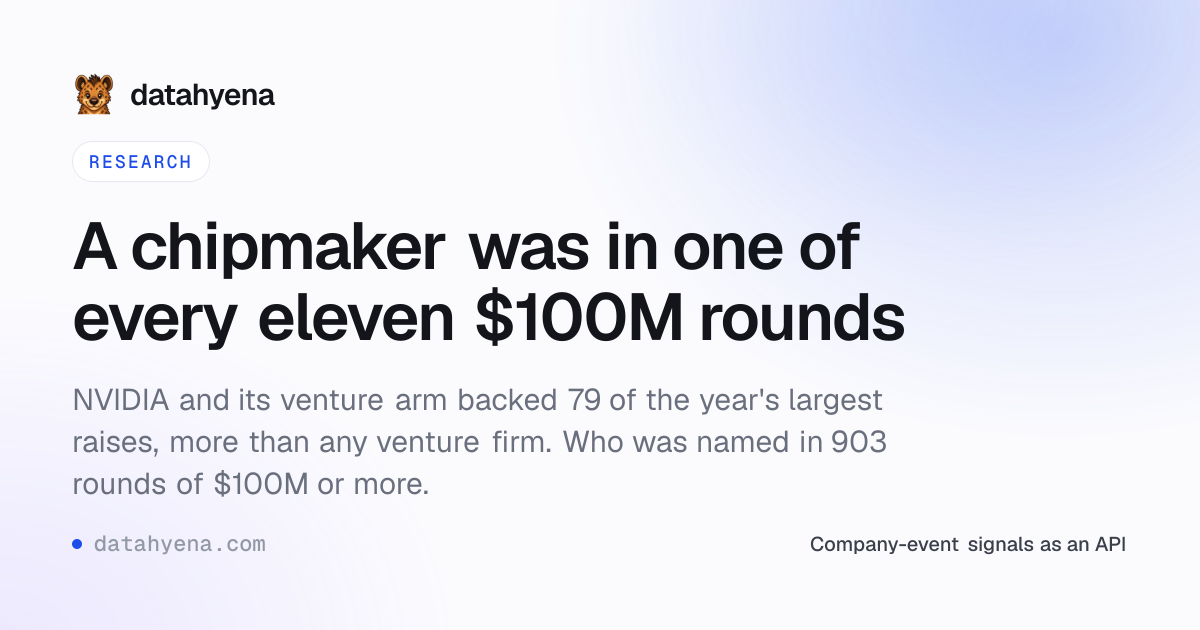
Nvidia and its NVentures arm participated in 79 of 903 venture rounds worth $100M or more between October 2025 and September 2026, about one in 11 such deals. That put Nvidia ahead of Sequoia (75) and Andreessen Horowitz (73), while 38% of the large rounds included a corporate investor.
CommentsTaco: The Tensor Algebra Compiler
2026-11-09TACO is an open-source tensor algebra compiler that generates efficient code for dense and sparse tensor computations across a variety of storage formats. The project’s website serves as a hub for documentation, source code, and resources for using the compiler.
Comments
A new comparison examines pointer provenance in Rust and C++, using LLVM IR to show why pointers carry more semantic information than plain integers. It contrasts how the two languages model provenance and the implications for optimization and undefined behavior.
CommentsA reader criticized the daily word puzzle Jointter for feedback that is confusing and unhelpful, citing shifting red lines and a misleading green letter that made solving feel like guesswork. The developer acknowledged the drawbacks and asked for suggestions on how to improve the game.
Comments
Ur-Nammu, who ruled circa 2112–2094 BCE, founded Sumer’s Third Dynasty of Ur and launched the Ur III period. His reign helped initiate the so-called Sumerian Renaissance, a era of renewed cultural and political activity in ancient Mesopotamia.
CommentsDBDelve is an open-source database client built in Rust with GPUI, shared via Hacker News’ Show HN. No further details about its features or availability were provided.
Comments
Y/n, an interactive AI storytelling startup backed by Y Combinator and $14M in funding, is hiring its first Growth Lead to find and scale marketing channels for its superhuman AI storyteller. The role involves testing paid ads and creator partnerships to reach teenagers and twenty-somethings, who have already sent over one billion messages on the platform. Based in San Francisco, the position pays $130,000–$300,000 and includes a paid work trial.
Comments