Programming Tech News
Writing software is a craft that keeps reinventing itself. This section gathers news and articles for people who program, covering language releases, compilers and runtimes, frameworks, development workflows, and the ideas that change how code gets written and reviewed.
Typical stories include new versions of Rust, Python, Java, JavaScript, and TypeScript, performance and debugging investigations, essays on architecture and code quality, and discussions of how AI coding assistants are changing day-to-day development. Hands-on tutorials and lessons from long-running projects show up often.
The tools and practices developers choose affect how fast teams ship and how well their software holds up over time. Working engineers, students learning to code, and engineering leaders follow this coverage to sharpen their skills and make better technical decisions.
2026-05-12
Senior developers often struggle to communicate their expertise because they focus on technical complexity while business stakeholders prioritize managing uncertainty. This misalignment hinders collaboration, but the integration of AI offers a unique opportunity to bridge the communication gap. By adapting their messaging to address business risks, engineering leaders can better align technical execution with organizational goals in the AI era.
Comments
If AI writes your code, why use Python?
2026-05-12AI coding assistants are challenging the long-standing dominance of Python and TypeScript. These languages were historically favored because their rapid development speeds outweighed slower execution performance. However, as AI automates much of the programming process, developers may soon prioritize runtime efficiency over the sheer ease of writing code.
Comments

Rendering the Sky, Sunsets, and Planets
2026-05-12A new article explores techniques for rendering realistic skies, sunsets, and entire planets in real time directly within the browser. The guide details a progression of shader-based methods, from simple sky domes to complex atmospheric simulations utilizing raymarching and scattering models.
CommentsCERT has disclosed six critical security vulnerabilities in the widely used dnsmasq DNS and DHCP server. The announcement has reignited developer debates over the necessity of rewriting legacy C codebases in memory-safe languages like Rust to prevent future exploits. However, critics warn that while memory safety eliminates certain bugs, it is not a universal fix and rewritten projects can still suffer from other security flaws.
CommentsThey Live (1988) inspired Adblocker
2026-05-12A developer has created an open-source adblocker inspired by the 1988 cult film They Live that replaces standard web advertisements with the movie's iconic subliminal slogans. The project is currently available on GitHub for users who want to browse the internet while seeing hidden messages like consume and obey.
CommentsLearning Software Architecture
2026-05-12A recent article responds to an inquiry from a research physicist seeking guidance on learning software architecture. The piece outlines practical strategies and resources for mastering software design skills tailored to those with a scientific background.
Comments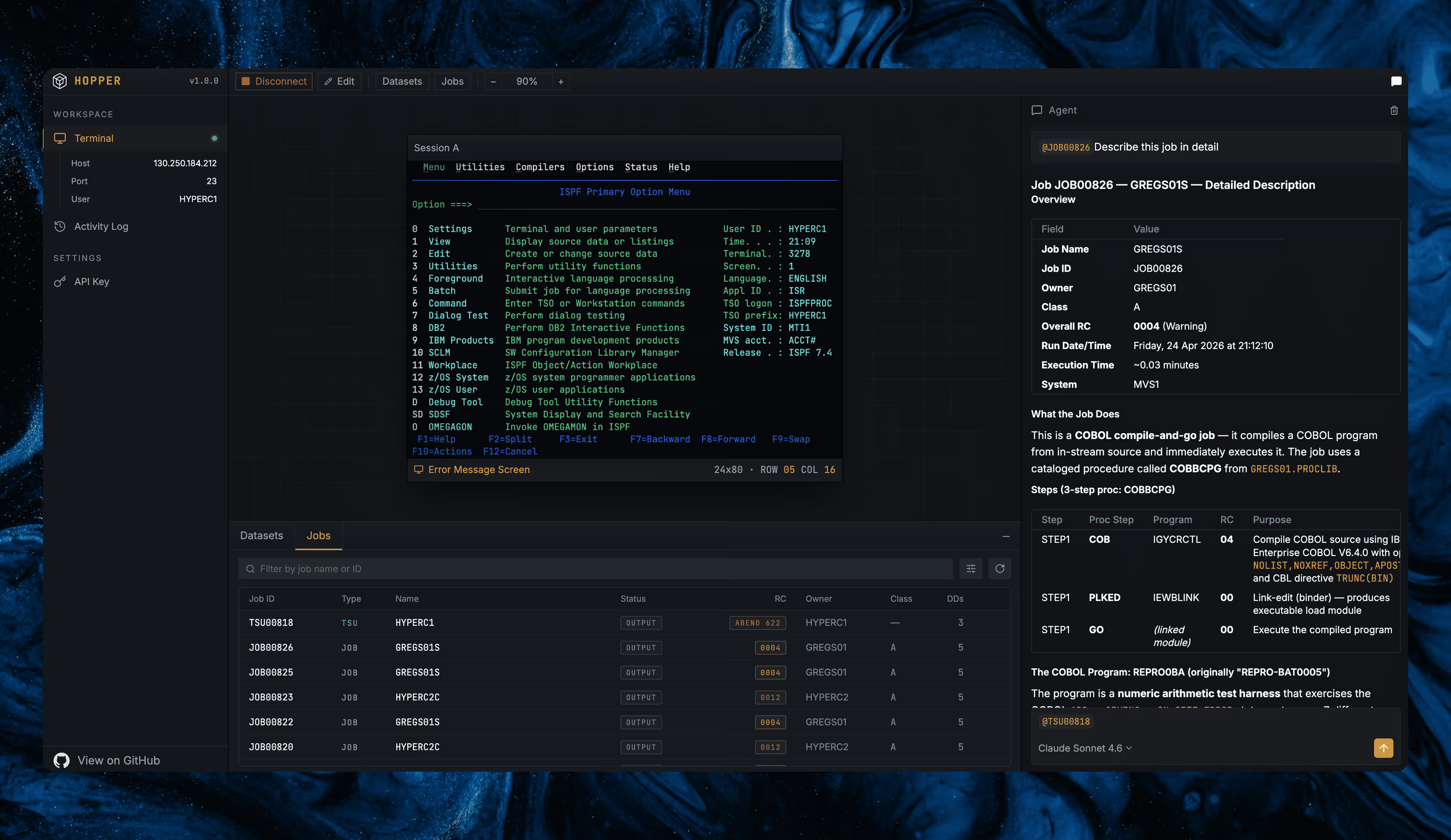
Hopper is a new agentic TN3270 terminal emulator that brings modern AI capabilities to legacy mainframe and COBOL environments. The tool allows AI agents to autonomously navigate ISPF, write column-strict JCL, debug failed jobs, and query VSAM directly within z/OS.
CommentsSoftware Internals Book Club
2026-05-12The Software Internals Book Club engages hundreds of developers in deep technical discussions on complex software books via a dedicated mailing list. Reader discussions highlight community interest in accessing archived comments and joining future cohorts, while also sparking technical debates about the complexities of email validation and the need for updated networking literature.
Comments
This piece highlights the importance of crafting clear and helpful error messages to improve the everyday online user experience. It emphasizes that effective error handling is a collaborative team effort that can transform frustrating system failures into positive user interactions.
CommentsY Combinator Summer 2024 startup Voker has launched an analytics platform designed to help developers monitor and improve AI agents in production. The tool eliminates the need to manually sift through logs, enabling teams to proactively identify and resolve agent issues before they impact end users.
CommentsGigacatalyst is an embedded AI builder that allows SaaS customers to generate custom frontend user interfaces on the fly using natural language prompts. The tool sandboxes the generated code to keep it independent of the core application, ensuring safe and easy sharing of new features without relying on third-party plugins. Currently serving over 2,000 daily users, the platform reflects a broader industry shift toward highly customizable, AI-driven enterprise software.
CommentsIntroduced on Hacker News, Statewright is a new open-source project that uses visual state machines to implement guardrails for AI agents. By restricting behaviors to defined operational states, the tool aims to make autonomous AI systems more reliable. Developers can find the source code and contribute to the project on GitHub.
Comments2026-05-11

A sophisticated supply-chain attack compromised 42 TanStack packages on the npm registry after an attacker exploited GitHub Actions vulnerabilities to publish 84 malicious versions. The breach chained a pull request exploit with cache poisoning and OIDC token extraction, prompting developers to review the official postmortem and audit their dependencies.
CommentsI'm going back to writing code by hand
2026-05-11In a piece about returning to manual coding, the author and readers criticize AI code generators for lacking the human judgment required to adapt architectural constraints over time. Without exhaustive, line-by-line human review, AI tools often contort software to fit outdated rules or hide catastrophic mistakes that eventually render the codebase unmaintainable. Consequently, developers are finding that the intense oversight needed to prevent hidden errors makes writing code by hand a more reliable and practical approach.
Comments
GitLab has announced a workforce reduction and the elimination of its CREDIT core values in a recent letter to customers and investors. The software development company stated that these structural changes are intended to streamline operations and better align with its current business priorities.
Comments
Ratty is a newly introduced terminal emulator that utilizes GPU rendering to support inline 3D graphics. This innovation allows developers to view and interact with complex 3D visuals directly within their standard command-line environment.
CommentsWhile some developers report that AI coding agents reduce maintenance costs by modernizing legacy code and automating testing, others warn that generating poorly understood code actually increases outages and technical debt. Consequently, participants emphasize that maintainability must remain a core engineering responsibility to ensure AI genuinely decreases rather than exacerbates long-term software maintenance burdens.
Comments
Mythos Finds a Curl Vulnerability
2026-05-11Anthropic withheld its new AI model, Mythos, from public release due to its exceptional ability to identify security vulnerabilities in source code. Demonstrating this advanced capability, the model has now successfully discovered a security flaw in curl.
Comments
A new technical guide demonstrates how to optimize large language model training in Swift by drastically accelerating matrix multiplication. By exploring ten handwritten implementations ranging from plain C and Swift to Apple's Metal API, the tutorial shows how developers can push performance from gigaflops per second up to teraflops per second.
Comments
After experiencing frequent sleep disruptions, an author utilized AI development tools to build a custom application that tracks and identifies the causes of nighttime awakenings. This project highlights how AI is lowering the barrier to entry, allowing individuals to easily create personalized tech solutions for everyday quality-of-life issues.
CommentsNvidia has introduced cuda-oxide, an official compiler that enables developers to write and compile GPU device code directly in Rust. Rather than replacing host-side libraries like cudarc, the new tool complements them by generating embedded PTX code from Rust source files for execution via existing CUDA APIs. Additionally, cuda-oxide leverages Rust's strict memory and type safety models to provide robust guardrails against common undefined behaviors in GPU kernel programming.
Comments
Despite the rise of AI code generators, industry professionals emphasize that software engineering is primarily about problem-solving, architecture, and understanding requirements rather than simply typing code. While developers who view their roles strictly as code writers may face obsolescence, those who adapt will transition into more complex roles where AI serves as a tool for rapid experimentation. Ultimately, delivering functional software still requires human critical thinking and contextual understanding that current AI models cannot fully replace.
CommentsA new Java 25 library called TypedMemory enables developers to efficiently map Java records to strongly typed off-heap native memory. By leveraging the Foreign Function and Memory API, the tool provides a fast and direct approach to native memory management for performance-critical applications.
Comments
A recent experiment explores the real-time processing capabilities of large language models by tasking Claude Code with simulating a user-space IP stack. The study specifically measures the model's latency by tracking how quickly it can process and respond to standard network ping requests.
CommentsA developer built a static HTTP web server entirely from scratch using aarch64 assembly language, embracing the extreme challenge of bare-metal programming. The project serves as both a deep dive into low-level architecture and a humorous personal quest for meaning through code.
CommentsReaders are revisiting a highly praised 2010 blog post by Matt Might that demonstrates how to implement a programming language in just seven lines of code. Commenters celebrate the tutorial for demystifying computer science and argue that such foundational concepts should be taught to everyone, not just computer science majors. The discussion also compares this elegant Lisp-based implementation to other minimal language projects, highlighting the enduring beauty of concise code.
Comments2026-05-10

Implementing API idempotency extends far beyond simply adding an HTTP header or performing a basic key lookup. A new article breaks down the complex failure cases that challenge real-world systems, such as mismatched requests, concurrent retries, and partial successes. It offers practical guidance for developers on handling critical edge cases like downstream uncertainty, response replay, and duplicate message handling.
CommentsA new macOS application called Drawers helps developers maintain focus by creating dedicated virtual spaces, customized docks, and isolated window environments for each of their projects. The app allows users to assign granular resources like specific chat channels to these workspaces to prevent context switching and distractions. The tech community has responded enthusiastically to the project, with users eager to beta test and suggesting future enhancements like project-specific app theming and crash isolation.
CommentsA developer has shared a MacOS web server written exclusively in ARM64 assembly language. The project, showcased on Hacker News, was built as a personal challenge to explore extreme low-level system programming. The resulting application operates natively without relying on higher-level abstractions or traditional software frameworks.
CommentsThink Linear Algebra (2023)
2026-05-10Allen Downey has released Think Linear Algebra, the latest addition to his widely praised series of freely available computer science textbooks. Readers commend his ongoing commitment to open educational resources and discuss the book's unique computational pedagogy. By using Jupyter notebooks to teach matrix multiplication and eigenvectors before basic vector arithmetic, the text takes a deliberate top-down approach to help students reach practical applications faster.
Comments