Legal Tech News Today
Law and technology now evolve side by side. This section follows legal tech news day by day, covering both the tools transforming legal work and the legal questions raised by new technology.
Typical stories include AI assistants for law firms, contract management and e-discovery software, court rulings on technology companies, copyright disputes over AI training, and new rules for data and online platforms.
Legal technology affects how disputes are resolved and how products are built. Lawyers, compliance teams, founders, and developers follow this coverage to stay ahead of legal risks and opportunities.
2026-06-12

Palantir, the Peter Thiel-chaired data intelligence group, has lost a legal challenge against a Swiss investigative magazine. The company had sued the publication over reports claiming that Switzerland rejected its business approaches.
Comments2026-06-10

A German regional court has ruled that Google is directly liable for false information in its AI search overviews, stripping away previous liability protections for search engine operators. This landmark decision, which stems from a case where the AI falsely linked publishers to fraud, could set a significant global precedent for the legal accountability of AI-generated content.
Comments

Anthropic has implemented a mandatory 30-day data retention policy for all traffic on its Mythos and Fable models, stating the information is used solely for safety monitoring and automatically deleted afterward. However, users are expressing significant concern over exceptions that allow the company to retain the data indefinitely for legal or safety investigations, alongside frustration over unilateral terms of service updates.
CommentsAWS Bedrock's decision to require data sharing with Anthropic for its upcoming Mythos AI models has sparked significant privacy concerns among enterprise users. The controversy centers on a 30-day data retention policy that critics fear could be exploited to train future models under the guise of abuse monitoring, potentially bypassing Zero Data Retention contracts. This has fueled broader skepticism regarding the trustworthiness of AI-as-a-service providers and their ability to keep private corporate data secure from model training.
Comments2026-06-05
A newly introduced branchless quicksort implementation has demonstrated faster sorting performance than standard C++ algorithms like std::sort and pdqsort in recent benchmarks. The accompanying discussion highlights the original author's subsequent collaboration on ipnsort and driftsort, two high-performance sorting algorithms recently integrated into the Rust standard library. Additionally, the thread explores the design of the misfortunate Rust crate, which intentionally violates the expected social contract of standard traits to test edge cases in safe Rust implementations.
Comments
The Dutch government will require companies managing its DigiD digital identity platform to be European for all contracts after August 2028. The upcoming tender will be governed by the Defense and Security Procurement Act to better protect national security. This specific legislation strictly limits eligibility to European firms to minimize potential security risks.
Comments2026-06-03

A Stanford Law School study led by Professor Julian Nyarko reveals that law professors overwhelmingly prefer AI-generated answers over those written by human students. This groundbreaking research demonstrates that current artificial intelligence models can match or exceed the analytical capabilities of experienced legal professionals. These findings highlight a significant shift in the legal field, indicating that AI tools will become increasingly essential for legal research and practice.
Comments2026-06-02

MAI-Code-1-Flash
2026-06-02Microsoft released MAI-Code-1-Flash, a 137B parameter mixture of experts model with 5B active parameters that the company claims significantly outperforms Claude Haiku on the SWE-bench Pro coding benchmark. Community critics accuse the company of cherry-picking weak opponents for comparison, arguing the model merely matches the performance of much smaller and more efficient open-source alternatives like Qwen. In defense of the release, some users highlight Microsoft's emphasis on decontaminated training data and clean licensing, which could offer better real-world generalization and reduced legal liability.
Comments
Open-source electronics company Adafruit has received a formal legal demand letter from Flux.ai, represented by the law firm Fenwick. This legal action highlights emerging tensions within the open-source hardware and maker community. Adafruit is currently reviewing the demands and is expected to share further updates with its community of hackers and electronics enthusiasts.
Comments2026-06-01
Florida has filed a lawsuit against OpenAI and Sam Altman over the potential risks associated with their artificial intelligence technologies. This marks the first time a state government has taken legal action against the company and its leader regarding AI safety concerns.
Comments2026-05-30
A Danish pension fund has excluded SpaceX from its investment portfolio, citing concerns over corporate governance and the company's high valuation. The news has sparked online debate among investors, who are discussing whether the valuation is driven by market hype and if the fund's decision was politically motivated.
Comments2026-05-29

A San Francisco startup is facing a lawsuit after allegedly using Airbnb rentals as testing grounds for its robots, resulting in extensive property damage. Bay Area hosts claim the company's testers destroyed personal belongings and trashed the homes, prompting them to issue negative reviews to the guests involved.
Comments2026-05-28
Although the original article aimed to critique a shell history scene in Tron: Legacy, the accompanying reader discussion focused almost entirely on international copyright laws and fair use defenses. Commenters debated the legal nuances of using film stills for critical review and discussed a creator's decision to move their content away from YouTube to avoid automated copyright strikes.
Comments2026-05-24

A newly discovered exploit uses invisible text and Unicode tricks in legal contracts to manipulate large language models into providing incorrect advice to human reviewers. Although the attack targets AI systems rather than the humans signing the documents, legal experts warn it could constitute fraudulent misrepresentation, prompting discussions on mitigating the vulnerability using the Rust programming language.
Comments2026-05-23

Improving C# Memory Safety
2026-05-23.NET 11 will introduce a preview of redesigned memory safety features for C# where the unsafe keyword marks caller-facing contracts instead of just syntax. This change ensures that safety obligations between callers and callees are fully visible and reviewable. The new model is primarily motivated by the rapid rise of AI-assisted code generation.
Comments2026-05-20
SpaceX S-1
2026-05-20A newly disclosed SpaceX S-1 filing reveals a $1.25 billion per month cloud services agreement with Anthropic to provide compute capacity across its COLOSSUS data centers. Income from this AI infrastructure contract has reportedly surpassed Starlink to become the company's largest revenue stream.
Comments
A Tennessee man who was jailed for 37 days over a Trump meme has won a settlement after filing a federal civil rights lawsuit. Larry Bushart sued Perry County for violating his constitutional rights, arguing that his imprisonment was unlawful retaliation for his protected speech.
CommentsA developer used AI coding agents to write over 130,000 lines of Rust in a few weeks, building a modern, high-performance multi-Paxos consensus engine to upgrade Azure's Replicated State Library. By leveraging AI-driven code contracts, lightweight spec-driven development, and automated performance tuning, the developer boosted system throughput from 23,000 to 300,000 operations per second. This project highlights the massive productivity gains and practical techniques available when using AI to architect and optimize complex, production-grade distributed systems.
Comments2026-05-19

Minnesota is the first state to officially ban prediction markets, passing a law that makes it a felony for platforms like Kalshi and Polymarket to operate within its borders. Although dozens of states have previously taken legal action against the controversial industry, this marks the first comprehensive legislative ban on event contracts in the United States.
Comments2026-05-18

Elon Musk has lost his lawsuit against Sam Altman and OpenAI after a California jury unanimously ruled that his claims were filed too late. The decision effectively dismisses his allegations of mistreatment by his former co-founders at the AI company.
Comments
The FBI is seeking to purchase nationwide access to automated license plate reader networks to expand its investigative capabilities. Due to the massive scale and technical requirements of this project, only a few vendors, primarily Flock and Motorola, are likely capable of fulfilling the contract.
Comments2026-05-14
Claude for Legal
2026-05-14Anthropic has released an open-source GitHub repository called Claude for Legal, providing a suite of plugins tailored specifically to streamline legal workflows. Developers are encouraged to contribute to the project's ongoing development to help integrate the company's AI capabilities into specialized legal processes.
Comments2026-05-13
Major publishers including the New York Times and USA Today have blocked the Internet Archive from automatically saving their content by updating their web crawler directives, prompting a petition to urge them to reverse the decision. Readers expressed frustration that the Internet Archive strictly respects these rules while AI companies routinely ignore them without facing legal consequences. The discussion also highlighted broader debates regarding copyright enforcement, the financial sustainability of digital journalism, and the distinction between automated web crawling and direct content redistribution.
Comments2026-05-12
The author of a prominent tech critique has reiterated their refusal to recommend Bambu Lab 3D printers following the company's aggressive push to make its always-connected cloud solution the default. To reclaim control over their existing P1S hardware, the creator has completely disconnected the printer from the internet and disabled automatic firmware updates. Additionally, they have abandoned the company's native software in favor of third-party slicing applications.
Comments2026-05-11
AI meeting note-takers are raising legal concerns by potentially voiding attorney-client privilege and turning casual conversations into discoverable permanent records. Beyond these privacy risks, users report that the tools frequently produce highly inaccurate transcripts when handling poor audio quality. This inaccuracy stems from the underlying language models confidently hallucinating missed words based on context rather than acknowledging audio uncertainties.
Comments2026-05-10
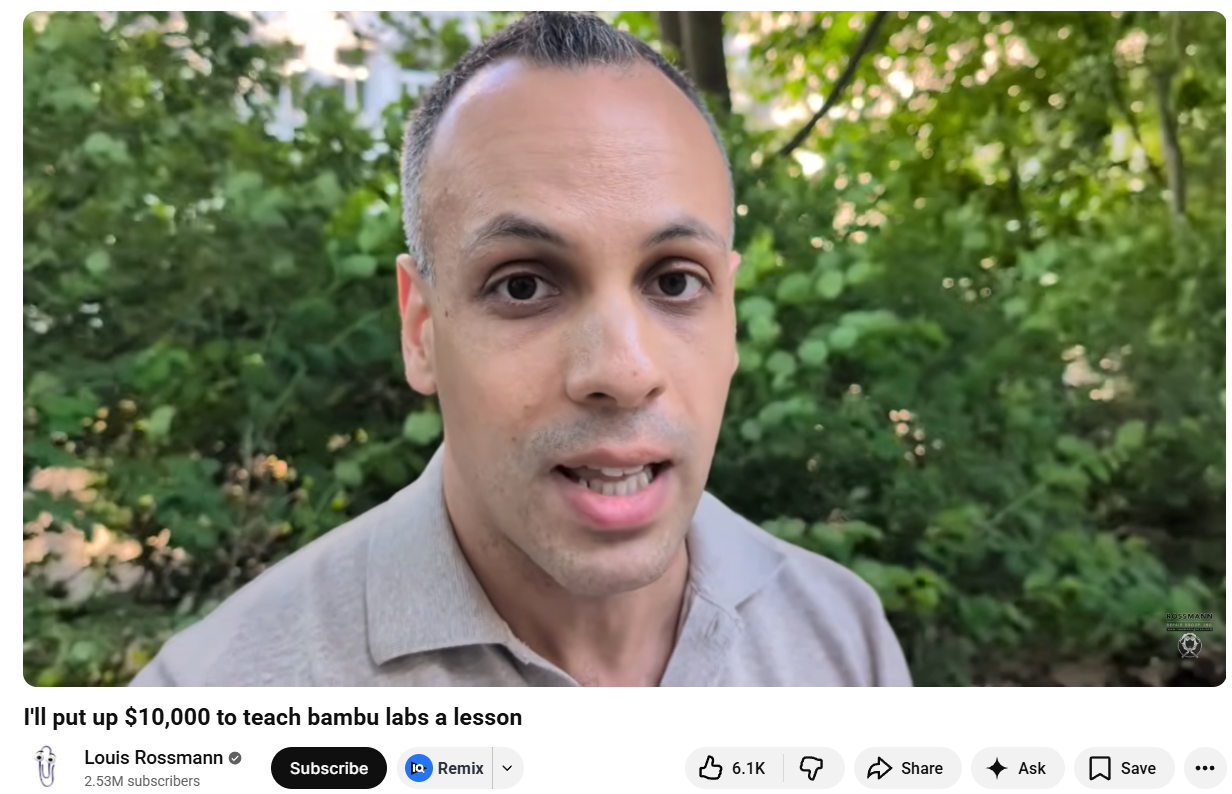
Right-to-repair advocate Louis Rossmann has offered to cover the legal fees of an OrcaSlicer developer facing legal threats amidst an escalating controversy with Bambu Labs. This financial support aims to protect open-source contributors as tensions rise between the 3D printing community and hardware manufacturers over software licensing disputes.
Comments2026-05-09
Internet Archive Switzerland
2026-05-09Readers suggest the Internet Archive should transition to a decentralized network of independent organizations that mirror data without sharing DMCA takedown notices. By leveraging distributed peer-to-peer protocols, the archive could better protect its massive repository from centralized legal attacks and ensure long-term preservation.
Comments2026-05-05

Google Chrome is silently downloading a 4 GB Gemini Nano AI model onto users' devices without consent, automatically re-downloading the file if it is manually deleted. A new article examines the legal and environmental implications of this practice, noting its massive scale and complete lack of user opt-out mechanisms.
Comments
Meta and CEO Mark Zuckerberg are facing a lawsuit from five publishers and author Scott Turow over allegations of massive copyright infringement. The plaintiffs claim the company illegally copied millions of books, articles, and other works to train its AI systems, specifically alleging that Zuckerberg personally authorized the practice.
Comments2026-05-04
Notepad++ creator Don Ho is demanding the immediate takedown of an unofficial Mac port website for trademark infringement. This legal action has sparked a debate within the open-source community, with some users sympathizing with the unauthorized developer due to the lack of an official Mac version. However, others clarify that trademark law strictly protects brand provenance and cannot be overridden by consumer demand.
Comments