Defense Tech Startup News
Defense has become one of the hottest areas in startup investing. Here you will find stories on companies building drones, autonomous systems, military AI, and secure infrastructure, along with the government contracts and venture rounds fueling them. The section also touches on the policy questions this new defense industrial base raises.
Expect coverage of large funding rounds at high valuations, contract wins that pit startups against established defense primes, and battlefield lessons that shape product roadmaps for drones and counter-drone systems. Procurement reform, allied cooperation, and export decisions form the policy backdrop to much of the news.
Interest in the sector has surged as geopolitical tension pushes governments to modernize faster than traditional contractors can move. Investors see a durable spending cycle, engineers face new questions about working on military technology, and policy watchers track how software companies are changing what armed forces buy.
2026-06-11

Data from 30 billion Pokémon Go scans has been utilized to train advanced spatial navigation technology for military drones. The massive crowdsourced dataset provides highly detailed mapping capabilities that are now transitioning from mobile gaming to the defense sector. This military application was made possible through a strategic partnership between Niantic Spatial and Vantor.
Comments2026-06-08
Despite a massive increase in data breaches, organizations continue to struggle with lax security practices because they face minimal consequences for failing to protect user information. The high cost of cybersecurity combined with a lack of financial liability disincentivizes companies from prioritizing robust data defense. Consequently, commenters argue that until strict accountability is enforced at the executive level for both corporate and government entities, the frequency of these leaks will only continue to rise.
Comments
2026-06-05

The Dutch government will require companies managing its DigiD digital identity platform to be European for all contracts after August 2028. The upcoming tender will be governed by the Defense and Security Procurement Act to better protect national security. This specific legislation strictly limits eligibility to European firms to minimize potential security risks.
Comments2026-06-04
Anthropic has released an open-source framework designed to enhance AI-powered vulnerability discovery and software defense. The customizable autonomous harness provides essential skills for threat modeling, automated scanning, triage, and patching. Developers can leverage this reference tool to significantly streamline the identification and resolution of code vulnerabilities.
Comments
A report by AOAV reveals that UK media outlets fail to disclose defense and technology industry ties in nearly 60 percent of cases featuring retired military experts. Presenting these figures as independent commentators without revealing their commercial connections obscures potential conflicts of interest in public debates surrounding war and military spending.
Comments2026-06-02

MAI-Code-1-Flash
2026-06-02Microsoft released MAI-Code-1-Flash, a 137B parameter mixture of experts model with 5B active parameters that the company claims significantly outperforms Claude Haiku on the SWE-bench Pro coding benchmark. Community critics accuse the company of cherry-picking weak opponents for comparison, arguing the model merely matches the performance of much smaller and more efficient open-source alternatives like Qwen. In defense of the release, some users highlight Microsoft's emphasis on decontaminated training data and clean licensing, which could offer better real-world generalization and reduced legal liability.
Comments2026-05-28
Although the original article aimed to critique a shell history scene in Tron: Legacy, the accompanying reader discussion focused almost entirely on international copyright laws and fair use defenses. Commenters debated the legal nuances of using film stills for critical review and discussed a creator's decision to move their content away from YouTube to avoid automated copyright strikes.
Comments2026-05-21
Readers criticize the defense of AI as a tool for unauthorized plagiarism at scale, arguing that automating the mass extraction of information creates qualitative harms that cannot be equated to individual learning. The discussion also highlights broader frustrations with online privacy, noting the stark contrast between easily accessible public records and the nearly impossible process of actually deleting personal information from the internet.
Comments2026-05-11

Researchers have developed three novel antibiotics using compounds derived from scorpion venom and habanero peppers. These new treatments could provide a crucial defense against tuberculosis and other drug-resistant bacterial infections.
Comments2026-05-10
Debian must ship reproducible packages
2026-05-10Debian's push to mandate reproducible packages has sparked community debate over whether the achievement is worth the increased contribution burden. Supporters praise the move as a vital security measure to protect build infrastructure from malicious compromises, while skeptics argue it offers little defense against compromised upstream source dependencies. However, proponents point out that recent supply chain incidents like the xz utils backdoor demonstrate that securing the build pipeline itself remains essential.
Comments2026-05-08
Google has introduced Google Cloud Fraud Defense as the next evolution of reCAPTCHA, featuring a new QR code scanning challenge for user verification. Despite the updated branding, the new tool is essentially just a repackaged version of the existing WEI technology.
Comments2026-05-06

At Google Cloud Next '26, the company introduced Google Cloud Fraud Defense, a new trust platform built specifically for the agentic web. This launch serves as the next evolution of reCAPTCHA, aiming to deliver enhanced security for modern digital interactions.
Comments2026-05-04

A critical multi-tenant authorization vulnerability lacking basic tenant isolation was discovered in a Department of Defense contractor's system, leading to the exposure of sensitive military training data. The issue was resolved following a five-month responsible disclosure timeline.
Comments2026-04-27
The woes of sanitizing SVGs
2026-04-27The persistent security vulnerabilities associated with sanitizing SVGs can be effectively mitigated by implementing strict Content Security Policies. Developers can reliably secure untrusted content by combining iframe sandboxing with HTML meta tags to enforce permanent, restrictive CSP rules. Although currently underutilized due to poor documentation and minor UX friction, this sandboxing approach provides a highly robust defense against malicious scripts and phishing.
Comments2026-04-26
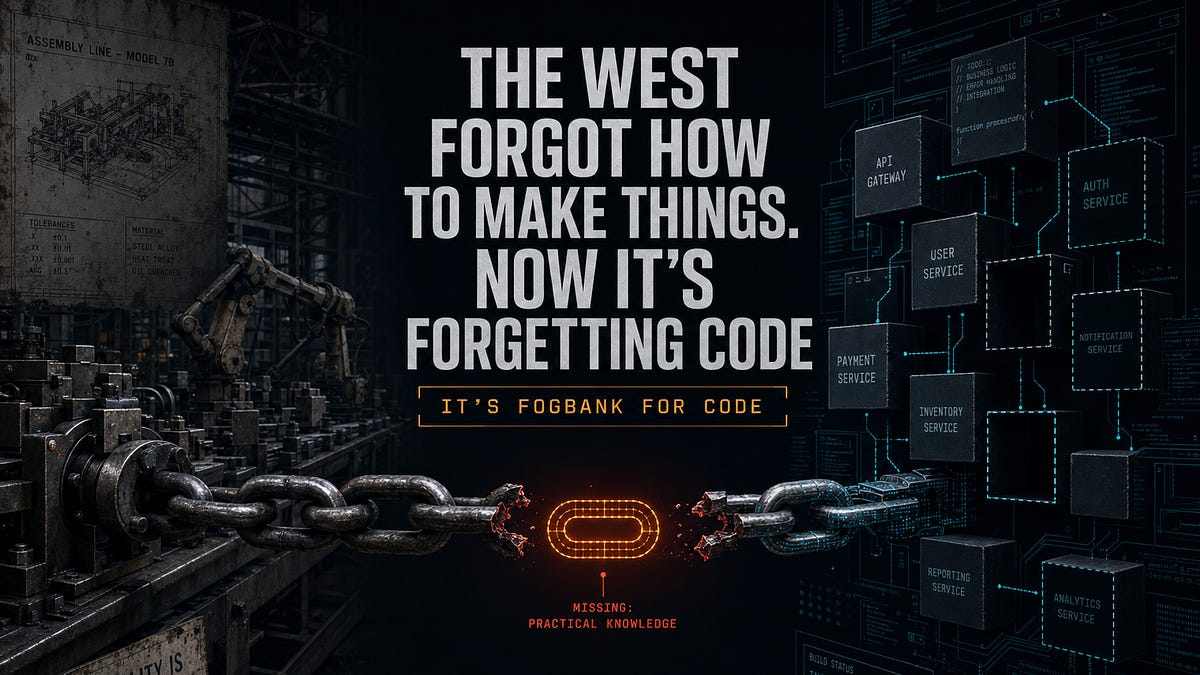
The West is rapidly losing its software engineering capabilities, mirroring the historical decline of its physical manufacturing and defense industries. This erosion of critical coding skills is following the exact same timeline and trajectory as the previous loss of physical production.
Comments2026-04-21

A recent OAuth supply chain compromise at Vercel highlights how trusted third-party applications and platform environment variables can bypass traditional defenses to significantly amplify a breach's impact. This incident underscores the critical need for developers to reassess software supply chain risks and the underlying design tradeoffs of modern PaaS environments.
Comments2026-04-15

Modern cybersecurity now resembles a computational proof of work model as defenders battle automated AI-driven threats. This new paradigm forces security teams to continuously outspend attackers in terms of processing tokens, raising critical concerns about the long-term sustainability of cyber defenses.
Comments2026-04-14

OpenAI is expanding its Trusted Access for Cyber program by granting vetted defenders access to its newly introduced GPT-5.4-Cyber model. The initiative also includes strengthened safety protocols to address the rapidly evolving capabilities of artificial intelligence in the cybersecurity landscape.
Comments