AI Tech Developments News Past 24 Hours June 2026
Artificial intelligence evolves so quickly that a single day can bring several major announcements. This section follows AI developments in a past-24-hours format, highlighting what changed around June 2026.
Typical stories include new language and image model releases, benchmark results, AI agents and developer tools, funding rounds for AI startups, chip supply news, and regulatory decisions affecting AI companies.
Tracking AI day by day helps readers separate meaningful progress from hype. Developers, product teams, investors, and policymakers use this coverage to keep up with a field that rarely slows down.
2026-10-09

What should we tell our students?
2026-10-09Mathematician Álvaro Lozano-Robledo addresses student concerns regarding the impact of artificial intelligence on their academic and professional futures. In a recent guest post, he advises learners to remain calm and continue studying mathematics. He emphasizes that despite rapid technological shifts, a strong foundation in math retains its enduring value.
CommentsThis opinion piece explores the reasons behind the tech industry's surprisingly muted reaction to the release of DeepSeek 4.1 Flash. By offering unconventional perspectives, the author questions whether this lack of widespread hype signifies a maturing AI market or a fundamental misjudgment of the technology's capabilities.
Comments
Yes, and
2026-10-09In his latest essay, Carson Gross addresses the anxieties of young computer science students regarding the rapid rise of artificial intelligence. He advises them to adopt a collaborative mindset, encouraging them to embrace and build upon AI advancements rather than fearing for their future careers.
Comments
A coalition of major tech companies and government agencies has committed $1.8 billion to expand the Virtual Biology Initiative. This collaborative investment from organizations including Google, Meta, the NIH, and the DOE will focus on creating open, AI-ready biological datasets to accelerate scientific research.
CommentsA recent Hacker News discussion explores popular self-hosting applications for cheap virtual private servers, with users recommending tools for media streaming, photo backups, and code repositories. The conversation also sparked a debate over the privacy implications of Tailscale and the ethics of media piracy, which participants jokingly euphemized as collecting Linux ISOs. Some users defended paying for high-quality media, arguing that piracy and artificial intelligence are actively harming art and culture.
CommentsStepFun's new flagship agentic model, Step 5 Preview, is now available on OpenRouter with a sparse Mixture-of-Experts architecture featuring 600 billion total parameters and a one million token context window. The model supports up to 64,000 output tokens and is priced at $1 per million input tokens and $2.70 per million output tokens.
CommentsEdi Life OS is a new self-hosted dashboard designed to help users track personal habits, goals, finances, and tasks. The open-source project features a built-in MCP server, allowing users to seamlessly integrate their personal productivity data with AI assistants.
Comments
Jevman is a new project that features six AI decision models playing Pac-Man in real time against classic arcade ghosts. Users can watch the algorithms navigate the maze, check a leaderboard to see which model performs best, or play against the AI themselves.
Comments
A North Carolina man has been sentenced to 18 months in prison for fraudulently collecting millions in music streaming royalties. Michael Smith used automated bots to artificially inflate the play counts of AI-generated songs. He was convicted of conspiracy to commit wire fraud by the US Justice Department for the scheme.
Comments
A developer challenged Claude Opus 5.5 and GPT-6 Astra to visualize Italo Calvino's novel Invisible Cities using Three.js from a single prompt. The six-hour experiment evaluates how these advanced AI models handle complex tasks in design, user experience, and interactive data visualization. Ultimately, the project showcases the growing potential of AI to generate explorable web experiences with minimal human intervention.
Comments2026-10-08
Docker Agent
2026-10-08Docker has introduced Docker Agent, a new platform developed by its engineering team to serve as a dedicated builder and runtime for AI agents. This release provides developers with a streamlined environment to create, manage, and deploy artificial intelligence applications.
Comments
Sharing AI progress in mathematics
2026-10-08OpenAI has published new results on open mathematical problems solved by an internal frontier model, demonstrating significant AI progress in the field. To support the broader research community, the company also released the associated Lean proof formalizations and detailed documentation on GitHub.
Comments
Navier–Stokes Lost in Translation
2026-10-08A new study using the Navier–Stokes equations demonstrates that successfully verifying AI-generated mathematical proofs in formal systems like Lean does not guarantee the original natural language proof is correct. Researchers found that critical translation errors frequently occur during the AI autoformalisation process. This highlights a major limitation in relying solely on machine verification to validate human-readable mathematical breakthroughs.
Comments
Google Playground is a new platform that allows users to build and play custom games using simple text prompts. The tool requires no coding experience, enabling anyone to easily create their own playable experiences.
Comments
Meta and Microsoft are rolling out new internal policies to limit employee access to Claude AI. This move reflects a broader trend among major tech companies to carefully regulate and manage the integration of generative AI tools in the workplace.
CommentsSynthID Detector
2026-10-08Readers discussing Google's SynthID detector expressed frustration with current AI-generated content detection tools, criticizing previous implementations for requiring authentication or relying on inefficient methods like querying other AI models. Although some initially hoped the tool would identify audio synthesizer settings, the conversation quickly shifted to the broader unreliability and poor design of existing AI detection systems. Ultimately, users remain skeptical of these platforms, noting that relying on them still requires blindly trusting artificial intelligence.
Comments2026-10-07
Sharing AI progress in mathematics
2026-10-07Recent AI advancements are reportedly solving major mathematical challenges, including Barnette's Conjecture and a potential breakthrough regarding the Quasi-Riemann Hypothesis. While AI models are now tackling dozens of top open math problems, these rapid developments evoke complex emotions among human researchers who have dedicated their lives to studying these puzzles. Furthermore, the mathematical community is actively debating whether these AI-generated solutions rely on brute-force computation or genuine, novel insights.
Comments
Mistral Large 4
2026-10-07Mistral has announced the release of Mistral Large 4, positioning it as the most powerful AI platform built for enterprise use. The new system allows organizations to customize, fine-tune, and deploy AI assistants, autonomous agents, and multimodal applications. By utilizing open models, it provides businesses with highly flexible and robust AI integration capabilities.
Comments
Penguin Mail is a new open-source email client for Linux built with Rust that includes AI capabilities. The fast, locally hosted application supports Gmail, Microsoft, IMAP, and POP3 accounts. It also integrates calendar and contacts management into a single unified interface.
Comments
EmbeddingGemma 2 is a newly introduced open and lightweight multimodal embedding model designed for developers. It is specifically optimized to support privacy-first use cases, providing a secure and accessible tool for building advanced AI applications without compromising user data.
CommentsReaders discussing a new suggested message feature in Claude Code note that it often frustratingly suggests reverting unwanted changes the AI made autonomously. While users debate the jarring all-lowercase formatting of these automated prompts, many suspect the feature is actually designed to harvest frictionless user feedback for future model training. Ultimately, the discussion highlights the irony of an AI tool where the underlying model appears to be the primary beneficiary of the user interaction.
CommentsOpenTPU is a newly released open-source AI accelerator that was entirely developed by artificial intelligence, featuring a comprehensive repository that includes its RTL, ISA, simulator, compiler, and profiler. The accelerator has already demonstrated its capabilities by successfully running large language models such as Qwen3, LFM2.5, and Qwen3.5 on a Kintex-7 PCIe card.
CommentsLLMs may have helped my RSI
2026-10-07A personal tech blog post details how the author's Repetitive Strain Injury improved after incorporating Large Language Models into their daily workflow. The writer explains that relying on AI for text generation and coding tasks significantly reduced the physical strain on their hands and wrists.
Comments
Utah has approved a program allowing artificial intelligence to examine patients and prescribe medication without human oversight. The initiative is currently limited to a one-year pilot focusing exclusively on treating mild-to-moderate acne.
CommentsResearchers have introduced UniEvo-VL, an on-policy self-distillation training recipe designed to enable multimodal models to continuously self-improve. This novel methodology allows artificial intelligence systems to autonomously refine their capabilities and enhance overall performance by learning from their own generated outputs.
CommentsTreg (OpenRouter for Tools)
2026-10-07Treg is a new project designed to act as an OpenRouter equivalent specifically for AI agent tools. It aims to simplify tool integration for developers building autonomous agents. The project is currently supported by an active Discord community for developer collaboration.
CommentsSouth Korea reports that AI agents were likely used to breach its banking sector, drawing skepticism and highlighting the nation's history of legacy security vulnerabilities. While some institutions avoided the attack by strictly isolating internal networks from external staff, experts warn that integrating AI could inadvertently expand these attack surfaces. The incident raises broader concerns about how automated systems might complicate financial operations and create new vectors for cyberattacks.
Comments2026-10-06

Reflection has introduced Beam, a new 501B parameter open-weight AI model designed to democratize artificial intelligence. This release aligns with the broader initiative to make advanced machine learning capabilities open and accessible to everyone.
Comments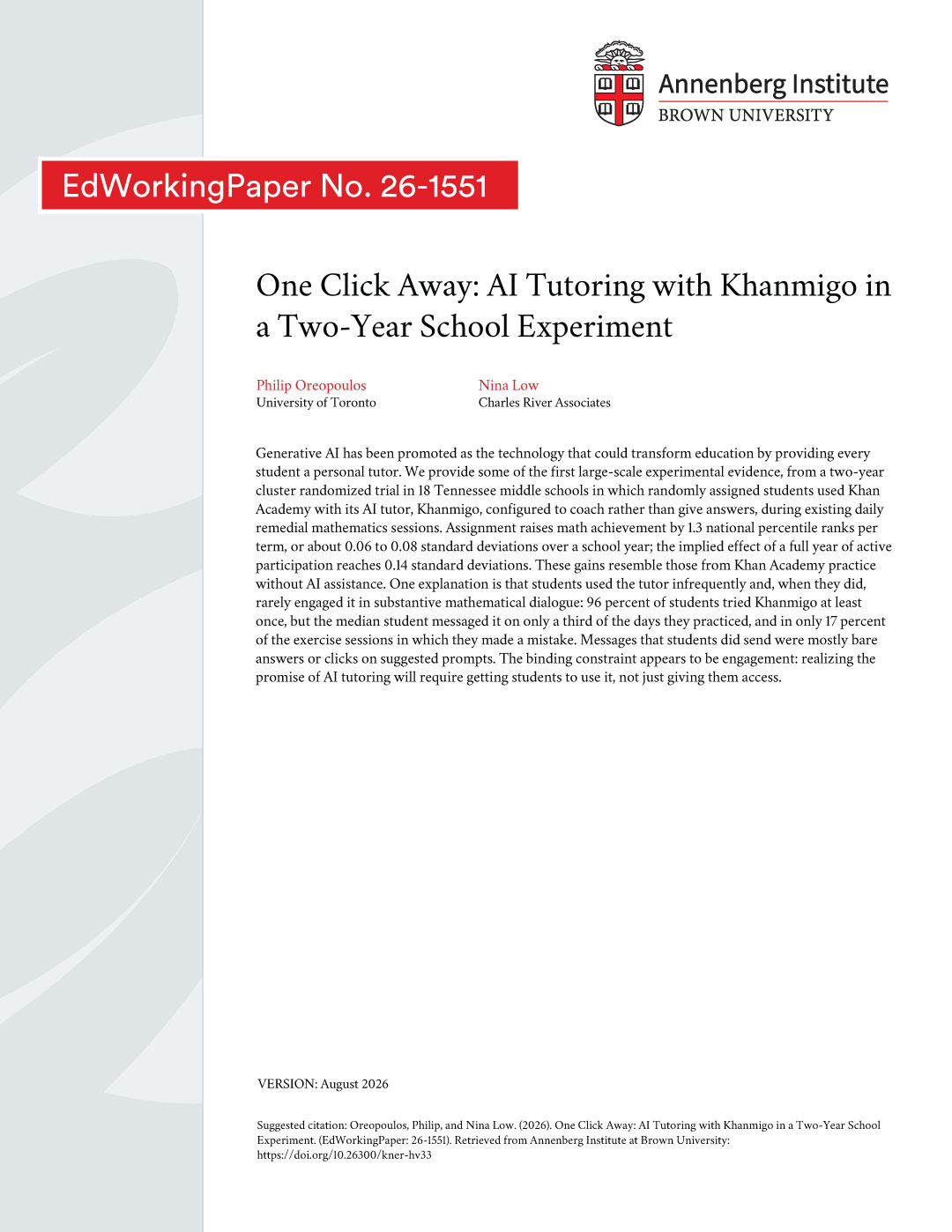
A two-year randomized trial across 18 Tennessee middle schools evaluated Khan Academy's AI tutor, Khanmigo, during daily remedial math sessions. The AI was specifically configured to coach students rather than simply giving answers. This large-scale experiment offers some of the first experimental evidence on whether generative AI can effectively deliver personalized educational tutoring.
Comments
A team of Claude Opus 5.5 AI agents has identified two room-temperature magnetic semiconductor candidates for next-generation computer memory. Both materials exhibit zero net magnetism while successfully sorting electrons by spin, featuring one newly designed compound and a material originally created in 1999. The team has released their complete calculations, code, and known caveats to support further research.
Comments