Aging Tech News
As populations grow older, a wave of companies is building technology for seniors and the people who care for them. Here you will find news on age-tech startups, remote health monitoring, longevity science, and accessible product design. The section also tracks investment flowing into this fast-growing market.
Stories in this section often cover fall-detection wearables, medication management apps, robotics for elder care, and research into extending healthy lifespan. Funding rounds for age-tech companies appear regularly, as do partnerships between technology firms, insurers, and healthcare providers aimed at helping people live independently for longer.
The topic matters because demographic change is one of the most predictable forces in the global economy. Caregivers, healthcare professionals, product designers, and investors all follow age-tech closely, since the market for products serving older adults keeps expanding while the workforce available to provide care keeps shrinking.
OpenJev
2026-09-19A new tool called OpenJev enables developers to run typed option logits and generate autoregressive JSON entirely locally using open-source models. By leveraging WebGPU for hardware acceleration, the project provides a fast and efficient solution for structured data processing directly on local devices.
CommentsBend is a new high-performance programming language designed to execute efficiently on both CPUs and GPUs while leveraging mathematical proofs to prevent errors. This innovative approach ensures greater reliability and safety in AI model development by eliminating common mistakes directly at the language level.
Comments

The DeepMind Institute
2026-09-17DeepMind has launched The DeepMind Institute, a new initiative dedicated to sharing bold and well-evidenced insights on artificial general intelligence. Leveraging its pioneering expertise in the field, the institute aims to provide forward-thinking research and perspectives on the future development of AGI.
CommentsSaving Jet Fuel
2026-09-16This tech update explores strategies for saving jet fuel while providing essential benchmarks and optimization tips for big data ecosystems. It also offers practical advice for leveraging cloud platforms like AWS and Google Cloud, alongside data processing tools such as PostgreSQL, Spark, and Python.
CommentsA newly launched interactive world map digitally catalogs and visualizes the diverse stories and folklore told by cultures across the globe. The tech-driven platform allows users to seamlessly navigate and explore the rich narrative heritage of different societies. By combining geography with digital storytelling, the tool offers an engaging way to discover how human myths and legends intersect worldwide.
Comments
Signal will soon allow users to register for the encrypted messaging app without a phone number by utilizing zero-knowledge proofs. This highly requested feature will enable alternative sign-up methods like email or usernames, improving privacy and accessibility for users of all ages.
Comments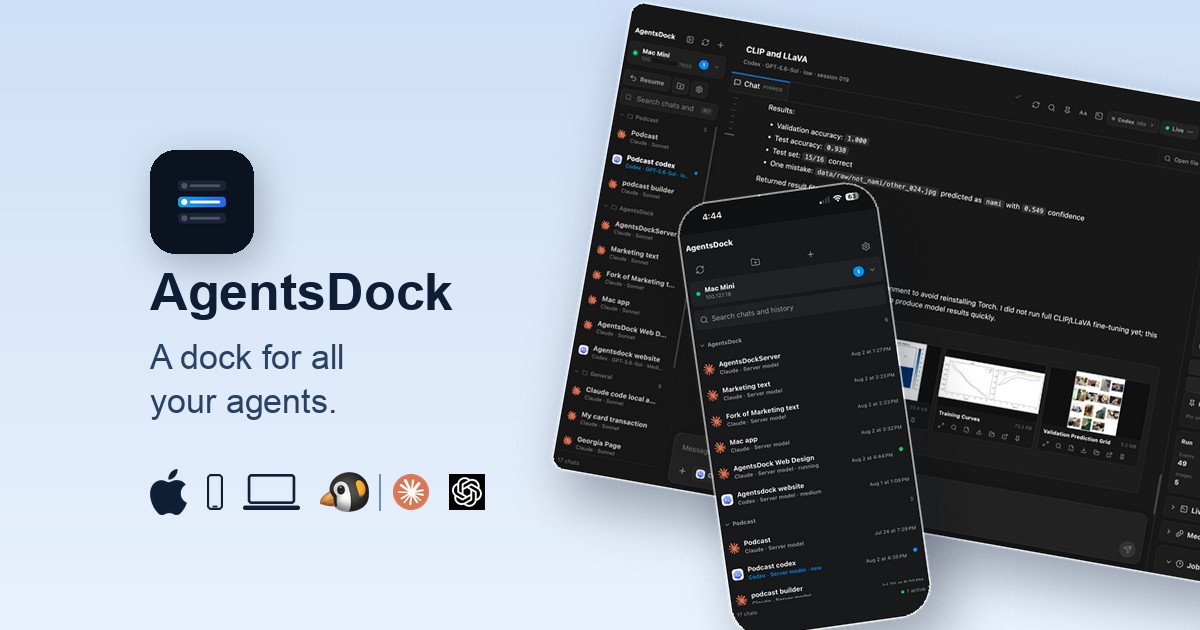
AgentsDock is a new self-hosted workspace designed specifically for agentic AI research. It serves as a centralized IDE for managing AI tools like Claude Code and Codex, offering features such as persistent chats, scheduled jobs, and integrated terminals.
CommentsGrapheneOS has released a completely rewritten version of its default Messages app for its privacy-focused mobile operating system. The open-source application is now available to users, and developers can contribute to its ongoing development via the project's GitHub repository.
CommentsResolveHQ is a newly launched open-source helpdesk and shared support inbox for small teams that was recently showcased on Hacker News. The application features a fully cloud-native architecture built entirely on the Cloudflare ecosystem, leveraging Workers, D1, R2, and Queues.
CommentsDeveloped by UC Berkeley, Snap is a blocks-based programming language designed to make computer science education engaging for both children and adults. The platform has achieved significant global reach and is currently utilized by hundreds of thousands of programmers worldwide.
Comments
An engineer shares five years of experience managing petabyte-scale ClickHouse clusters in production. The retrospective details the practical lessons, successes, and failures encountered while operating the database at a massive scale. It provides a valuable, real-world guide for teams deploying and maintaining ClickHouse in demanding environments.
Comments
OpenAI Agents API
2026-09-11OpenAI has released a new Agents API allowing developers to create durable, cloud-based autonomous agents. By leveraging a managed Codex harness, the API provides a persistent execution environment designed to handle long-running, complex tasks reliably.
CommentsResearchers are leveraging advanced remote sensing techniques, specifically false-color and infrared satellite imagery, to uncover hidden ancient archaeological sites and historical landscapes. By manipulating spectral bands to highlight features invisible to the human eye, this method transforms raw satellite data into detailed maps of the past. This breakthrough underscores the immense value of non-visible light spectrums in revealing the Earth's buried history.
Comments
Muse – Meta’s personal AI agent
2026-09-09Meta has introduced Muse, a new personal AI agent designed to assist users with a variety of everyday tasks. The tool aims to streamline daily workflows and boost overall productivity by seamlessly managing routine activities.
Comments
A user recently encountered an annoying bug on YouTube and decided to use ChatGPT to investigate the issue. By leveraging the AI chatbot, they were able to successfully troubleshoot the problem and find actionable answers. This highlights the growing utility of generative AI for everyday technical troubleshooting.
CommentsGrapheneOS is releasing a major update today that overhauls its default Messaging app with a modern user interface built in Android Compose. The update also refreshes the secure clipboard and includes numerous other improvements and bug fixes across the operating system.
CommentsAsk HN: How do you manage skills files?
2026-09-07In a recent discussion on managing AI agent skill files, developers shared strategies for centralizing and distributing custom prompts to improve coding workflows. While participants debated whether advancing AI models will eventually make general-purpose skills obsolete, there is consensus that context-specific skills remain vital for efficient task execution. Consequently, developers are adopting various organizational methods, including personal repositories, dotfile managers, and shared team directories, to keep their skill collections streamlined and accessible.
Comments
A 2011 report investigates the Black Hole of Los Alamos, a channel used for selling surplus nuclear research materials from the national laboratory. The piece sheds light on the broader challenges of managing, tracking, and disposing of excess scientific equipment and sensitive resources.
CommentsHacker News readers discussing the appeal of statistics textbooks note that traditional texts are often too dry and fail to build early intuition for complex concepts. The community suggests that a visually engaging, beginner-friendly book connected to modern technological breakthroughs would successfully make the subject accessible and interesting to a wider audience.
Comments
The CHC5 open camera platform features a modular design that allows users to easily interchange various sensor PCBs. A recent overview compares the technical specifications of the multiple image sensors available for the system, highlighting the hardware flexibility developers have to customize their imaging setups.
CommentsConnecting every app to every other app
2026-09-05New technologies leveraging DCR and CIMD are solving the complex n-squared scaling problem inherent in traditional OAuth integrations. By streamlining authentication and eliminating massive integration overhead, these solutions pave the way for seamless connectivity between every application.
CommentsHow to Create a Tor Exit Node (2015)
2026-09-05Readers are strongly discouraging individuals from following a 2015 guide on setting up a Tor exit node, citing severe legal, technical, and ISP-related risks. Commenters warn that exit node operators face constant law enforcement scrutiny, malware infections, and IP blacklisting. Instead of running exit nodes, they suggest that network supporters run safer middle relays or donate to established organizations.
Comments
New findings suggest that aging brains do not simply lose memories, but rather blend them together. Older individuals tend to replay experiences too broadly, which causes distinct memories to mix instead of fading away completely.
CommentsTech enthusiasts are increasingly scavenging second-hand markets to refurbish vintage, high-end test equipment like the Tektronix TDS7104 oscilloscope and Rohde & Schwarz signal generators for a fraction of their original cost. By repairing aging hardware and replacing obsolete components, hobbyists are breathing new life into these powerful tools for specialized engineering tasks and high-speed data analysis. Some creators are even taking these restorations a step further by gutting the classic chassis to build custom, retro-modern personal assistants powered by AI models.
CommentsSnakes and Ladders
2026-09-01A reader discussion on cooperative board games highlights the frustration of dominant players turning collaborative play into a rigid optimization problem. Participants argue that games featuring hidden information or chaotic elements are more engaging because they prevent a single person from dictating the group's strategy. The conversation also notes that classic games like Snakes and Ladders remain uniquely valuable for teaching children social skills and how to handle collective loss.
Comments
Researchers have published an arXiv paper detailing the computational algorithms used to calculate the longest unbroken straight-line paths across the Earth's continuous landmasses and oceans. By leveraging advanced optimization techniques and great-circle navigation, the study highlights the complex intersection of geographic data analysis and algorithmic problem-solving.
CommentsSQLite as a Document Database (2020)
2026-08-30Readers discussing the use of SQLite as a document database share practical strategies for storing JSON, managing backups, and implementing change data capture. The conversation also sparks a broader debate on data modeling, contrasting the natural, self-contained hierarchy of document databases with the analytical power of relational structures. Ultimately, participants note that the term document database has evolved to simply mean a JSON blob, shifting away from its original meaning of self-contained, non-relational data.
Comments
A recent article on Rust's typestate and newtype patterns sparked reader discussions about leveraging the language's strict type system to make invalid states unrepresentable. Developers debated the practical trade-offs of implementing these functional state machines, comparing the use of generic ticketing and wrapper types to enforce strict function call orders against simpler trait-based approaches. The conversation highlighted the ongoing challenge of balancing compile-time safety with code verbosity in complex Rust applications.
CommentsA new open-source project named Open Oscar Server enables users to self-host an instant messaging server compatible with classic AIM and ICQ clients. Written in Go, this independently developed tool revives the nostalgic messaging protocols without any affiliation to or endorsement from AOL.
Comments
Quantifying Colour
2026-08-30This visual guide breaks down the CIE 1931 colour spaces, illustrating the foundational mathematical model used to quantify human colour perception. By mapping out these historical standards, the piece offers valuable insights for developers and designers working with modern digital displays and imaging technologies.
Comments