Software Tech News
2026-10-24

A new project called Local Wikipedia reimagines the traditional online encyclopedia by restricting its content to a strict geographic radius. The platform exclusively features articles about locations and topics within a half-hour walking distance from the user to foster community-driven documentation of immediate neighborhoods.
CommentsApple Music 404 Not Found
2026-10-24Apple Music's 404 error page features a hidden Breakout style brick game that pays homage to the classic iPod. This Easter egg serves as a nostalgic nod to the original arcade game developed by Apple founders Steve Jobs and Steve Wozniak for Atari. Readers discussing the feature also discovered that the hidden game can be accessed directly via a specific URL without triggering the error page.
Comments

CVE Tracker
2026-10-24The CVE Tracker provides a comprehensive daily count of published Common Vulnerabilities and Exposures records dating back to 1999. The database is automatically rebuilt every day using data directly from the official CVE list to ensure complete accuracy. This tool offers security professionals a reliable way to monitor both historical data and current daily vulnerability publication trends.
CommentsA newly disclosed remote code execution vulnerability dubbed http2shell affects the Brotli decoder across Node, Python, and .NET environments, sparking debate over its actual server-side impact. While some developers argue the threat is overblown because the vulnerable decoder is not enabled by default, others warn that hidden dependencies in popular libraries could leave many systems unexpectedly exposed. Commenters advise checking dependency trees and applying patches, despite frustrations over the sensationalized naming of the underlying memory bug.
Comments
The newly launched web discovery tool Swurf allows users to browse the internet by swiping through one website at a time. It features a personalized algorithm that learns user preferences to recommend new, non-repeating content without requiring an account.
Comments
Bringing uv and ty together
2026-10-24An experimental integration between uv and ty introduces first-class support for Python scripts across the command line and code editors. This update also features a unified uv check command to streamline developer workflows.
CommentsCorgi is a new multiplexer tool designed to manage both terminal sessions and AI agents from a single unified interface. It acts as a centralized helper to streamline developer workflows involving concurrent automated tasks. By combining terminal and agent management, the project aims to significantly reduce the overhead of running multiple background processes.
CommentsAnimations for System Builders
2026-10-24A recent article highlights the effective use of animations in system builder user interfaces to intuitively guide user attention to critical elements. Readers praised the design for purposefully highlighting important UI components without being distracting. However, some in the community questioned why the animations were implemented as videos instead of native HTML and discussed alternative tools like Motion Canvas.
Comments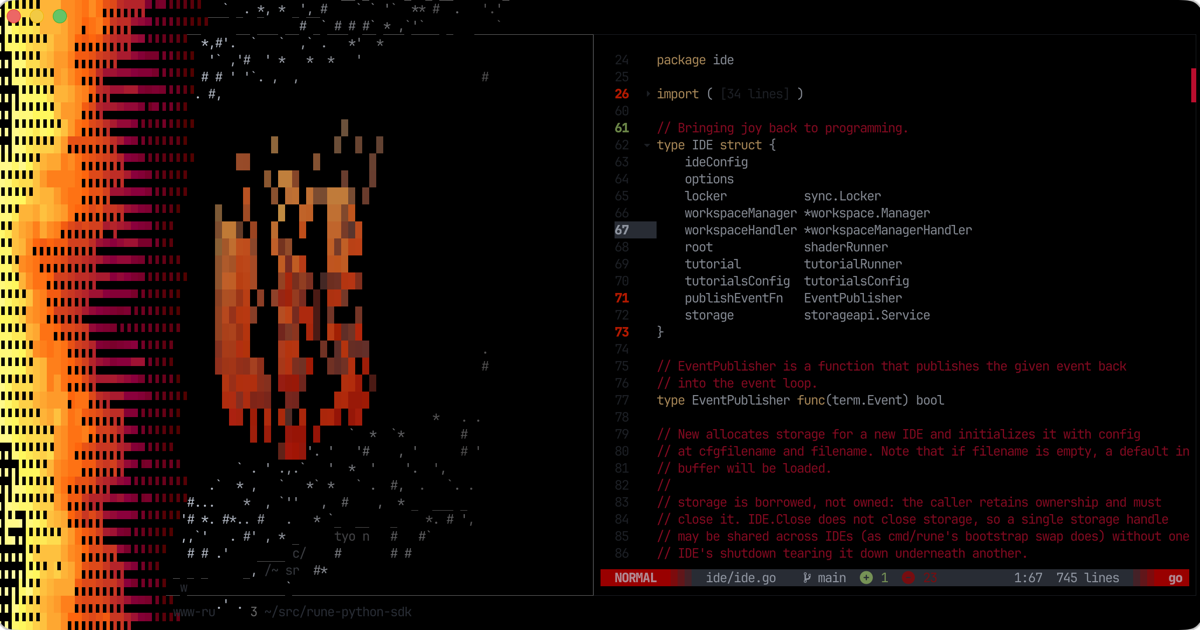
Rune 1.3 introduces TypeScript support, Helix editor integration, and Kitty graphics to enhance the platform. The update also adds a new browser package, animated activity tabs, and full workspace restoration including Agent conversations. This milestone marks the first release to feature community contributions.
CommentsNo Source Code? No Problem
2026-10-24A recent discussion highlights how AI-driven agentic coding is enabling developers to successfully recreate legacy software without access to the original source code, a feat recently demonstrated by reviving the classic game No One Lives Forever. While this capability is celebrated for preserving retro projects and challenging corporate monopolies, critics warn it could stifle open-source innovation and force companies to adopt restrictive, online-only business models to protect their intellectual property.
CommentsA new 2025 guide explores systemd-nspawn, a lightweight containerization tool that creates virtual machine-like environments on Linux without requiring a traditional hypervisor. The article provides a practical walkthrough for setting up and configuring these efficient containers. It highlights how this technology offers developers a streamlined and resource-friendly approach to modern system management.
CommentsDNS: A Replacement for Finger
2026-10-24A recent proposal suggests using the DNS protocol to replace the legacy Finger protocol for sharing personal status updates. Readers note that implementing this requires delegating DNS zones to third-party providers for real-time API updates. Additionally, the community warns that storing large amounts of data in DNS TXT records could expose servers to amplification DDoS attacks.
Comments
C vs. C#: racing VLC's Gaussian blur
2026-10-24A new benchmark compares the execution speed of C and C# by porting VLC's Gaussian blur video filter line-by-line into C#. Both implementations were optimized and tested within VLC 4, ensuring byte-identical output throughout the performance race.
CommentsTwelve Years of Distributed SQLite
2026-10-24The distributed database project rqlite is celebrating its twelfth anniversary since its initial release in September 2014. By placing a Raft consensus log in front of SQLite, the tool replicates writes across a cluster to ensure high availability and prevent data loss if a node fails.
Comments2026-10-23
Global digital trust company eMudhra Limited has announced its board's decision to voluntarily exit the global SSL/TLS certificate business. This withdrawal marks the end of the firm's operations in providing these web security certificates.
Comments
What Is Gridifcation
2026-10-23A 50-year analysis of Billboard hits reveals the rise of gridification, a technique that corrects human performances into machine-perfect audio. This technological shift highlights how modern music production increasingly prioritizes flawless, automated precision over natural human timing.
CommentsA security researcher apologized for prematurely disclosing a PHP remote code execution vulnerability after unknowingly breaking a coordinated disclosure embargo. The incident sparked a debate within the tech community about whether third parties who are not explicitly informed of an embargo are still ethically bound by responsible disclosure practices. Commenters analyzed the complexities of information asymmetry and the game theory behind coordinated security announcements to determine accountability.
Comments
What’s getting pwned right now
2026-10-23A cybersecurity tracker is currently monitoring 41 active security incidents worldwide, 19 of which are classified as critical. The report provides comprehensive details on each threat, including CVE identifiers, patch statuses, and links to the original advisories that exposed the breaches.
CommentsA new GitHub project called hackios-xnu-kernel is working to port Apple's XNU kernel to Android hardware. This open-source initiative aims to allow users to run the full iOS 16.5 firmware natively on non-Apple smartphones. Developers interested in the project can now create an account and contribute to the repository's ongoing development.
CommentsNVIDIA has introduced OpenShell, a secure and private runtime environment designed specifically for managing fleets of autonomous AI agents. The platform provides a safe operational space for multiple AI systems to execute tasks simultaneously while maintaining strict data privacy and security standards.
Comments
A farewell to Arc browser
2026-10-23The Arc browser will officially sunset on December 22, 2026, marking the end of the current platform. The company plans to transition its user base to a new next-generation web browser called Dia.
CommentsGNU Taler is preparing to launch its operations in Germany, introducing a new libre electronic payment system to the region. The platform enables users to conduct fully anonymous transactions while remaining strictly compliant with local tax regulations. This expansion marks a significant milestone for privacy-preserving and taxable digital reserves in Europe.
Comments
Xbox is implementing a new streaming pricing model that charges users 24 to 40 cents per hour to play games they already own. These time-based, a la carte fees are applied in addition to the original purchase price of the titles. As a result, consumers will incur ongoing hourly costs for digital games they have already paid to buy.
Comments
Developers have released earstrip, a new C++ and WebAssembly triangulation library designed to outperform the popular earcut algorithm. By rebuilding the ear clipping process from scratch, the library can triangulate 3.7 million real-world map polygons in just 489 milliseconds.
CommentsDocker is weird
2026-10-23Docker's creator joined a community discussion to clarify the platform's technical evolution from OpenVZ to LXC and eventually to an in-house Go implementation. The conversation also highlighted Docker's historical struggles with monetization and enterprise adoption, noting that the company's heavy open-source focus and initial neglect of enterprise needs allowed alternatives like Podman to gain traction.
Comments
Large language models are making formal software verification scalable by automating the proof of security properties in compiled code. For example, Claude successfully verified 123 open-source libraries and uncovered hidden bugs that had evaded detection for years.
CommentsA developer has published Hedra, a 3D open-world game they built entirely from scratch while in high school. The impressive project features a massive codebase of over 100,000 lines of code. The full source code is now publicly available on GitHub for the tech community to explore.
CommentsA new project named Uberblok transforms the complex internals of the OpenZFS file system into an interactive, room-by-room virtual museum. The tool visually maps each core architectural concept directly to its underlying source code. This provides developers with a highly engaging and intuitive way to explore the mechanics of ZFS storage architecture.
Comments
Revisiting a 1978 critique of natural language programming, a recent discussion debates whether AI models function as modern compilers or simply replace human software developers. Critics argue that unlike traditional compilers that precisely preserve formal semantics, AI translation of natural language is inherently ambiguous and can yield multiple interpretations. Ultimately, the thread highlights that both human engineers and AI require highly detailed, iterative communication to accurately transform vague specifications into functional code.
Comments