Regulation Tech News
2026-06-28

The proposed KIDS Act would require age verification for all internet users to protect minors, while also introducing government-directed content moderation and new encryption rules. Critics argue that despite its child safety goals, the legislation severely compromises digital privacy, free expression, and secure communications.
CommentsChoosing a Public DNS Resolver
2026-06-28A new interactive resource helps users select the most suitable public DNS resolver by comparing 30 global options. Users can evaluate these services across critical metrics including privacy, content filtering, security protocols, and regional jurisdiction. Additionally, the platform allows individuals to benchmark DNS over HTTPS speeds directly from their own web browser to ensure optimal network performance.
Comments
The European Union is advancing chat control legislation behind closed doors, prompting widespread concern that the policy will compromise end-to-end encryption for everyday citizens. Critics argue that forcing major messaging providers to implement message scanning will result in mass surveillance and privacy violations without effectively stopping criminals. Furthermore, users fear that upcoming EU interoperability mandates could ultimately be leveraged to enforce these surveillance backdoors across both centralized and decentralized communication platforms.
Comments2026-06-27

The U.S. government has permitted Anthropic to release the Mythos AI model exclusively to trusted U.S. organizations. This clearance arrives on the same day as a simultaneous limited release of a new model from rival AI developer OpenAI.
Comments
Starting July 1, California will prohibit streaming services from broadcasting excessively loud advertisements. The new legislation aims to protect viewers from jarring volume spikes during ad breaks. This follows a similar law in Illinois, giving platforms an increased incentive to normalize ad audio volumes across the board.
Comments
A combination of incoming international investment and restrictive local regulations is causing market prices to rise much faster than supply can meet. This growing economic disparity presents ongoing challenges for scaling critical resources and infrastructure in the technology sector.
Comments2026-06-26

Despite initially promising a hands-off approach to artificial intelligence, the Trump administration is increasing its oversight of the industry. As part of this shift, the U.S. government will now directly control and decide who is granted access to the advanced GPT-5.6 model.
Comments
Despite warnings from the Electronic Frontier Foundation regarding severe privacy and technical risks, the California State Assembly has approved a bill mandating surveillance software for 3D printers. The amended legislation ignores significant threats to consumer rights and speech, prompting advocates to renew their efforts to stop the mandate.
Comments2026-06-25

New internet regulations requiring age verification are effectively forcing Americans to undergo mandatory identity checks, ushering in a papers, please era of the web. Consequently, these measures will severely decimate online privacy for everyday users.
CommentsAnthropic has accused Alibaba and associated Chinese resellers of illicitly extracting Claude's capabilities to sell heavily discounted AI tokens to users blocked by regional restrictions. These operators bypass payment and identity barriers using bot networks and fraud, while subsidizing their deeply discounted rates by harvesting and selling model reasoning traces to domestic AI labs for training data.
Comments2026-06-24
An entrepreneur reveals that starting a business in Germany cost them €9,600 and 152 days of navigating severe bureaucracy. Despite registering two separate companies over a five-month period, the founder is still unable to issue a single invoice, highlighting the country's notoriously complex company formation process.
Comments2026-06-23
Critics argue that proposed online age verification mandates are a Trojan horse for mass surveillance, as enforcing these rules requires linking user identities to specific devices and accounts. While privacy advocates suggest digital identity wallets could authenticate users anonymously, skeptics warn that the underlying device attestations act as stable tracking identifiers that destroy online privacy. Furthermore, lawmakers' insistence on preventing credential sharing ensures these systems will inherently function as invasive surveillance tools.
Comments2026-06-22

Reports reveal that police chiefs have been misusing Flock surveillance technology to track and stalk women. This abuse of power highlights the urgent need for mandatory legal warrants to prevent law enforcement from exploiting mass tracking systems.
Comments
Never Give Them Your Face
2026-06-22This article argues against the use of facial recognition for age verification, warning that it creates a permanent biometric identity checkpoint in public life. The author urges users to refuse installing these invasive systems on their personal devices to protect their digital privacy.
Comments2026-06-21

Identity verification on Claude
2026-06-21Anthropic's implementation of identity verification for Claude is driving some international users away due to frustrations over US export controls and data privacy concerns. As affected subscribers begin migrating to alternative models like Mistral, the broader tech community is actively debating the company's underlying motives. Many question whether the new restrictions are merely a temporary compliance measure or a calculated strategy to achieve regulatory capture against open-weight AI.
Comments
FDA advisors have unanimously voted to approve Moderna's mRNA vaccine, overcoming recent political interference at the agency. This decisive approval follows controversy in February when a Trump administration official initially refused to review the vaccine.
Comments2026-06-20
In response to a proposed mandate requiring real ID for all internet traffic, readers are discussing extreme technical countermeasures to avoid future censorship and surveillance. Suggested tactics include building decentralized underground radio mesh networks, using cash-purchased hardware with immutable operating systems, and relying on specific end-to-end encrypted protocols to defeat metadata tracking. The discussion highlights a growing desperation within the hacker community, framing the fight against internet identification as a critical battle for fundamental civil rights.
Comments2026-06-19
Norway has implemented a near ban on generative AI for elementary school students aged 6 to 13, restricting its use for older teenagers to supervised settings in an effort to combat declining education scores. This policy follows a recent smartphone ban and has prompted widespread discussion about overhauling educational assessments, with many suggesting a necessary shift toward invigilated exams and project-based learning to verify true student comprehension.
CommentsGoogle is reportedly threatening to block Mozilla Firefox users from accessing its Workspace suite of applications. This potential restriction has sparked significant concern within the tech community regarding browser competition and the future of web compatibility.
Comments
A new bipartisan bill aims to protect lawful online speech by allowing individuals to sue government officials who coerce tech platforms and AI providers into censoring First Amendment-protected content. The proposed legislation also establishes a transparency system to track government communications with these digital intermediaries regarding user expression.
Comments2026-06-18

The Swiss parliament has lifted its ban on the construction of new nuclear power plants. This major policy shift is one of numerous critical issues being addressed during the ongoing summer session of the Federal Parliament in Bern.
Comments
Despite championing digital sovereignty and open-source software, European public institutions have recently migrated their social media accounts to W Social. This decision contradicts their stated goals, as W Social is a private, for-profit network owned by Swedish entrepreneurs that has quietly transitioned to a closed-source model. The move highlights a growing contradiction in the region's push for technological independence.
Comments
The Norwegian Data Protection Authority has fined electronics retailer Elkjop €1.8 million for enforcing unlawful forced consent practices within its loyalty club. The penalty arrives five years after a privacy advocate explicitly warned the company's data protection officer that the practice was illegal.
Comments2026-06-17
Although the US has temporarily delayed blacklisting DeepSeek while flagging over 100 other firms as security risks, developers continue to praise the AI model for its unmatched cost-effectiveness for everyday coding tasks. In community discussions, users express apathy toward data privacy concerns and heavily debate the model's capabilities against other frontier systems. Many developers note that while DeepSeek excels at routine programming, a temporarily available model named Fable significantly outperformed both DeepSeek and Claude Opus in complex software engineering and reasoning tasks.
Comments
U.S. science is in chaos
2026-06-17This report investigates the compounding political, funding, and structural challenges that have destabilized the United States scientific enterprise. It traces the historical and policy decisions that led to the current crisis. Ultimately, the piece warns that this ongoing turmoil threatens the nation's future global leadership in research and technological innovation.
Comments
Despite gathering 1.3 million signatures, the Stop Killing Games campaign has failed to secure new European Union legislation. The EU has declined to mandate that publishers keep discontinued digital titles playable, dealing a major setback for digital game preservation advocates.
Comments2026-06-16

Researchers clarified that the federal government's recent panic over a Fable 5 security research paper was based on a fundamental misunderstanding. Officials initially believed the paper detailed a system jailbreak, prompting widespread concern. However, a closer review revealed the study was actually focused on routine code fixes rather than bypassing security measures.
Comments2026-06-13
The US government has issued an export control directive to suspend all access to Fable 5 and Mythos 5. This mandate applies to any foreign national, regardless of whether they are currently located inside or outside the United States.
Comments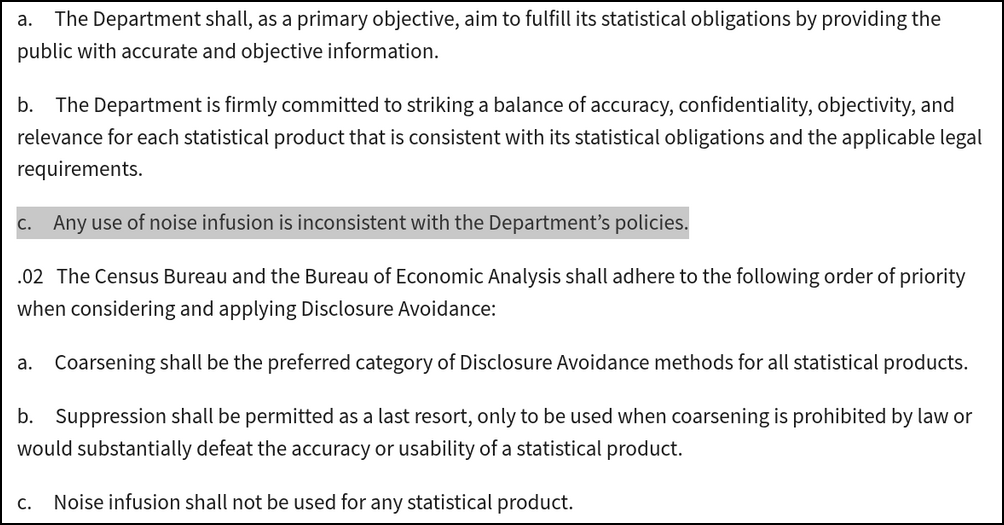
The Census Bureau has banned the use of noise infusion, a differential privacy technique, in its official statistical products. However, experts warn that removing this disclosure avoidance tool does not resolve the fundamental trade-offs between data accuracy and respondent confidentiality.
CommentsFollowing discussions between Amazon's CEO and U.S. officials, the White House has launched a regulatory crackdown on Anthropic's advanced Mythos AI models over national security concerns regarding their cybersecurity capabilities. While critics argue the intervention is arbitrary given the known vulnerabilities of all large language models, the administration maintains these specific models surpass previous safety thresholds and require mandatory government review. Tech industry observers are heavily criticizing this sudden, opaque regulatory approach as chaotic and detrimental to long-term market investments.
Comments