Programming Tech News
Submit2026-11-22
2026-11-21

Levent Alpöge released a proof of the Riemann Hypothesis as a Lean library on November 20, 2026. The Lean FRO and Mathlib Initiative issued a joint statement on the Lean verification of the result.
Comments
Slopstrap is a new CSS framework designed to make websites look intentionally hastily “vibecoded,” as if they were generated by an LLM. It bills itself not just as styling but as a “load-bearing accelerant” for achieving that unmistakably AI-made aesthetic.
Comments

Valkey 9.2 replaces the skiplist used for large sorted sets with a cache-friendly B+ tree, reducing memory overhead by up to 43%. The change also improves several ordered-set operations.
CommentsClawDOS – An AI coding agent for DOS
2026-11-21ClawDOS is an AI chat and coding harness designed for DOS, running on a real IBM PC 5160 with an 8088 processor at 4.77 MHz. It brings AI-assisted coding to extremely constrained vintage hardware rather than modern systems.
Comments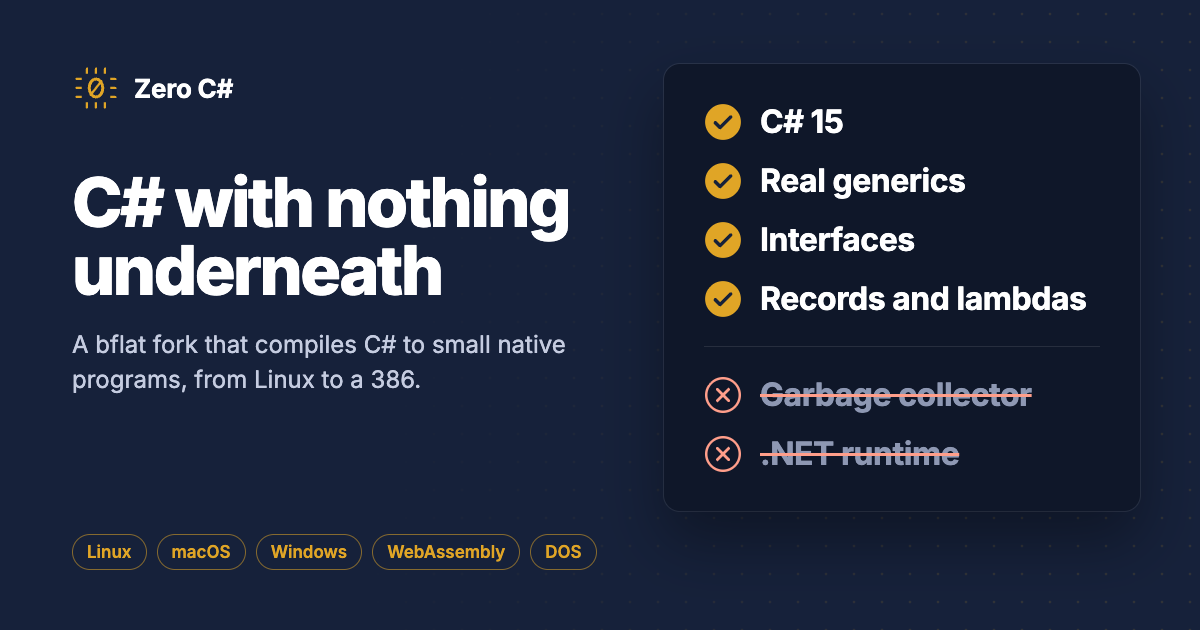
A Show HN project called Zero C# uses a fork of bflat to compile C# into small native executables with no .NET runtime and no garbage collector. It targets Linux, macOS, Windows, WebAssembly, and even DOS on a 386.
CommentsA tech worker with 15 years of experience and two years unemployed asked for advice, and commenters described a broken hiring front door where hundreds of applications yield few replies. The most effective paths reported were personal referrals and networking with former colleagues, plus staffing agencies and contract-to-hire roles. Commenters also suggested broadening location searches, targeting in-demand roles like solutions architect, and considering self-employment while the industry remains in crisis.
Comments
The article makes the case that deterministic simulation testing—running software against controlled, repeatable simulated environments—should be treated as a general-purpose technique rather than a niche practice. It argues the approach is accessible and useful to all developers.
CommentsReaders discussing a 2017 article say Clojure’s focus on data structures and transformations, plus its instant-evaluation REPL, had a lasting impact on how they program. Some credit it with building an appreciation for immutability and dataflow, while others say it left them wary of dynamic types and overusing maps and lists. The thread also points to continued ecosystem interest, including a Clojure SDK for Conductor OSS.
CommentsRCE in Gnupg
2026-11-21A remote code execution vulnerability in GnuPG’s GPGME component, discovered by Johan Carlsson, was disclosed on November 20, 2026, earlier than planned after GitLab moved up its update due to the Ruby2Shell bug. The flaw is especially serious for GitLab because it supports signed commits, and a GitLab Omnibus patch has been published.
CommentsA new report shows frontier LLMs can interpret executable binaries from only a hex dump, without tools, in a single reply. They can explain compiled programs, edit bytes to add features, and write working executables from scratch, suggesting new capabilities in low-level binary analysis and generation.
CommentsA new Show HN project called An ASCII cell aquarium brings a living microscope slide to the terminal by rendering cells as ASCII art. The project is hosted on GitHub under kborer/cells and invites contributors to its development.
Comments
Raylene Yung, drawing on a decade of scaling engineering and product teams at Facebook and Stripe, shares career-growth advice for engineers at every stage. Her guidance spans individual contributors through organization leaders, offering lessons for advancing in technical careers.
Comments
The piece introduces Defcon 5’s California Caravan Program/Zine through a personal recollection of the author’s first Defcon in 1994, when a friend invited them to an underground computer/hacker gathering in Las Vegas after reading about it on Usenet. The author recalls learning a little and being confused by a lot, capturing the early Defcon experience.
Comments
A developer has forked TuxGuitar into a tab editor for 17-EDO music, with support for tablature, notation, and playback. The project includes a detailed specification intended to be complete enough for a coding agent to rebuild it.
CommentsA new Show HN project, LZ0, introduces an asymmetric LZ compressor built around a minimal, zero-allocation decoder. The lightweight codec aims for ultra-fast decompression by avoiding malloc in the decoder, making it suitable for performance-sensitive or constrained environments.
CommentsA team working on exascale fusion simulation has been named a finalist for the 2026 Gordon Bell Prize. The recognition highlights advanced simulation work at exascale for fusion research.
Comments
PostgreSQL Extensions in Go
2026-11-21Developers can now build PostgreSQL extensions from plain Go code using TinyGo. Functions marked with //gopgext:function are automatically exposed as SQL functions, simplifying extension creation.
Comments2026-11-20
Anthropic’s Nasdaq debut
2026-11-20Anthropic’s Nasdaq debut sparked reader debate over AI’s impact on software engineering, with some warning that junior roles and traditional engineering careers are being displaced while others see LLMs as a tool for solving more real-world problems. The discussion also criticized current hiring practices, arguing that LeetCode-style interviews and many rounds are creating new barriers for aspiring developers.
CommentsA reported “java4shell” bug in September 2026 points to an OpenJDK JDK pull request fixing an AVX-512 Base64 decoder issue that overwrites the output buffer on a short padded tail. The fix, by albertnetymk, is in JDK main-line development.
CommentsOpenSSL has disclosed a critical buffer overflow vulnerability in EVP_EncodeBlock(), tracked as CVE-2026-121481 and rated CVSS 9.8. The flaw affects the widely used TLS and cryptography library, though the excerpt provides no further details on affected versions or exploitation. Users should watch for the OpenSSL advisory and apply patches promptly.
Comments
Pete Warden discusses the promise of local AI and open models, along with the evolving role of voice interfaces. He also shares his perspective on the future of hardware in an interview/podcast episode.
Comments
A discussion argues that engineers who stop writing code also lose proficiency at reviewing it, a view once widely accepted before 2022. The piece notes that this consensus has unexpectedly shifted, raising questions about how code review skills are maintained.
CommentsFFmpeg 9.1 'Gauss'
2026-11-20FFmpeg 9.1 “Gauss” adds ASTC image encoding/decoding, an extensively improved AAC encoder, an APV Vulkan encoder, LCEVC bitstream handling, and a graph-based bitstream filtering API. The release also expands codec and format support with DVD-Audio LPCM, DSD encoding, xHE-AAC via libfdk, JPEG Multi-Picture Format, and several new demuxers and decoders. New protocol and hardware features include libcurl and Windows handle protocols, NVDEC CUARRAY hwaccels, NVIDIA optical-flow interpolation, and D3D12 DirectML zero-copy inference.
Comments
Jujutsu Primer
2026-11-20A new primer offers a short tour of Jujutsu, an alternative version control system, covering its basic concepts and workflows. It gives developers a concise overview of how the tool works for those curious about trying it.
CommentsOnlook, a YC W25 startup, has launched an open-source AI-first design tool aimed at designers and visual engineers. The tool lets users visually build, style, and edit code with AI, emphasizing designing with real code rather than static mockups.
Comments
A new Show HN audio-to-MIDI model claims to be 60x more efficient while outperforming MuScriptor 1.3B and slightly beating Mirelo’s closed-source model. It uses only 20 million parameters and was trained without copyrighted recordings.
Comments
Postgres 19 introduces built-in REPACK and REPACK (CONCURRENTLY) commands to clean up table bloat. They let users reclaim space online without downtime, external extensions, or table locks.
Comments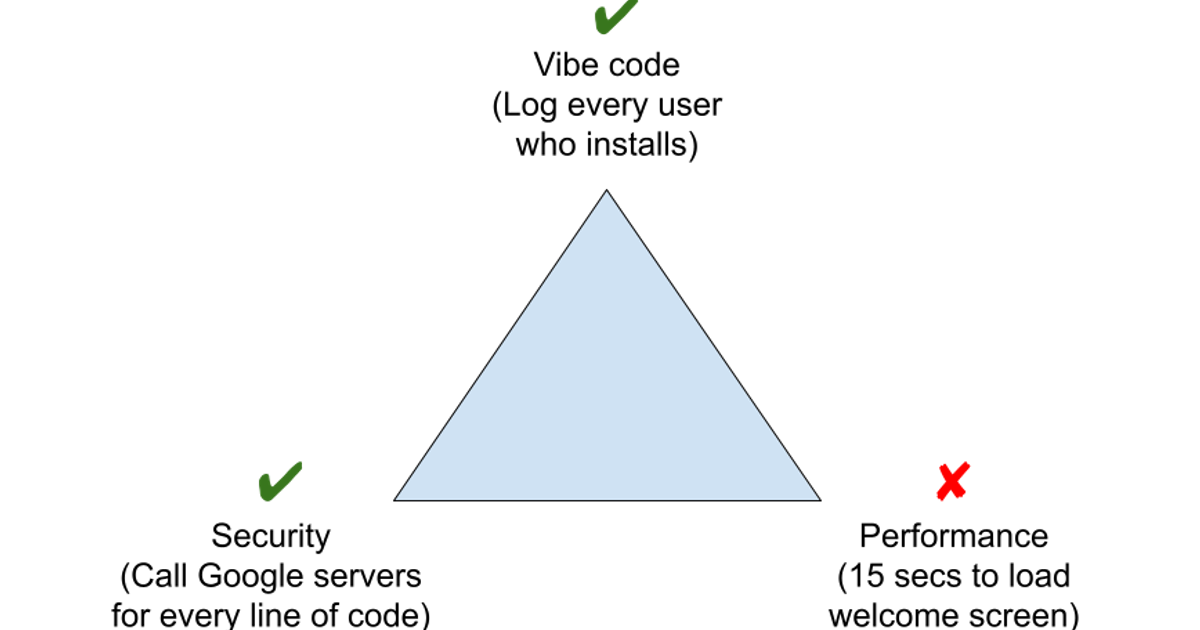
The piece argues that AI-assisted “vibe coding” frustrates developers only when they cling to the old hands-on role, since AI will execute instructions without pushing back on bad requirements or cleaning up test data. It suggests developers should shift to an architect mindset—setting direction and constraints—rather than continuing to work as traditional coders.
Comments
Weight-Space Programming lets developers construct neural networks by directly writing their weights, echoing the handcrafted approach common in 1990s research. Its writing process doubles as a history lesson, showing how early practitioners assembled networks manually rather than relying on modern training pipelines.
Comments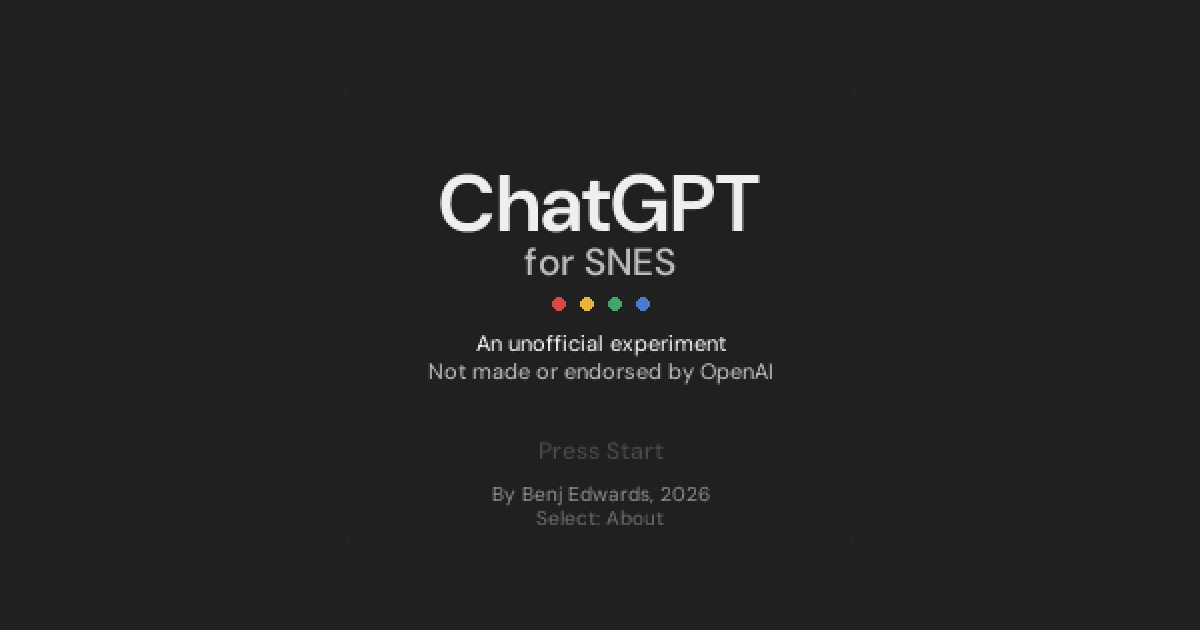
ChatGPT for SNES
2026-11-20Benj Edwards has created an unofficial experiment that runs a small language model on the Super FX chip of a Super NES cartridge, playable in a browser. The project is not made or endorsed by OpenAI.
Comments