Programming Tech News
2026-09-27

Go Concurrency Distilled
2026-09-27A newly released interactive mini-book titled Go Concurrency Distilled offers developers a hands-on approach to mastering concurrent programming in Go. The resource provides practical exercises and insights to help programmers efficiently leverage the language's powerful concurrency features.
CommentsReladraw is a new open-source diagramming language that gives users full manual control over element placement. Unlike tools with automated layouts, it allows creators to precisely dictate the exact position of every diagram component. The project is currently available for public contribution on GitHub.
Comments
The rise of AI-driven code generation is prompting a fundamental reevaluation of how programming languages are designed. As machines become the primary writers of code, future languages will likely evolve to prioritize machine efficiency and optimization over human readability. This transition will ultimately reshape the entire landscape of software development.
Comments
Researchers have reverse-engineered the historic Intel 8087 floating-point coprocessor to uncover the underlying hardware mechanics of its tangent calculation. The analysis reveals that the 1980 chip employs a more complex method than the standard CORDIC algorithm to compute trigonometric functions.
CommentsDrawgent is a next-generation social coding platform that integrates an AI coding agent directly onto a live Excalidraw canvas. This tool enables developers to collaboratively build and visualize software projects in real-time by seamlessly merging visual whiteboarding with automated code generation.
CommentsA new technique enables the generation of custom fonts where every large language model token is rendered at the exact same visual width. This ensures uniform text alignment and spacing in AI outputs, offering improved visual consistency for user interfaces and data visualizations.
CommentsA new introduction to modern Object Pascal has sparked nostalgic discussions among developers who originally learned to code using Turbo Pascal and Delphi. The community highlights the language's historical impact on early software while expressing renewed interest in its modern capabilities, such as compiling to JavaScript and supporting inline variable declarations. Some readers also suggest that a light fork could further modernize the ecosystem by cleaning up legacy namespaces and starting the runtime library afresh.
CommentsReaders discussing an article about modifying programming languages criticized the recurring trend of dismissing fundamental concepts just because LLMs can process them faster. However, the discussion highlights that the fear of language macros is largely overblown. While macro abuse can occur, features like the core.async library in Clojure show that macros often improve code readability and understanding when used properly.
Comments
The Lost Atomic Update on Loongson CPU
2026-09-27A new technical article details a developer's troubleshooting process for a missing atomic update bug on the Loongson CPU. The piece provides practical insights into low-level programming and board-level debugging required to resolve this critical hardware synchronization issue.
Comments
This article explores strategies for software developers to maintain their passion for coding amid the rapid rise of large language models. It addresses common industry anxieties, including AI burnout, job displacement by less skilled programmers, and frustrations over declining code quality. Ultimately, the piece offers guidance on how to uphold high engineering standards and find fulfillment in an increasingly AI-driven landscape.
CommentsA single Twitch chat message was able to achieve remote code execution on a streamer's PC by exploiting a vulnerable chat overlay in OBS. The severe vulnerability stemmed from a lack of backend message sanitization combined with the streaming software running an outdated Chromium engine. Furthermore, the exploit was facilitated by OBS having its browser sandbox completely disabled, leaving the system highly exposed to malicious payloads.
Comments2026-09-26
Plan mode is dead
2026-09-26The author of a recent piece argues that plan mode is dead, reversing their earlier belief that planning would be the most critical aspect of building software with AI. This shift suggests a fundamental change in how developers should approach AI-assisted coding and software creation.
Comments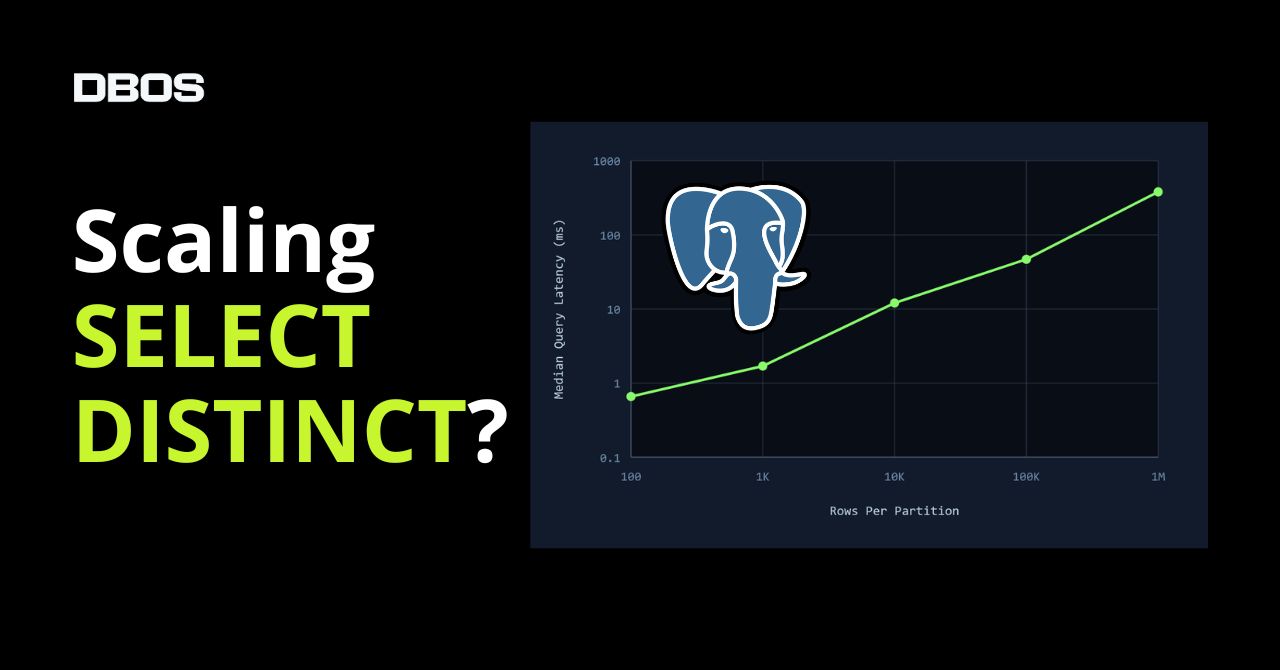
Postgres SELECT DISTINCT Does Not Scale
2026-09-26A recent technical analysis reveals that PostgreSQL's SELECT DISTINCT command suffers from severe performance degradation as datasets scale. The authors break down the underlying reasons for this unexpected bottleneck and outline the specific optimization strategies they implemented to resolve the issue.
Comments
Platform-independent SIMD in Go
2026-09-26Go 1.27 introduces an experimental, platform-agnostic API to bring SIMD capabilities directly into the language. This addition allows developers to write high-performance, vectorized code that runs consistently across diverse hardware architectures without relying on platform-specific implementations.
CommentsThe open-source project git-bug provides a distributed, offline-first bug tracking solution embedded directly within Git repositories. By keeping issue tracking inside the version control system, developers can manage bugs seamlessly without relying on external servers or internet connectivity.
CommentsHacker Atlas is a new interactive tool that visualizes and maps the topics discussed on Hacker News. The project features a semantic graph and category breakdowns that help users track conversation trends and uncover niche discussions. While the community praises the concept, readers suggest future updates should include historical data graphs and continuous scrolling.
CommentsRemembering Johannes Doerfert
2026-09-26The LLVM project community is paying tribute to Johannes Doerfert, a dedicated contributor to the open-source compiler infrastructure. This memorial highlights his significant impact on the project and the lasting legacy he leaves behind in the software development trenches.
CommentsI wrote a ray tracer in Brainfuck
2026-09-26A developer has successfully built a ray tracer using the notoriously difficult esoteric programming language Brainfuck. To accomplish this, they designed a custom domain-specific language and utilized a Python-based code generator to compile the final output. The project highlights an impressive technical workaround for rendering complex graphics in an extremely constrained programming environment.
CommentsThis technical piece explores the mathematical principles of Fourier analysis through a creative visualization that draws a llama using rotating circles. By programming a series of connected epicycles, the project demonstrates how complex spatial curves can be accurately reconstructed from simpler frequency components. The demonstration highlights the fascinating intersection of advanced mathematics, computer programming, and digital art.
CommentsA developer's realization about Redis hash slots during a serverless migration has sparked community discussions on the mechanics of distributed caching and data retrieval. Commenters emphasize the importance of regularly reading documentation to fully understand the everyday infrastructure tools they rely on.
CommentsTiddlyInstall is a universal installation system created by Matthew Roberts with AI assistance that packages a complete, cross-platform installer builder into a single HTML file. The tool simplifies software distribution by automatically managing runtime dependencies like Python and Node.js, allowing users to create, edit, and sign reusable installers directly in their browser without a server.
Comments
Computing pioneer Alan Kay recently delivered a live online performance of an avant-garde audio feedback loop. The improvisational piece served as a musical tribute to Claude Shannon and his foundational theories on managing noisy communication channels. The unique presentation was part of the broader celebrations for Kristen Nygaard's 100th birthday.
Comments2026-09-25

A new project showcased on Hacker News introduces a specialized type foundry for generating cursed web fonts, featuring playful creations like Times New Bastard. The tool provides a unique resource for designers and developers looking to incorporate intentionally chaotic typography into their digital projects.
CommentsYC W26 startup Whiteboard has launched an open-source IDE and digital canvas designed to help developers visually plan their projects. The platform focuses on thoughtful software design by allowing teams to architect applications before writing code. The project is now open for public use and community contribution on GitHub.
Comments
2DWillNeverDie
2026-09-25A new guide teaches pixel art hobbyists how to create 2D game sprites inspired by Capcom's classic Street Fighter series. The tutorial highlights quick and easy shortcuts to help enthusiasts efficiently achieve authentic retro aesthetics.
CommentsFearless SIMD v1.0
2026-09-25The Fearless SIMD library has officially reached its 1.0 release, providing a stable toolset for developers working with vectorized instructions. This major milestone aims to make high-performance SIMD programming safer and significantly more accessible for software engineers.
Comments
Rails World 2026 Opening Keynote [video]
2026-09-25During the opening keynote at Rails World 2026 in Austin, DHH focused his presentation on the rapid rise of AI agents in software development. He revealed that 37signals has ceased handwritten coding to transition toward AI-driven workflows. Additionally, he explained how the foundational conventions of the Rails framework continue to provide essential structure in this new landscape.
CommentsWriting Parquet files using Haskell
2026-09-25The DataHaskell/Dataframe library has introduced a new Parquet writer for Haskell developers. Users can easily export their data by simply passing their dataframe into the newly implemented writeParquet function.
CommentsA developer has released an open-source tool that encrypts files into self-decrypting HTML pages, enabling secure offline sharing without requiring any software installation. By embedding OpenPGP signatures and manipulating the HTML structure, the project ensures the files remain fully auditable and can be decrypted using just a standard web browser or bare OpenSSL. While self-decrypting files are not a new concept, this implementation specifically focuses on zero dependencies and reproducible builds.
Comments
A recent blog post reviews Paul E. McKenney's free online textbook on parallel programming, authored by the creator of the Linux kernel's RCU synchronization mechanism. The reviewer shares their initial impressions and personal context after reading a substantial portion of the comprehensive guide.
Comments