Programming Tech News
2026-06-04

UC Berkeley computer science classes are experiencing a drastic increase in failing grades during the spring 2026 semester, marking a sharp departure from historical grading guidelines. This decline in student performance is largely attributed to a growing reliance on AI tools and deteriorating foundational math skills.
Comments
VoidZero Is Joining Cloudflare
2026-06-04VoidZero, the team behind popular web tools like Vite, Vitest, and Rolldown, is officially joining Cloudflare. Despite the acquisition, the team confirmed that Vite will remain completely open source and vendor-agnostic for the broader community.
Comments
Anthropic has released an open-source framework designed to enhance AI-powered vulnerability discovery and software defense. The customizable autonomous harness provides essential skills for threat modeling, automated scanning, triage, and patching. Developers can leverage this reference tool to significantly streamline the identification and resolution of code vulnerabilities.
Comments
A security researcher built a deliberately vulnerable book review app and spent $1,500 to test if Large Language Models could successfully hack it. The experiment aimed to determine if AI can reproduce common classes of software exploits typically found in real-world applications.
CommentsHuawei has introduced KVarN, a new native vLLM backend designed for KV-cache quantization. This calibration-free enhancement allows developers to achieve three to five times more context length while maintaining FP16-level accuracy and exceeding standard throughput. The improved performance can be easily enabled for AI agents using just a single flag.
Comments
A recent arXiv paper systematically evaluates variants of the standard query, key, and value projections used in transformer architectures. The study investigates whether all three projections are strictly necessary by exploring alternative configurations to optimize model efficiency and performance. These insights could help developers create more streamlined and computationally effective transformer designs for future AI applications.
Comments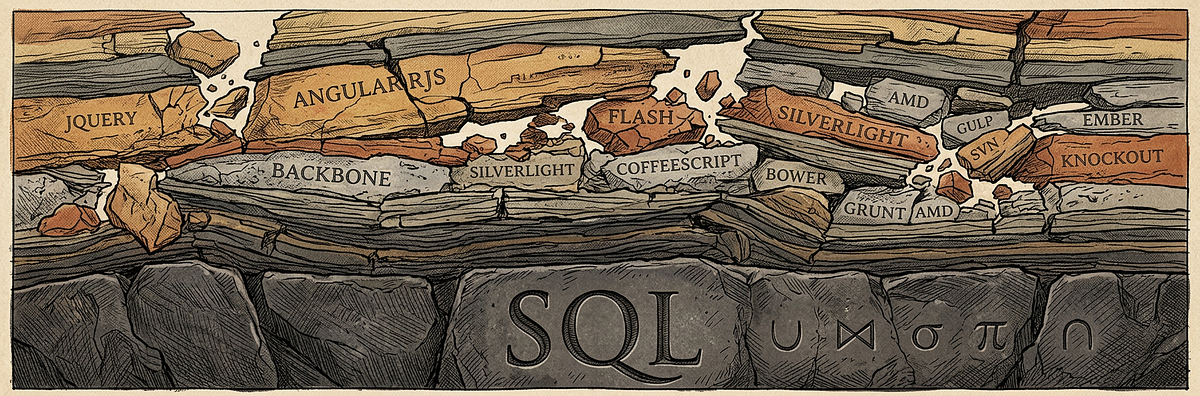
Learn SQL Once, Use It for 30 Years
2026-06-04SQL has maintained its industry relevance for decades because it is fundamentally built on mathematics rather than fleeting technological trends. This enduring stability makes learning the language a valuable, long-term investment for developers looking to future-proof their technical skill sets.
Comments
JLink JTAG Access on the Pinecil
2026-06-04Building on previous hardware modifications, a developer has established JLink JTAG access on the Pinecil smart soldering iron for advanced debugging. This renewed exploration of the device was prompted by the recent addition of upstream support for its Bouffalo Lab BL706 microcontroller in the Zephyr operating system.
Comments2026-06-03

Elixir version 1.20 is now a gradually typed language, marking a significant shift in how code is validated. This update ensures that every program is automatically type-checked to detect verified bugs and typing violations.
CommentsA newly discovered vulnerability in Visual Studio Code allows attackers to steal GitHub authentication tokens with a single click. This security flaw puts developers at risk of having their repositories and sensitive source code compromised if the exploit is triggered.
CommentsMathematicians and technologists warn that the rapid advancement of AI threatens to erode fundamental human understanding by outsourcing critical cognitive work in mathematics and programming. Although some view this automation as inevitable technological progress, critics argue that delegating tasks to AI sacrifices essential knowledge and quality for mere efficiency. Ultimately, they fear that an overreliance on AI will sever vital human control over the foundational technologies shaping our society.
CommentsGooey is a new hybrid immediate and retained mode UI framework for the Zig programming language designed to build fast, GPU-rendered applications. It supports cross-platform development by leveraging graphics APIs such as Metal, WebGPU, and Vulkan across macOS, WebAssembly, and Wayland environments.
CommentsEvery Byte Matters
2026-06-03A recent article highlights how Java developers frequently add numerous fields to large classes without considering the resulting memory overhead. Instead of evaluating the byte-level impact of these additions, programmers typically rely on asymptotic algorithmic analysis to measure performance. The author argues that true optimization requires recognizing that the memory cost of every single field matters in class design.
Comments
Ableton Extensions SDK
2026-06-03Ableton has introduced the Extensions SDK, an open JavaScript toolkit designed to expand the capabilities of its Live 12 Suite. This framework empowers developers and users to build custom tools that introduce fresh functionalities directly into the music production software.
Comments
After six years of development, the reactive notebook environment Pluto.jl has reached its official 1.0 release. This milestone celebrates the project's significant progress and signifies that the platform is fully mature and ready for widespread use.
Comments
Edsger is a newly launched handwritten Clojure REPL designed specifically for the reMarkable 2 e-ink tablet, allowing developers to write and execute functional code by hand. To demonstrate the tool's capabilities, the creator also published a companion blog post written entirely by hand.
CommentsA developer has reverse-engineered the classic 1990 DOS game Test Drive 3 to extract and map its complete world routing data. This open-source project is now available on GitHub, allowing fans to explore the retro game environment and contribute to further development.
CommentsCapstone is a multi-platform and multi-architecture disassembly framework designed for comprehensive binary analysis. Dubbed the ultimate disassembler, the tool offers versatile capabilities for developers and security researchers. It serves as a highly adaptable solution for reverse engineering across diverse hardware and software environments.
CommentsThe new open-source tool sandboxd allows developers to self-host an AI app builder that constructs real applications within isolated Docker and Go environments. It generates live preview URLs for each project without requiring Kubernetes and can be deployed on your own server with a single command.
Comments2026-06-02
Chipotlai Max
2026-06-02A new satirical GitHub repository named Chipotlai Max presents itself as an AI coding agent powered by stolen computing resources from Chipotle. The humorous project is a fork of OpenCode that utilizes a fictional default model called Pepper AI. Its community-driven roadmap jokingly aims to expand the network by adding unauthorized compute providers from other major retailers like Home Depot, Target, and Starbucks.
CommentsA discussion stemming from a developer's month-long Clojure experience highlights the Lisp community's tradition of building custom static site generators, alongside the challenges of integrating with broader web ecosystems. The conversation also explores Clojure's powerful portability, emphasizing how its various dialects enable the language to run seamlessly across multiple host environments like JavaScript, Python, and C++.
Comments
Why Janet? (2023)
2026-06-02After using the Lisp dialect Janet for personal projects, the developer wrote and published a free book to help grow the language's community. The article serves as a persuasive pitch outlining why other programmers should give the lesser-known language a chance.
Comments
HP is re-releasing its iconic HP-16C programmer calculator as a new Collector's Edition. The updated device merges the beloved classic design of the original with modern programming functions for today's computer scientists.
CommentsA new 2024 DOS demo called Pits has achieved native multicore processing and Full HD graphics in pure DOS without relying on external drivers. Since the legacy operating system lacks built-in multithreading, developers accomplished this by running standard DOS on one CPU core while executing custom code on additional cores. This workaround coordinates the cores via shared memory and requires programmers to manually implement synchronization, effectively writing a micro-kernel to manage the complex cross-core execution.
CommentsMuxcard, a DIY credit card size computer
2026-06-02The Muxcard is a DIY project that packs a fully functional computer into the dimensions of a standard credit card, featuring an ESP32 microcontroller, an E-Paper display, and NFC capabilities. This ultra-compact open-source design provides makers with a highly portable and customizable platform for their hardware projects.
Comments
A developer's weekend project experimenting with encrypted reasoning blobs offered valuable insights into frontier LLM APIs and coding agents. While the exercise did not expose major cryptographic flaws, it provided practical, hands-on experience with advanced AI systems.
Comments2026-06-01

CS336: Language Modeling from Scratch
2026-06-01Stanford University has announced the details for its upcoming Spring 2026 course, CS336: Language Modeling from Scratch. The newly launched official course website provides students with access to the full schedule, assignments, and comprehensive course materials. This offering aims to teach the foundational principles and practical implementation of modern language models.
CommentsStanford has introduced specific guidelines for AI agents assisting students in its CS336 Language Modeling From Scratch course. The newly added CLAUDE.md file in the first assignment outlines rules to ensure AI coding assistants are used appropriately while building foundational models. This update reflects a growing trend of academic institutions proactively regulating AI tools in advanced computer science curricula.
CommentsStepSecurity has identified multiple compromised npm packages within the Red Hat Cloud Services namespace that contain malicious code. Developers utilizing these affected dependencies are urged to immediately audit their environments and remove the compromised versions to mitigate supply chain risks.
Comments
A 10 year old Xeon is all you need
2026-06-01Software engineer and NixOS Steering Committee member Christina Sørensen explains why a decade-old Intel Xeon processor remains perfectly adequate for modern development and server workloads. She highlights the practical benefits of utilizing older enterprise hardware, emphasizing that continuous upgrades to the latest processors are often unnecessary.
Comments