Legal Tech News
2026-07-06

The Private Capture of Public Genius
2026-07-06The first essay in the Upstream of Everything series explores how private technology companies are monopolizing publicly funded research and collective innovation. It examines the historical and economic mechanisms that allow corporations to enclose shared scientific breakthroughs and open data. Ultimately, the piece argues that this privatization of public knowledge threatens future technological progress and exacerbates economic inequality.
Comments2026-07-05

PlayStation's announcement to stop producing physical game discs has sparked widespread consumer frustration. While the immediate backlash focuses on the loss of physical media, the core issue is actually the broader loss of true ownership over digital purchases.
Comments
Meta's Un-Stable Signature
2026-07-05Amid discussions about Meta's digital signature practices and new EU AI Act mandates, users are raising significant privacy and mass surveillance concerns over persistent AI watermarking and C2PA provenance tracking. Although these embedded identifiers are designed to authenticate media and clearly label AI-generated content, critics warn they could inadvertently expose sensitive personal data and tool usage in vulnerable contexts. In response to these controversies, developers are already creating specialized applications designed to detect and strip these embedded digital watermarks from images.
CommentsA Delta Airlines flight was struck by a firework while landing at Midway Airport on the Fourth of July, highlighting the aviation and safety risks posed by widespread, unregulated fireworks use. This incident underscores broader discussions about the cultural entrenchment of fireworks in the United States and the practical challenges of enforcing safety bans across the country.
Comments
The European Union Council has fast-tracked Chat Control 1.0, allowing messaging platforms to scan user communications for illegal content by overriding a recently expired temporary exemption. Although the measure enables widespread chat scanning, the EU Parliament successfully blocked the more severe Chat Control 2.0, which would have compromised end-to-end encryption. Privacy advocates criticize the Council's maneuver, arguing that national governments are forcefully pushing for increased digital surveillance and outsourcing policing to tech companies.
Comments2026-07-04

Leaking YouTube creators' private videos
2026-07-04A bug bounty hunter discovered a vulnerability on YouTube that potentially exposed the private videos of content creators to unauthorized access. The issue was promptly reported to Google, which has since patched the flaw to secure user privacy on the platform.
Comments
Anna's Archive has announced a $200,000 bounty to incentivize volunteers to acquire all scanned books from Google Books and similar restricted digital platforms. This 2025 crowdsourced initiative aims to bypass existing access limitations to expand the archive's collection of digitized literature.
CommentsA newly reported bug has revealed a potential session and cache leakage issue involving an AI agent. Despite strict authentication to a secure Enterprise workspace, the agent unexpectedly began discussing an unrelated consumer Minecraft project from another user's session. This cross-account contamination highlights critical vulnerabilities in data isolation and raises privacy concerns for enterprise environments.
CommentsA critical vulnerability in MSI Center allows attackers to escalate to LocalSystem privileges in just seconds. The flaw is caused by improperly secured named pipes within the proprietary utility software. This rapid privilege escalation could allow malicious actors to gain complete control over affected systems.
Comments2026-07-03
Protect your right to run local AI
2026-07-03Tech advocacy groups are urging users to protect their right to run artificial intelligence locally on their personal devices. Supporters are encouraged to sign a quick online petition and call their state representatives to defend this digital freedom.
Comments
Former Member of the European Parliament Stelios Kouloglou was hacked with Pegasus spyware while serving on the committee investigating spyware abuses across Europe. Forensic analysis of his compromised device indicates that attackers potentially gained access to highly confidential documents and sensitive committee deliberations.
Comments
An American Privacy Emergency
2026-07-03Harvard computer science professor Cynthia Dwork warns of an American privacy emergency following a reported Trump administration action that threatens to ban differential privacy and algorithmic fairness. The proposed restrictions have sparked widespread concern among academic and tech communities regarding the future of data protection.
Comments
Nikon has publicly released a specialized variant of its Z6 III camera that completely lacks wireless connectivity. This wireless-free model is specifically built for security-conscious customers who require strict data protection.
Comments2026-07-02

A new malware campaign is using the guise of Android Developer Verification to silently install dormant viruses on devices running Android 8 and higher. Disguised as a legitimate security feature, the malicious code remains quietly on compromised devices while awaiting remote activation from attackers. This highlights a growing trend of cybercriminals leveraging trusted system processes to bypass mobile defenses.
Comments
Virginia has passed legislation prohibiting the sale of precise geolocation data to protect consumer privacy. The ban targets data brokers and tech companies that monetize users' exact physical locations, marking a significant step in state-level digital privacy regulation.
CommentsA silent bug introduced in Linux 6.9 caused LUKS disk encryption to fail to wipe encryption keys from memory during system suspend, leaving data vulnerable on locked devices for over two years. The issue stemmed from an unexpected interaction caused by a kernel refactoring, which has now been resolved with a one-line patch. Developers have also implemented automated tests and warning logs to prevent similar silent failures in the future.
Comments
Zero-Knowledge Proof libraries have been open-sourced to enhance privacy in digital age verification systems. This technology release builds upon a partnership with Sparkasse to support age assurance compliance across the European Union. Making these cryptographic tools publicly available will empower developers to build more secure age verification solutions.
CommentsJapan's highest court has ruled that artificial intelligence cannot be named as an inventor on patent applications, affirming that AI is a tool lacking legal ownership rights. The ruling has sparked broader reader debates regarding the economic utility of intellectual property laws, weighing whether patents genuinely incentivize innovation in high-cost sectors like pharmaceuticals or simply protect corporate monopolies.
Comments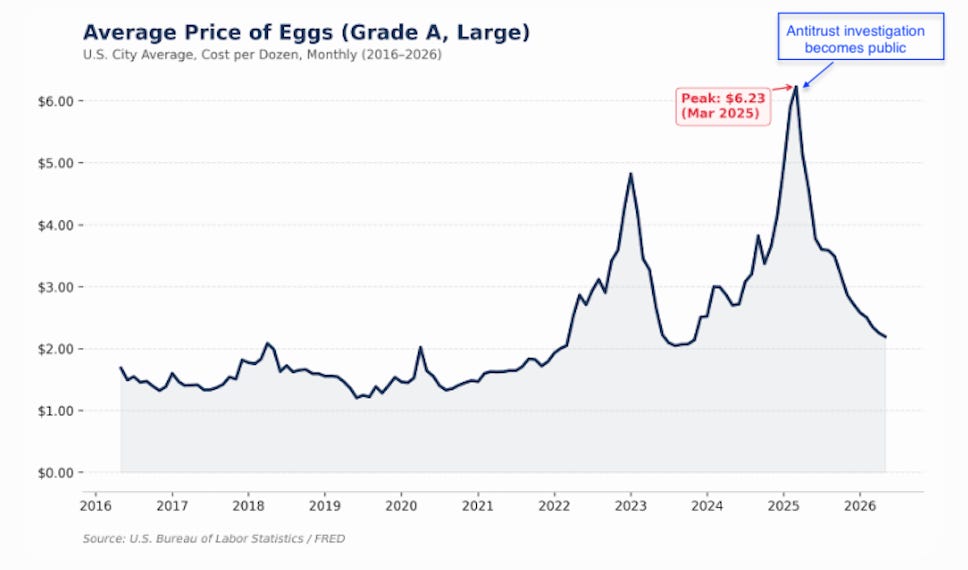
Egg producers involved in a brazen price-fixing conspiracy paid a negligible fine, ultimately profiting a thousand times more than their penalty. Although the Trump administration and state attorneys general allowed the companies to largely escape severe consequences, the investigation successfully forced retail egg prices to drop.
Comments
The Electronic Frontier Foundation submitted a letter to the FTC urging strict enforcement of X's consent order regarding user data privacy. The organization warns that the platform has a continued history of misusing and profiting from user information, necessitating vigilant oversight and strong data safeguards.
CommentsEurope's top court has upheld a record $4.7 billion antitrust fine against Google for anti-competitive practices, dismissing the tech giant's appeal. The ruling solidifies the European Union's strict regulatory stance on major American technology companies. This decision marks a significant victory for European regulators in their ongoing efforts to curb the market dominance of US tech firms.
Comments2026-07-01

The Department of Commerce has lifted export controls on Claude Fable 5 and Mythos 5. Following the regulatory change, the provider will begin restoring user access to both systems tomorrow.
CommentsSony's revocation of access to 551 previously purchased PlayStation movies has sparked widespread outrage and renewed calls for legislation to protect digital ownership rights. Consumer advocates are urging lawmakers to treat digital purchases as permanent property rather than revocable licenses, arguing that strong regulations in major markets would force companies globally to stop removing paid content.
Comments2026-06-30

A developer inspecting Claude Code for privacy reasons discovered that the tool secretly embeds hidden steganographic markers within its system prompts. These undisclosed tags are dynamically generated based on the API base URL and timezone, raising concerns about hidden tracking in AI coding assistants.
Comments
Daniel Sanchez Estrada has been sentenced to 30 years in prison for transporting a box of pamphlets, raising severe concerns among free speech advocates. Critics warn that this extreme punishment sets a dangerous precedent for the criminalization of information possession and distribution.
Comments
One million passports leaked online
2026-06-30A security lapse at Cannabis Club Systems, also known as Nefos Solutions, has potentially exposed over one million passports and photo IDs on the public web. The company left the highly sensitive identification documents completely unsecured online, putting countless users at risk of identity theft.
Comments
The US ambassador in Belgium used local police to interrupt journalists reporting on a privately funded Freedom 250 celebration organized by American embassies. Reporters were stopped by law enforcement acting on the ambassador's behalf while attempting to cover the event. This incident has sparked immediate backlash from press freedom advocates over the diplomatic suppression of independent journalism.
Comments
A new non-invasive brain-computer interface technique leverages machine learning and EEG data to translate brain waves into text without surgery, offering incremental but notable improvements over existing methods. However, the technology has sparked intense debate over neural privacy and corporate data tracking, prompting experts to urge lawmakers to establish strict national regulations before such commercial mind-reading tools become widespread.
Comments2026-06-29
Governments across the US, Europe, and Australia are introducing age verification regulations under the guise of protecting children. However, these new rules may actually serve as a stepping stone toward broader digital surveillance. Ultimately, this framework could act as a precursor to the automated tracking and attribution of all online speech.
Comments
The US Supreme Court has ruled that law enforcement must adhere to constitutional privacy protections when using geofence warrants to sweep smartphone location data. This decision ensures that authorities cannot access broad digital location records without meeting strict legal standards.
Comments