Legal Tech News
Submit2026-04-15

Google has broken its nearly decade-long promise to notify users before handing their data to law enforcement. The company recently provided user Amandla Thomas-Johnson's information to ICE without prior warning, depriving him of the opportunity to challenge the subpoena.
Comments
A jury has ruled that Live Nation illegally monopolized the ticketing market, culminating in a landmark antitrust trial after years of regulatory scrutiny. The verdict now sets the stage for a potential breakup of the largest US concert promoter and ticket seller.
Comments
Stop Flock
2026-04-15Discussions surrounding the deployment of Flock license plate recognition cameras highlight a deep divide over their effectiveness in addressing public safety concerns. Critics argue the surveillance technology masks broader police inefficiencies and ignores the root causes of crime. Conversely, proponents maintain the systems provide crucial investigative tools that help solve crimes in struggling cities.
Comments
Spotify and several major record labels have secured a $322 million default judgment against the piracy site Anna's Archive. The case concluded without a fight because the operators of the shadow library remain unknown and did not respond to the lawsuit.
CommentsA New York federal court has ruled that conversations with AI chatbots do not qualify for attorney-client privilege because sharing data with a third-party service eliminates the expectation of confidentiality. The decision relied on the terms of service to classify the interactions as discoverable personal notes rather than protected legal communications. This ruling highlights the growing legal gap between consumer expectations of digital privacy and the realities of using artificial intelligence tools.
Comments2026-04-14
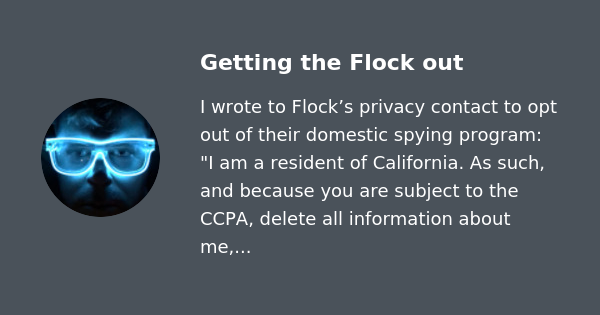
A California resident invoked the state's Consumer Privacy Act to demand that surveillance company Flock delete all personal and vehicle data from its databases. The individual formally revoked consent for the company to collect their information in the future. Flock has since responded to the privacy inquiry.
Comments
California’s proposed bill AB 2047 would mandate censorware on all 3D printers and criminalize the use of open-source alternatives. Critics warn that the legislation will stifle technological innovation and introduce severe consumer harms like surveillance and platform lock-in. Advocates are urging the state to reject the bill, arguing that it merely repeats the historical failures of digital rights management.
CommentsFiverr is facing severe criticism after a security flaw left sensitive customer files, including tax returns and Social Security numbers, publicly searchable via Google for nearly a week. Although the company claimed the documents were uploaded with explicit user consent as work samples, affected users dispute this and stress the severe privacy risks posed to vulnerable individuals using the platform. The leaked files were recently blocked by the hosting provider, but the prolonged exposure has sparked widespread outrage over the marketplace's data protection practices.
Comments
Spain plans to expand dynamic internet blocking during live sports and movie broadcasts to combat piracy, a strategy critics argue causes collateral damage by inadvertently restricting access to legitimate websites. In response to these aggressive measures and the sports industry pushing to ban consumer VPNs, digital rights advocates are calling for stricter EU-level intervention. They argue that broad IP-based restrictions violate net neutrality principles and set a dangerous precedent for internet freedom and user privacy across the European Union.
Comments2026-04-13

The 5th U.S. Circuit Court of Appeals has declared a nearly 158-year-old federal ban on home distilling unconstitutional. This ruling removes longstanding restrictions on individuals producing their own spirits at home and could spur new innovations in small-scale distillation equipment.
Comments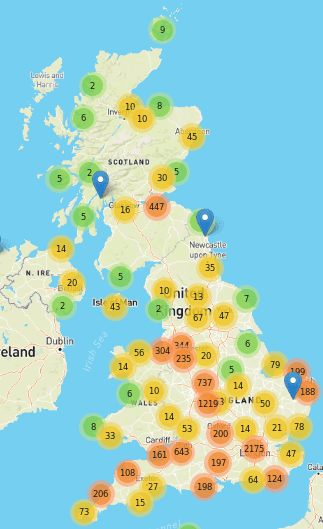
Google's latest Android update strips location metadata from photos when users upload them through web browsers, breaking functionality for mapping sites like OpenBenches. This change prevents developers from using embedded geolocation data to accurately place user-submitted images on a map.
Comments
This year’s insane timeline of hacks
2026-04-13A newly compiled archive details a staggering timeline of major cybersecurity breaches that have largely flown under the radar this year. By documenting these underreported hacks, the collection sheds light on the escalating and often overlooked digital threats facing modern organizations.
CommentsMichigan lawmakers withdrew proposed digital age legislation following backlash over its handling of consumer data privacy. Critics argued the bills relied on flawed opt-out mechanisms rather than requiring strict opt-in permission for data sales. The controversy highlights broader frustrations with tech companies using delayed consent models to harvest user data for AI training without explicit approval.
CommentsThe final installment of a tech series explores AI safety and alignment, arguing that trusting commercial or government entities to align AI systems with individual goals is inherently dangerous. Reader discussions highlight the adversarial nature of these power dynamics, emphasizing how concentrated institutional power actively undermines natural human cooperation to prioritize corporate and governmental interests.
Comments