Tech News Today February 27 2026
This section presents tech news as a daily edition, centered on the headlines of February 27, 2026. It brings together the stories that technology professionals were reading and discussing that day.
Typical entries include major announcements from big tech companies, new AI capabilities, developer tools, startup news, cybersecurity incidents, and opinion pieces that captured the industry's attention.
A daily edition gives a clear picture of the industry at a specific moment. Readers use it to catch up after time away or to research what was happening on a particular date.
2026-05-08

Instructure's Canvas learning management platform has been restored online following a disruption caused by a confirmed data breach. The ShinyHunters hacking group claimed responsibility for the incident and is threatening to leak sensitive school data if ransom demands are not met.
CommentsA recent project hosts a website entirely from the RAM of a Raspberry Pi Zero by offloading computationally heavy TLS termination to an external cloud provider. However, community discussions question the necessity of the complex proxy setup and note that modern operating systems already cache web pages in RAM by default, diminishing the technical impressiveness of the project.
Comments
Google has introduced Google Cloud Fraud Defense as the next evolution of reCAPTCHA, featuring a new QR code scanning challenge for user verification. Despite the updated branding, the new tool is essentially just a repackaged version of the existing WEI technology.
CommentsPrompted by a developer's report of an unexpected UUIDv4 collision, the tech community emphasizes that such failures are surprisingly common due to flawed or poorly understood entropy sources. To prevent this, experts advise against using UUIDv4 in high-reliability systems, recommending instead the aggregation of multiple diverse, non-deterministic data points. Furthermore, modern cryptographic techniques can extract true randomness from these imperfect sources by blending them into a single, unpredictable seed.
Comments2026-05-07
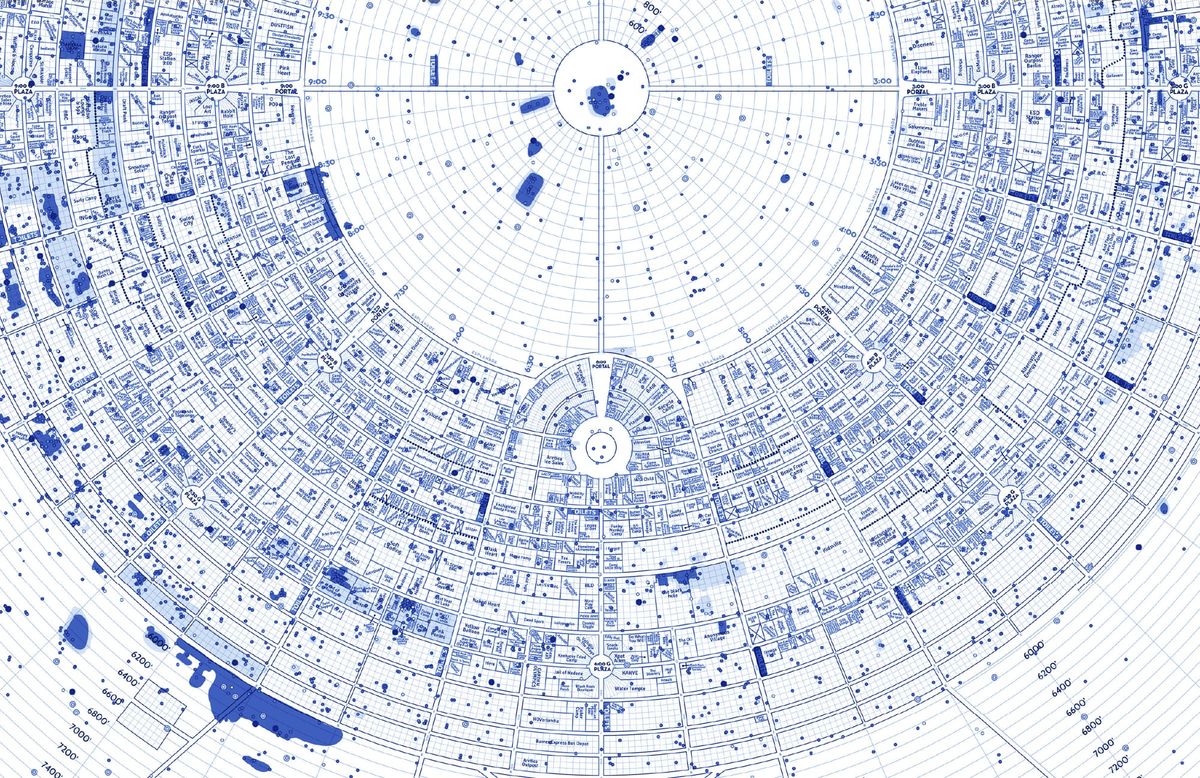
The map that keeps Burning Man honest
2026-05-07Burning Man utilizes mapping technology to measure and track its environmental footprint, transforming its Leave No Trace principle into a data-driven commitment. The resulting maps are made publicly available to ensure the event maintains strict accountability for its cleanup standards.
Comments
AlphaEvolve is a coding agent powered by Gemini that optimizes algorithms to accelerate scientific progress across multiple disciplines. By applying this technology to complex challenges in genomics, quantum physics, and global infrastructure, the tool aims to solve critical real-world problems at scale.
CommentsProgramming Still Sucks
2026-05-07A recent tech commentary highlights the tiresome, repetitive questions programmers face from non-tech individuals about AI replacing their jobs. Through a brief social anecdote, the author illustrates how this specific inquiry has become an exhausting cliché, proving that the social annoyances and public misconceptions surrounding the programming profession remain unchanged.
CommentsPermacomputing Principles
2026-05-07The Permacomputing movement advocates for the sustainable and ecological use of technology, drawing parallels to agricultural permaculture. However, its explicit alignment with anti-capitalist and progressive political ideologies has sparked debate, with some critics arguing this broad framing alienates potential supporters. Proponents counter that addressing systemic societal and environmental challenges is an inherently political act that is fundamental to the practice.
CommentsA discussion surrounding a 2004 tutorial on TI-83 Plus Basic programming has prompted readers to share how secretly coding on graphing calculators during math classes launched their tech careers. Many current software developers credit their early experiences writing games, chat programs, and math solvers on devices like the TI-83 and TI-85 as the foundational spark for their professional journeys in computer science and engineering.
Comments
The Self-Cancelling Subscription
2026-05-07A recent tech anecdote reveals how a simple family TV night devolved into an unexpected systems debugging session due to a glitchy streaming service. The user encountered a bizarre issue with a self-cancelling subscription that required extensive troubleshooting to resolve. This highlights growing consumer frustration with the increasingly complex and buggy nature of modern digital billing and account management.
Comments
Researchers have developed SoundOff, a novel smart home sensing system that utilizes low-cost, passive ultrasound tags for environmental monitoring. This technology enables non-invasive and non-intrusive tracking without relying on traditional cameras or active wearables. By leveraging ultrasound, the system provides an affordable and privacy-preserving solution for everyday home automation.
Comments2026-05-06

YouTube, your RSS feeds are broken
2026-05-06YouTube's RSS feeds are currently broken, preventing users from tracking channel updates through their preferred third-party feed readers. The tech community is urging the company to resolve the issue quickly and restore reliable functionality for independent content consumption.
CommentsMulti-stroke text effect in CSS
2026-05-06Replicating retro multi-stroke text effects is challenging because the native CSS text-stroke property only accepts a single value, causing common workarounds like stacking elements to fail. This article explores alternative techniques to successfully implement complex multi-stroke typography in modern web design.
CommentsA new technical walkthrough details the installation of a Sun Ray server on a fresh OpenIndiana Hipster 2025.10 environment. The project specifically tests the functionality and stability of the newly updated Sun Ray support from a completely clean slate.
Comments
Researchers have developed battery-free smart home sensors using simple metal tags that emit unique ultrasonic fingerprints to detect physical movements. These passive tags can reliably monitor events like door openings without requiring any electrical power or ongoing maintenance.
Comments
A new technical deep dive explores the mathematical foundations of diffusion models by examining their integrals through the lens of flow maps. The article details how understanding these continuous flow processes can lead to more efficient training and inference for generative AI architectures. This analysis provides machine learning practitioners with crucial insights into the continuous-time dynamics of modern generative models.
Comments
Telus is using AI to alter the accents of its offshore call center agents in real time to reduce communication friction. The practice has sparked public backlash and criticism from labor groups who argue the technology is deceptive and requires mandatory disclosure. Meanwhile, Canadian competitors Rogers and Bell have confirmed they have no plans to implement similar voice-altering tools.
CommentsA developer successfully ported Wolfenstein 3D to the Game Boy Color using a custom cartridge, demonstrating an impressive technical execution that pushes the classic console's hardware limits. Community discussions highlight the project's innovation while delving into the complex programming techniques, such as mid-frame tile switching and directly driving the LCD, required to overcome the system's original constraints. Fans also reminisced about early handheld first-person shooters like Faceball 2000 while debating the intricate memory and rendering optimizations necessary for such advanced ports.
Comments2026-05-05

Recent updates detail how Multi-Token Prediction drafters are significantly accelerating inference speeds for Gemma 4 models. By predicting multiple tokens simultaneously, this technique allows the AI to generate outputs up to three times faster. This optimization marks a major performance improvement for developers deploying these language models.
Comments
I'm scared about biological computing
2026-05-05A veteran AI developer with extensive experience in language models and their underlying mathematics expresses growing apprehension regarding biological computing. Drawing on their deep background in the AI space since the launch of ChatGPT, the author contrasts their foundational understanding of traditional artificial intelligence with their fears about the future of biological systems in technology.
Comments
AI didn't delete your database, you did
2026-05-05A recent tech commentary argues that blaming artificial intelligence for deleting databases is merely a deflection of human error and poor decision-making. To prevent future disasters, organizations must take full accountability and ensure their teams consist of competent developers.
Comments
Hand Drawn QR Codes (2025)
2026-05-05A newly highlighted open-source Python project enables the generation and decoding of hand-drawn QR codes, blending analog artistry with digital data encoding. The tool leverages internet-driven community collaboration to demonstrate how physical, handcrafted visuals can seamlessly integrate with modern computational technologies.
Comments2026-05-04
OpenAI has published a technical breakdown of how it delivers low-latency voice AI at scale, highlighting its use of the open-source Pion WebRTC library. The company's strategy focuses on aggressively optimizing its own WebRTC transit layer to reduce latency, complementing rather than replacing the need for fast inference models.
Comments
A new underdrawing technique improves the accuracy of text and numbers in AI-generated images by first generating a deterministic layout. The image model then paints over this precise base structure to produce significantly more legible and correct typography.
CommentsDeveloper discussions regarding a Redis array project reveal that advanced AI-assisted coding relies on rigorous verification and adversarial prompting rather than the hands-off vibe coding trend. By utilizing techniques like persona-driven prompting and continuous model cross-examination, engineers maintain strict control over code quality while significantly speeding up the development cycle. Ultimately, practitioners emphasize that large language models serve as powerful accelerators for established software engineering workflows rather than ushering in a completely unsupervised paradigm.
Comments
A Bloomberg investigation revealed that health insurance marketplaces in Virginia and Washington, D.C., were sharing sensitive user data, including race and citizenship status, with advertising technology firms. In response to the findings, both jurisdictions have paused their data collection and sharing practices.
Comments
How Monero’s proof of work works
2026-05-04Unlike Bitcoin's fixed hash model, Monero utilizes a unique proof of work algorithm called RandomX that requires executing random, CPU-friendly programs over a large memory dataset. This distinct approach allows the network's mining process to behave fundamentally differently from ASIC-first systems.
CommentsIntroduction to Atom
2026-05-04A recent Hacker News discussion explored the continued relevance of the Atom XML syndication format, noting that platforms like GitHub and YouTube still actively use the 2005 protocol for tracking updates. Despite its niche status today, users praised the feed's reliability and highlighted its practical applications for monitoring repositories and videos. Participants also criticized major tech companies for deliberately abandoning semantic web standards in favor of closed ecosystems that restrict open information sharing.
CommentsA discussion on discovering hard disk physical geometry through microbenchmarking highlights how probing storage hardware helps identify undisclosed defects and tune I/O scheduler performance. Although modern drives utilize extensive internal remapping that complicates traditional mapping, these techniques remain crucial for characterizing storage behavior and preventing hardware anomalies from being misattributed to software failures.
CommentsThe 'Hidden' Costs of Great Abstractions
2026-05-04Driven by the rise of AI tools, the tech industry is shifting away from deep engineering fundamentals and premium developer compensation toward rapid commercial development. This transition threatens long-term software quality as non-technical managers cut corners, mirroring the decline seen in the homebuilding sector. Nevertheless, software companies will likely avoid consumer backlash and financial liability due to high switching costs and restrictive end-user agreements.
Comments