Software Tech News
Software is where most of the technology industry's ideas take shape. This section collects news about applications, platforms, open-source projects, and online services, along with the teams and companies that design, ship, and maintain them.
Typical stories include major releases and redesigns, open-source projects gaining traction, creators presenting tools they built, SaaS companies changing pricing or features, and post-mortems explaining why a product failed or an outage happened. Critical takes on bloat, reliability, and user experience are common too.
Knowing which software is improving, stagnating, or being abandoned helps people pick better tools and avoid costly migrations later. Developers, product teams, IT buyers, and everyday users follow this coverage to keep their stack current and discover useful alternatives.
2026-05-11
A sophisticated supply-chain attack compromised 42 TanStack packages on the npm registry after an attacker exploited GitHub Actions vulnerabilities to publish 84 malicious versions. The breach chained a pull request exploit with cache poisoning and OIDC token extraction, prompting developers to review the official postmortem and audit their dependencies.
CommentsI'm going back to writing code by hand
2026-05-11In a piece about returning to manual coding, the author and readers criticize AI code generators for lacking the human judgment required to adapt architectural constraints over time. Without exhaustive, line-by-line human review, AI tools often contort software to fit outdated rules or hide catastrophic mistakes that eventually render the codebase unmaintainable. Consequently, developers are finding that the intense oversight needed to prevent hidden errors makes writing code by hand a more reliable and practical approach.
Comments

GitLab has announced a workforce reduction and the elimination of its CREDIT core values in a recent letter to customers and investors. The software development company stated that these structural changes are intended to streamline operations and better align with its current business priorities.
Comments
Nullsoft, 1997-2004 (2004)
2026-05-11America Online has effectively dismantled its Nullsoft division by purging the team down to just three remaining employees. This drastic downsizing marks the abrupt end of an era for the prolific branch that significantly contributed to the software landscape between 1997 and 2004.
Comments
Google has introduced a new verification step for Gmail registration that requires users to send a text message. To create an account, users must now scan a QR code with their smartphone, which automatically triggers an SMS to Google to verify their phone number.
Comments
Ratty is a newly introduced terminal emulator that utilizes GPU rendering to support inline 3D graphics. This innovation allows developers to view and interact with complex 3D visuals directly within their standard command-line environment.
CommentsWhile some developers report that AI coding agents reduce maintenance costs by modernizing legacy code and automating testing, others warn that generating poorly understood code actually increases outages and technical debt. Consequently, participants emphasize that maintainability must remain a core engineering responsibility to ensure AI genuinely decreases rather than exacerbates long-term software maintenance burdens.
Comments
Mythos Finds a Curl Vulnerability
2026-05-11Anthropic withheld its new AI model, Mythos, from public release due to its exceptional ability to identify security vulnerabilities in source code. Demonstrating this advanced capability, the model has now successfully discovered a security flaw in curl.
CommentsGoogle's threat intelligence group reported that criminal hackers likely used an AI model to discover and weaponize a major software vulnerability, citing the exploit script's textbook formatting and hallucinated details as evidence. However, readers note that while these markers strongly indicate the code was generated by an AI, they do not definitively prove the model was used to find the underlying bug.
Comments
After experiencing frequent sleep disruptions, an author utilized AI development tools to build a custom application that tracks and identifies the causes of nighttime awakenings. This project highlights how AI is lowering the barrier to entry, allowing individuals to easily create personalized tech solutions for everyday quality-of-life issues.
CommentsNvidia has introduced cuda-oxide, an official compiler that enables developers to write and compile GPU device code directly in Rust. Rather than replacing host-side libraries like cudarc, the new tool complements them by generating embedded PTX code from Rust source files for execution via existing CUDA APIs. Additionally, cuda-oxide leverages Rust's strict memory and type safety models to provide robust guardrails against common undefined behaviors in GPU kernel programming.
CommentsA new Java 25 library called TypedMemory enables developers to efficiently map Java records to strongly typed off-heap native memory. By leveraging the Foreign Function and Memory API, the tool provides a fast and direct approach to native memory management for performance-critical applications.
Comments
Papel is a new research app aiming to bring the TikTok experience to the discovery of scientific papers. The black-and-white platform allows users to easily find literature and read it using on-device AI. It also includes collaborative features so researchers can discuss their work with peers.
CommentsA new guitar tuner application uses a smartphone's accelerometer to detect physical vibrations and determine musical pitch. However, readers warn that this technique poses significant privacy and security risks, as the sensor could potentially be exploited to eavesdrop on surrounding sounds or capture keystrokes without requiring explicit microphone permissions.
CommentsA developer built a static HTTP web server entirely from scratch using aarch64 assembly language, embracing the extreme challenge of bare-metal programming. The project serves as both a deep dive into low-level architecture and a humorous personal quest for meaning through code.
Comments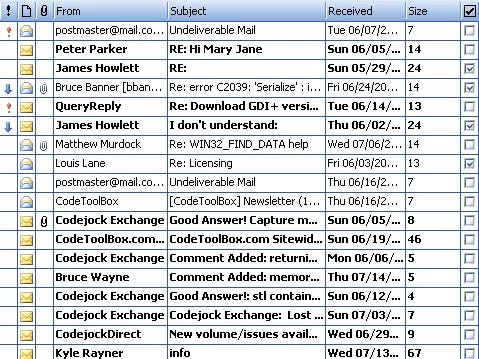
dBase: 1979-2026
2026-05-11The pioneering database software dBase has officially ended its nearly five-decade run, with its final newsgroup servers going offline in November 2025. The platform's ultimate demise was hastened by years of product neglect, complex vendor litigation, and the rapid rise of artificial intelligence.
CommentsReaders are revisiting a highly praised 2010 blog post by Matt Might that demonstrates how to implement a programming language in just seven lines of code. Commenters celebrate the tutorial for demystifying computer science and argue that such foundational concepts should be taught to everyone, not just computer science majors. The discussion also compares this elegant Lisp-based implementation to other minimal language projects, highlighting the enduring beauty of concise code.
Comments2026-05-10
Hardware Attestation as Monopoly Enabler
2026-05-10Apple and Google are increasingly pushing third-party services to adopt hardware-based attestation to verify device integrity across mobile apps and the web through similar frameworks like their respective Integrity APIs. This coordinated expansion of hardware verification standards could ultimately serve as a powerful tool to further entrench the tech giants' market dominance.
CommentsLocal AI needs to be the norm
2026-05-10The tech industry is increasingly advocating for a shift toward running artificial intelligence directly on user devices rather than relying on remote cloud servers. By establishing local AI models as the standard default, the ecosystem can significantly improve system performance and enhance overall data privacy for end users.
CommentsAn early cloud advocate who championed foundational AWS services like S3 and EC2 during the platform's infancy recently returned to the ecosystem. Upon re-engaging with the cloud giant, the author was quickly reminded of the exact frustrations that initially drove them to leave.
Comments
Incident Report: CVE-2024-YIKES
2026-05-10A new security vulnerability designated as CVE-2024-YIKES has been reported, with the incident details ominously characterized as a series of unfortunate events. Cybersecurity teams are currently investigating the exact nature of the flaw, though specific technical details remain undisclosed. Users are advised to monitor official channels for further updates and potential patch deployments.
Comments
Implementing API idempotency extends far beyond simply adding an HTTP header or performing a basic key lookup. A new article breaks down the complex failure cases that challenge real-world systems, such as mismatched requests, concurrent retries, and partial successes. It offers practical guidance for developers on handling critical edge cases like downstream uncertainty, response replay, and duplicate message handling.
Comments
A sophisticated cyber campaign is exploiting a malicious Obsidian note-taking app plugin to deploy a new remote access trojan named PHANTOMPULSE. The malware is specifically targeting victims operating within the finance and cryptocurrency sectors.
CommentsA new macOS application called Drawers helps developers maintain focus by creating dedicated virtual spaces, customized docks, and isolated window environments for each of their projects. The app allows users to assign granular resources like specific chat channels to these workspaces to prevent context switching and distractions. The tech community has responded enthusiastically to the project, with users eager to beta test and suggesting future enhancements like project-specific app theming and crash isolation.
Comments
Right-to-repair advocate Louis Rossmann has offered to cover the legal fees of an OrcaSlicer developer facing legal threats amidst an escalating controversy with Bambu Labs. This financial support aims to protect open-source contributors as tensions rise between the 3D printing community and hardware manufacturers over software licensing disputes.
CommentsA developer has shared a MacOS web server written exclusively in ARM64 assembly language. The project, showcased on Hacker News, was built as a personal challenge to explore extreme low-level system programming. The resulting application operates natively without relying on higher-level abstractions or traditional software frameworks.
Comments
Traces Of Humanity
2026-05-10After a seven-year hiatus, the lead developer of the privacy-focused operating system Qubes OS has resurfaced with a new blog. The creator of the highly secure system, which they began developing in 2009, announced their return to reconnect with the tech community.
Comments
Space Cadet Pinball on Linux
2026-05-10Stephen Brennan has reverse-engineered and ported the classic Windows 3D Pinball Space Cadet game to run natively on Linux. This project allows Linux users to play the nostalgic title directly without relying on emulators or compatibility layers.
CommentsA recent article explores a new method for preventing Man-in-the-Middle attacks during the initial SSH connection to newly provisioned cloud servers, aiming to solve the cryptographic bootstrapping problem. Readers debate the technique's novelty, arguing that existing built-in solutions like SSHFP DNS records and private key-certs already address the issue despite requiring complex configurations like DNSSEC. The broader discussion highlights the ongoing industry challenge of securely establishing initial trust and distributing keys in cloud environments without relying on bespoke workarounds.
Comments
Gemini API File Search is now multimodal
2026-05-10Google has updated the Gemini API File Search tool to support multimodal data processing. This enhancement makes it significantly easier for developers to build efficient file retrieval systems. These new capabilities allow applications to seamlessly handle and search through diverse file types.
Comments