Regulation Tech News
Governments everywhere are writing new rules for technology, and companies are adjusting how they build products as a result. This section tracks that regulation as it is drafted, debated, passed, and enforced, along with how the industry responds.
Typical stories include lawmakers proposing rules for AI, privacy, and online safety, regulators opening investigations or issuing penalties, compliance deadlines that force product changes, lobbying fights, and moves to loosen or roll back existing rules. Coverage spans national, regional, and international efforts.
Regulation decides which features ship, which markets stay open, and how much compliance work teams must take on. Founders, engineers, legal and policy professionals, and investors follow this coverage to anticipate changes before they arrive.
2026-07-10

Starting October 1, New York City will enforce a new rule banning deceptive subscription practices to protect consumers from misleading cancellation processes. Alongside this initiative, the Mamdani administration is also pursuing efforts to prohibit companies from charging hidden junk fees.
Comments
The European Commission has ruled that Instagram and Facebook are in breach of the Digital Services Act due to their use of addictive design features. This regulatory action targets parent company Meta for implementing platform mechanics that prioritize user engagement over well-being. Consequently, the social media platforms will be required to modify their applications to fully comply with these European digital regulations.
Comments
2026-07-09
The European Parliament has greenlit the Chat Control 1.0 proposal following a controversial procedural maneuver by the European Commission to force a second-reading vote on previously defeated legislation. Critics argue this tactic undermines democratic norms by requiring an absolute majority to reject the measure, effectively bypassing prior parliamentary rejections to push through the surveillance initiative.
CommentsThe Federal Trade Commission and state attorneys general have secured a right to repair settlement with John Deere. Under the agreement, equipment owners will be allowed to independently fix their own machines without facing corporate restrictions.
Comments2026-07-08

The Government Accountability Office reports that the Department of Energy is prematurely dismissing cheaper alternatives for nuclear waste cleanup. Instead of evaluating these less expensive options, the agency continues to spend billions of taxpayer dollars on massive infrastructure projects. This approach leads to the pursuit of large-scale facilities like waste treatment plants without fully considering more cost-effective solutions.
Comments
The European Parliament has approved an urgent procedure to fast-track legislation reviving the expired Chat Control 1.0 rules. This decision brings the private message scanning measures one step closer to official reinstatement.
Comments2026-07-07
Chat Control 1.0 and 2.0 Explained
2026-07-07This article explains the key differences between the EU's proposed Chat Control 1.0 and 2.0 regulations. It provides a clear overview of their respective legislative timelines and implementation goals. Finally, it details the current status of the legislation and where the ongoing debates stand today.
Comments
Under new European Union regulations, all new cars must be equipped with driver monitoring cameras to help prevent accidents caused by distracted driving. While the mandate aims to improve road safety, the privacy safeguards and data handling rules for these in-car systems remain largely unresolved.
Comments
The Chat Control legislation has cleared its first round in the EU Parliament following a procedural maneuver by its proponents. This push comes just before the summer break and aims to reactivate the indiscriminate scanning of chat messages.
Comments2026-07-06

The Private Capture of Public Genius
2026-07-06The first essay in the Upstream of Everything series explores how private technology companies are monopolizing publicly funded research and collective innovation. It examines the historical and economic mechanisms that allow corporations to enclose shared scientific breakthroughs and open data. Ultimately, the piece argues that this privatization of public knowledge threatens future technological progress and exacerbates economic inequality.
Comments
Nintendo will begin releasing revised versions of its products in Europe with replaceable batteries starting in the summer of 2026. The move ensures the company's hardware complies with new European Union regulations that will mandate user-replaceable batteries by February 2027.
Comments2026-07-05
Meta's Un-Stable Signature
2026-07-05Amid discussions about Meta's digital signature practices and new EU AI Act mandates, users are raising significant privacy and mass surveillance concerns over persistent AI watermarking and C2PA provenance tracking. Although these embedded identifiers are designed to authenticate media and clearly label AI-generated content, critics warn they could inadvertently expose sensitive personal data and tool usage in vulnerable contexts. In response to these controversies, developers are already creating specialized applications designed to detect and strip these embedded digital watermarks from images.
Comments
The European Union Council has fast-tracked Chat Control 1.0, allowing messaging platforms to scan user communications for illegal content by overriding a recently expired temporary exemption. Although the measure enables widespread chat scanning, the EU Parliament successfully blocked the more severe Chat Control 2.0, which would have compromised end-to-end encryption. Privacy advocates criticize the Council's maneuver, arguing that national governments are forcefully pushing for increased digital surveillance and outsourcing policing to tech companies.
Comments2026-07-04

The rapid proliferation of satellites and proposed space mirrors is raising significant concerns among astronomers regarding the degradation of the night sky. These objects reflect sunlight and create light pollution that interferes with ground-based astronomical observations. Experts warn that without stricter international regulations, the uncontrolled growth of space infrastructure will permanently alter our view of the cosmos.
Comments2026-07-03

Former Member of the European Parliament Stelios Kouloglou was hacked with Pegasus spyware while serving on the committee investigating spyware abuses across Europe. Forensic analysis of his compromised device indicates that attackers potentially gained access to highly confidential documents and sensitive committee deliberations.
Comments
An American Privacy Emergency
2026-07-03Harvard computer science professor Cynthia Dwork warns of an American privacy emergency following a reported Trump administration action that threatens to ban differential privacy and algorithmic fairness. The proposed restrictions have sparked widespread concern among academic and tech communities regarding the future of data protection.
Comments
This article argues that the United States lags behind Switzerland in deploying ultra-fast 25 Gbit internet infrastructure due to a flawed reliance on free-market principles. It suggests that treating broadband as a public utility rather than leaving it to private monopolies is essential for achieving world-class connectivity.
Comments2026-07-02

Virginia has passed legislation prohibiting the sale of precise geolocation data to protect consumer privacy. The ban targets data brokers and tech companies that monetize users' exact physical locations, marking a significant step in state-level digital privacy regulation.
CommentsSpain has blacklisted U.S. data analytics firm Palantir Technologies from working with public entities and state-controlled private companies. The government implemented the ban due to national security concerns over the potential misuse of classified information. This decision highlights growing international scrutiny over how foreign tech giants handle sensitive state data.
Comments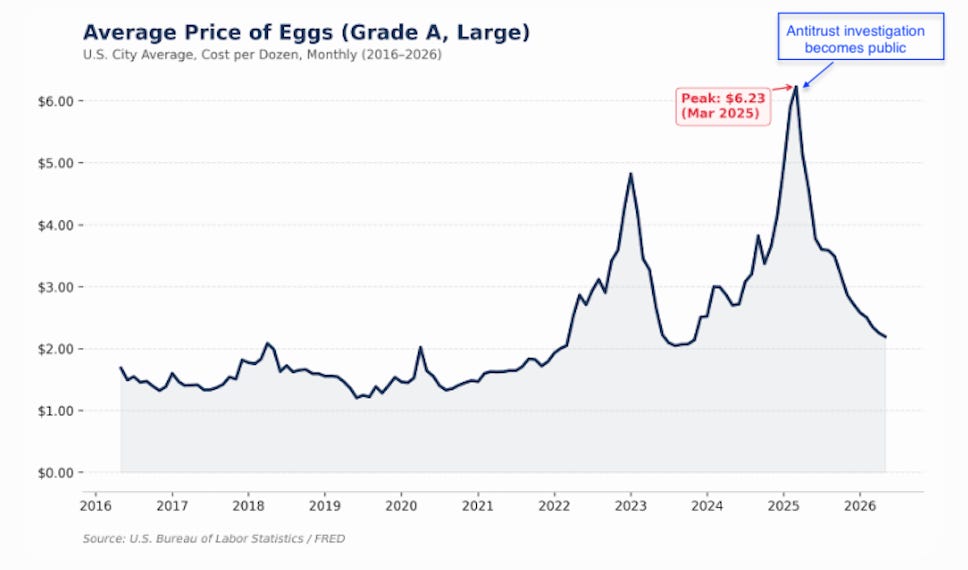
Egg producers involved in a brazen price-fixing conspiracy paid a negligible fine, ultimately profiting a thousand times more than their penalty. Although the Trump administration and state attorneys general allowed the companies to largely escape severe consequences, the investigation successfully forced retail egg prices to drop.
Comments
The Electronic Frontier Foundation submitted a letter to the FTC urging strict enforcement of X's consent order regarding user data privacy. The organization warns that the platform has a continued history of misusing and profiting from user information, necessitating vigilant oversight and strong data safeguards.
CommentsEurope's top court has upheld a record $4.7 billion antitrust fine against Google for anti-competitive practices, dismissing the tech giant's appeal. The ruling solidifies the European Union's strict regulatory stance on major American technology companies. This decision marks a significant victory for European regulators in their ongoing efforts to curb the market dominance of US tech firms.
Comments2026-07-01

The Department of Commerce has lifted export controls on Claude Fable 5 and Mythos 5. Following the regulatory change, the provider will begin restoring user access to both systems tomorrow.
CommentsSony's revocation of access to 551 previously purchased PlayStation movies has sparked widespread outrage and renewed calls for legislation to protect digital ownership rights. Consumer advocates are urging lawmakers to treat digital purchases as permanent property rather than revocable licenses, arguing that strong regulations in major markets would force companies globally to stop removing paid content.
Comments
Why jet engines aren't made in China
2026-07-01China's ongoing struggles to develop advanced jet engines highlight the inherent limitations of state-directed industrial policy in highly complex technological sectors. Despite massive government investments, the extreme metallurgical precision and engineering expertise required for aerospace cannot be easily mandated. This demonstrates that cutting-edge manufacturing relies on deep, organic industrial ecosystems rather than just heavy state funding.
Comments2026-06-30

European governments are introducing digital identity wallets to allow citizens to access public services and verify their age online. However, a major issue with this rollout is its heavy reliance on the safety services provided by Google and Apple.
Comments2026-06-29
Governments across the US, Europe, and Australia are introducing age verification regulations under the guise of protecting children. However, these new rules may actually serve as a stepping stone toward broader digital surveillance. Ultimately, this framework could act as a precursor to the automated tracking and attribution of all online speech.
Comments
The US Supreme Court has ruled that law enforcement must adhere to constitutional privacy protections when using geofence warrants to sweep smartphone location data. This decision ensures that authorities cannot access broad digital location records without meeting strict legal standards.
Comments
The European ISP trade association EuroISPA is calling for rightsholders to be held financially accountable for damages caused by website overblocking. Currently, copyright holders can secure broad site-blocking orders without facing liability when legitimate content is accidentally restricted. EuroISPA argues that imposing this responsibility is essential to protect internet service providers and users from the negative impacts of excessive copyright enforcement.
Comments
South Korea plans to invest $1 trillion to significantly expand its memory chip manufacturing and accelerate the development of commercial humanoid robots. This major financial commitment is part of a broader national strategy to establish global leadership in physical AI technologies by 2028.
Comments