Programming Tech News
Writing software is a craft that keeps reinventing itself. This section gathers news and articles for people who program, covering language releases, compilers and runtimes, frameworks, development workflows, and the ideas that change how code gets written and reviewed.
Typical stories include new versions of Rust, Python, Java, JavaScript, and TypeScript, performance and debugging investigations, essays on architecture and code quality, and discussions of how AI coding assistants are changing day-to-day development. Hands-on tutorials and lessons from long-running projects show up often.
The tools and practices developers choose affect how fast teams ship and how well their software holds up over time. Working engineers, students learning to code, and engineering leaders follow this coverage to sharpen their skills and make better technical decisions.
2026-08-11
Developer Antirez has released h3.c, a new open-source MiniMax H3 inference engine specifically optimized for Mac computers. The project is hosted on GitHub, where developers are invited to contribute to its ongoing development.
CommentsChicken Scheme 6.0
2026-08-11Chicken Scheme 6.0 has been released, introducing full Unicode support and compatibility with Crunch, a compiler for a statically typed subset of the language. The system translates Scheme source code into C to generate highly portable standalone binaries. Developers continue to praise the update for its robust compiler and lively ecosystem.
Comments
A developer has created an interactive web tool that allows users to scroll through all 43 quintillion possible permutations of a Rubik's Cube. The project provides a unique way to visualize the massive number of reachable states for the classic puzzle.
CommentsRust SIMD on the GPU
2026-08-11Rust's portable SIMD is now available for GPU programming, enabling more efficient parallel processing on graphics hardware. The latest update details the technical implementation of this feature and highlights the new performance capabilities it unlocks for developers.
CommentsSonic Pi v5
2026-08-11Sonic Pi v5 has officially launched, introducing a major update designed to make the music programming tool more accessible, powerful, and user-friendly. This comprehensive release brings extensive improvements to the platform to provide a more enjoyable and intuitive experience for creators.
CommentsBefore the term open source existed, consumer electronics and educational kits routinely included detailed schematics that allowed users to understand, modify, and repair their devices. This historical culture of hardware transparency fostered early innovation and information sharing, serving as a physical precursor to the collaborative software movement of today.
Comments
Squeak 6.1
2026-08-11Squeak 6.1 has been released with interactive documentation optimized for viewing directly within the native Squeak environment. Although the release notes can be accessed in a web browser via the SqueakJS virtual machine, users are encouraged to download the software for the best experience.
CommentsThe Story of Mac: A Just-So Story
2026-08-11A recent article attempts to explain the concept of macros using an extended Just-So metaphor. However, readers have criticized the piece, noting that the torturous analogy fails to actually clarify how macros work.
CommentsFollowing increased interest in choreographic programming on Hacker News, the developers of Choral have shared the compiler they have been building for Java. The team has been working on the project for several years and is inviting the community to ask questions about their work.
CommentsDevelopers debating the best programming language for AI agents are increasingly favoring strongly typed, compiled languages like Go and Rust over Python's vast but often unreliable ecosystem. Many programmers report that LLMs generate more stable, crash-free code in languages with strict typing and fast tooling, making them superior for building reliable AI agent harnesses.
CommentsA recent Hacker News discussion outlines essential UI and UX design conventions for e-ink displays, emphasizing that developers should treat the medium more like print than a traditional computer screen. Contributors advise avoiding animations and scrolling in favor of pagination, pure black and white line art, and static layouts to accommodate slow refresh rates and prevent screen ghosting.
Comments2026-08-10
A developer has launched Sawdust, a skeuomorphic carpentry simulator that replaces traditional CAD extrusions with real-world woodworking operations and integrates with AI agents to automate parametric design. Hacker News readers praised the platform's practical approach to digital woodworking, noting its ability to generate material lists and export projects for 3D printing or augmented reality visualization.
Comments
Picophysics is a new single-file physics engine designed for retro game development on classic consoles like the Nintendo 64, PlayStation, and Dreamcast. Hosted on GitLab, this open-source project provides homebrew developers with a lightweight and easily integrable solution for adding physics to their games.
CommentsCool URIs Don't Change (1998)
2026-08-10This 1998 article outlines the foundational web principle that Uniform Resource Identifiers should remain permanent to preserve link integrity. The piece emphasizes that keeping URLs consistent is essential for maintaining a stable and reliable internet experience for users.
Comments
This article examines ATProto from the perspective of distributed backend engineering, detailing the decentralized architecture and data models of the protocol. It provides systems engineers with a technical deep dive into the design principles required to build and scale applications on the network.
Comments
OpenChamber is a new agentic development environment that enables AI coding across desktop, browser, mobile, and VS Code platforms. The tool allows developers to actively monitor AI agents, review code diffs, and manage branching sessions while keeping the entire project board visible.
CommentsThe classic Project Oberon System has been ported to run on the RISC-V architecture, replacing the original RISC-5 instruction set. This modified version is specifically adapted for use with the Oberon IDE and is available as an open-source project on GitHub.
Comments
The Hacker's Renaissance (2025)
2026-08-10The 2025 publication of The Hacker's Renaissance underscores the enduring role of Phrack as both a technical journal and a cultural document. This latest zine provides a vital snapshot of the modern cybersecurity landscape, capturing the ongoing evolution of the hacking community.
CommentsA new tool tracks whether specific lines of text were written by humans or AI agents during collaborative editing. Rather than relying on embedded file markup, it determines line-level provenance by analyzing version history diffs. This approach helps developers clearly distinguish between human and machine contributions in shared documents and codebases.
Comments2026-08-09
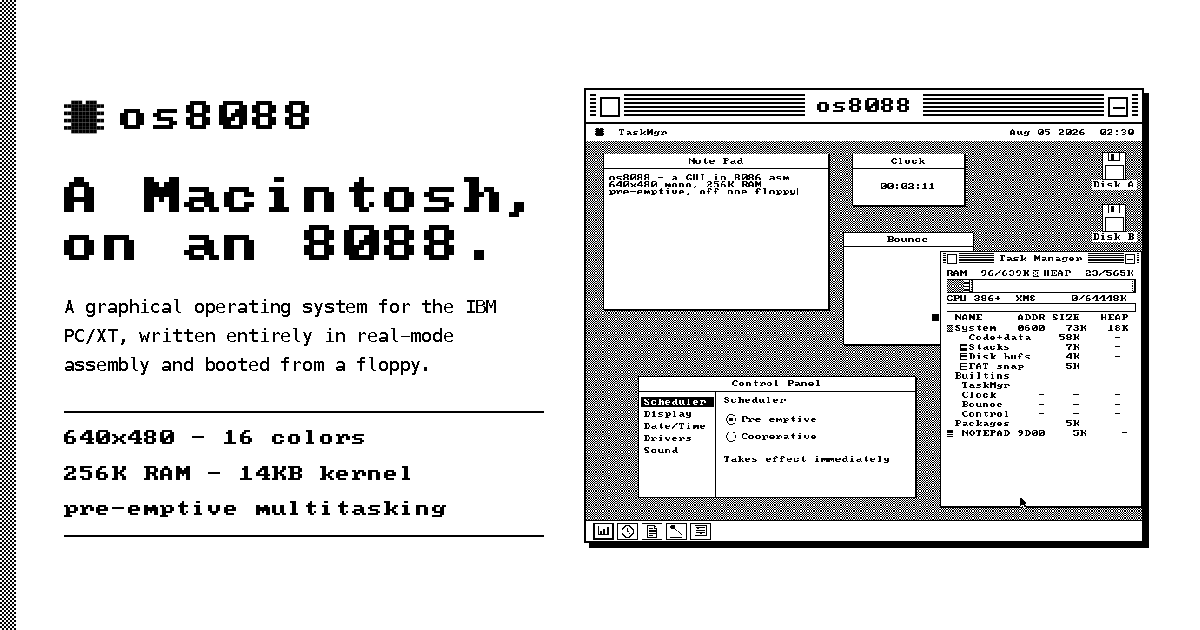
Os8088 is a free, newly released operating system that brings a classic Macintosh System 1-style graphical interface to vintage Intel 8086 and 8088 machines. Written entirely in real-mode assembly, the lightweight software boots from a floppy disk and requires only 256KB of RAM to run on older IBM XT, 286, and 386 computers.
CommentsImproving Heuristics for A* Pathfinding
2026-08-09A newly published guide on improving the A-star pathfinding algorithm details advanced techniques like landmark-based distance estimation to drastically reduce node exploration. The interactive article by Red Blob Games, which the author refined over nearly two decades, provides deep insights into algorithmic bounds and practical applications for dynamic path recalculations in game development. Readers are highly praising the resource for its intuitive explanations and significant value to software developers.
Comments
Shopify successfully migrated its inventory reservation system from Redis to MySQL to achieve greater scalability. The engineering team leveraged specific database features, including SKIP LOCKED, composite primary keys, and connection visibility, to meet their demanding performance targets.
Comments
Making difficulty curves in games
2026-08-09A recent post on the Just Things Made By Dave blog explores the mechanics of designing effective difficulty curves in video games. The article breaks down how developers can balance challenge and player progression to optimize engagement and refine difficulty scaling techniques.
Comments
TheoremDB is a new public workspace dedicated to advancing collaborative machine mathematics. The platform allows users to track open problems, maintain permanent records of proofs, and properly attribute credit to contributors. By centralizing this computational evidence, the tool aims to streamline research and preserve the history of mathematical attempts.
CommentsTriton: DirectX 11 Driver for QEMU
2026-08-09The newly released Triton Windows driver brings full DirectX 11 support and modern graphics acceleration to QEMU virtual machines. By working alongside the previously introduced Neptune protocol forwarding layer, it enables high-performance graphics for Windows guests.
CommentsGrammaTech has released DDisasm, a fast and accurate reversible disassembler that supports bidirectional operations. The open-source tool is hosted on GitHub, where developers are encouraged to contribute to its ongoing development.
Comments
As the software development profession faces significant upheaval from the AI revolution, a new article pushes back against the dismissive claim that writing code was never the hard part. The piece defends the complex problem-solving and architectural skills that truly define a programmer's work beyond just typing out syntax.
Comments
Message your other Claude Code sessions
2026-08-09Claude Code now allows users to list and message multiple active sessions running on a single machine. With the new Remote Control feature, developers can also reply to these sessions remotely from other devices or directly through the web. This update streamlines multitasking and enables seamless cross-device workflow management.
CommentsVoyager 1 FDS Computer Emulator
2026-08-09A developer has created an emulator for the Voyager 1 spacecraft's FDS computer, highlighting its remarkably minimal instruction set. Enthusiasts are praising the project and suggesting enhancements like implementing realistic deep-space signal delays and integrating the emulator with virtual space simulators.
Comments2026-08-08

The Nixpkgs core team has disbanded
2026-08-08The Nixpkgs core team has disbanded after ten months of leading the project. The team expressed pride in their achievements and their role in establishing a bottom-up, consensus-focused governance model.
Comments