Programming Tech News
Writing software is a craft that keeps reinventing itself. This section gathers news and articles for people who program, covering language releases, compilers and runtimes, frameworks, development workflows, and the ideas that change how code gets written and reviewed.
Typical stories include new versions of Rust, Python, Java, JavaScript, and TypeScript, performance and debugging investigations, essays on architecture and code quality, and discussions of how AI coding assistants are changing day-to-day development. Hands-on tutorials and lessons from long-running projects show up often.
The tools and practices developers choose affect how fast teams ship and how well their software holds up over time. Working engineers, students learning to code, and engineering leaders follow this coverage to sharpen their skills and make better technical decisions.
2026-05-05

Recent updates detail how Multi-Token Prediction drafters are significantly accelerating inference speeds for Gemma 4 models. By predicting multiple tokens simultaneously, this technique allows the AI to generate outputs up to three times faster. This optimization marks a major performance improvement for developers deploying these language models.
Comments
Plain Docker Compose remains a viable option for production workloads in 2026, provided teams address its inherent operational limitations. To ensure stability and security, organizations must implement specific solutions for cleanup, service healing, image pinning, socket security, and automated updates.
Comments
Zig → Rust porting guide
2026-05-05The Bun team has published a Phase-A porting guide to assist developers in migrating its high-performance JavaScript runtime and package manager from Zig to Rust. This new documentation outlines the initial steps for contributors to help streamline the ongoing codebase transition.
Comments
Agent Skills
2026-05-05AI coding agents often prioritize rapid task completion by bypassing crucial software development practices like specifications, testing, and code reviews. This shortcut approach can severely compromise the reliability of scalable software. New methodologies centered on Agent Skills aim to correct this behavior by enforcing robust engineering standards in AI-driven development.
Comments
Async Rust never left the MVP state
2026-05-05A Rust contributor has submitted an official Project Goal to address the persistent async bloat that has kept the language's asynchronous implementation in a suboptimal MVP state. Seeking to resolve the inefficiencies directly within the compiler rather than relying on workarounds, the author is currently asking for funding and collaborator support to drive the effort forward.
CommentsTrain Your Own LLM from Scratch
2026-05-05A new open-source GitHub project by developer angelos-p provides the code and resources necessary to train an LLM entirely from scratch. The repository serves as a collaborative space for programmers to learn the foundational mechanics of AI architecture. Users are encouraged to create an account and contribute to the ongoing development of the codebase.
Comments
As AI agents make code generation virtually costless, software development is undergoing a fundamental paradigm shift. This piece outlines essential guidelines for developers navigating the era of agentic coding and adapting their workflows to this new reality. Ultimately, it emphasizes that programmers must shift their focus from writing code to effectively managing, reviewing, and directing abundant AI-generated outputs.
Comments
AI didn't delete your database, you did
2026-05-05A recent tech commentary argues that blaming artificial intelligence for deleting databases is merely a deflection of human error and poor decision-making. To prevent future disasters, organizations must take full accountability and ensure their teams consist of competent developers.
Comments
Hand Drawn QR Codes (2025)
2026-05-05A newly highlighted open-source Python project enables the generation and decoding of hand-drawn QR codes, blending analog artistry with digital data encoding. The tool leverages internet-driven community collaboration to demonstrate how physical, handcrafted visuals can seamlessly integrate with modern computational technologies.
Comments2026-05-04
Developer discussions regarding a Redis array project reveal that advanced AI-assisted coding relies on rigorous verification and adversarial prompting rather than the hands-off vibe coding trend. By utilizing techniques like persona-driven prompting and continuous model cross-examination, engineers maintain strict control over code quality while significantly speeding up the development cycle. Ultimately, practitioners emphasize that large language models serve as powerful accelerators for established software engineering workflows rather than ushering in a completely unsupervised paradigm.
CommentsI am worried about Bun
2026-05-04Anthropic's recent acquisition of the excellent developer tool Bun has sparked concerns about its future. Because Bun now sits under Claude Code, observers fear it could suffer from the same quality decline recently experienced by Anthropic's AI coding assistant.
Comments
How Monero’s proof of work works
2026-05-04Unlike Bitcoin's fixed hash model, Monero utilizes a unique proof of work algorithm called RandomX that requires executing random, CPU-friendly programs over a large memory dataset. This distinct approach allows the network's mining process to behave fundamentally differently from ASIC-first systems.
CommentsIntroduction to Atom
2026-05-04A recent Hacker News discussion explored the continued relevance of the Atom XML syndication format, noting that platforms like GitHub and YouTube still actively use the 2005 protocol for tracking updates. Despite its niche status today, users praised the feed's reliability and highlighted its practical applications for monitoring repositories and videos. Participants also criticized major tech companies for deliberately abandoning semantic web standards in favor of closed ecosystems that restrict open information sharing.
CommentsPyInfra 3.8.0
2026-05-04PyInfra version 3.8.0 has been released, updating the infrastructure tool that translates Python code into executable shell commands. The release continues to support fast, highly scalable ad-hoc and declarative operations across SSH servers, local machines, and Docker containers.
CommentsThe 'Hidden' Costs of Great Abstractions
2026-05-04Driven by the rise of AI tools, the tech industry is shifting away from deep engineering fundamentals and premium developer compensation toward rapid commercial development. This transition threatens long-term software quality as non-technical managers cut corners, mirroring the decline seen in the homebuilding sector. Nevertheless, software companies will likely avoid consumer backlash and financial liability due to high switching costs and restrictive end-user agreements.
Comments
Formatting a 25M-line codebase overnight
2026-05-04A developer productivity team successfully deployed rubyfmt, an ultra-fast Rust-based autoformatter, across the world's largest Ruby codebase. The zero-config tool was specifically extended to handle massive scales, enabling the team to format the entire 25-million-line repository overnight.
Comments
Texico is a new educational program that teaches fundamental programming principles without requiring students to use a computer. The platform uses engaging animated characters to introduce five core computational processes in a fun and accessible way.
Comments
Despite the persistent myth among developers that text-based applications are inherently accessible, modern terminal user interfaces often create significant barriers for visually impaired users. The article explores how these text environments frequently fail to support screen readers and other assistive technologies properly. It urges developers to look beyond basic text rendering and implement genuine accessibility standards in their terminal applications.
CommentsK3sup – bootstrap K3s over SSH in < 60s
2026-05-04K3sup is an open-source tool that allows developers to rapidly bootstrap K3s Kubernetes clusters over SSH in under 60 seconds. The utility significantly simplifies cluster provisioning, offering a highly efficient solution for deploying lightweight Kubernetes environments.
Comments
Agentic Coding Is a Trap
2026-05-04While agentic coding tools offer significant productivity benefits, a new article warns that over-reliance on AI agents can lead to severe cognitive debt and skill atrophy among developers. To avoid this technological trap, engineers must remain vigilant and actively maintain a fundamental understanding of their own codebases.
Comments2026-05-03
DeepClaude is a new open-source project that allows developers to run Claude Code's autonomous agent loop using DeepSeek V4 Pro or other Anthropic-compatible backends. This integration provides the exact same user experience as the original tool while reducing overall costs by up to 17 times.
Comments
Fintech company Mercury recently shared insights into its production engineering practices, revealing that it now operates a massive codebase of two million lines of Haskell. This extensive use of the functional programming language successfully supports the backend infrastructure for approximately 300,000 business customers. The update provides a rare look into the scalability and reliability of running functional languages in large-scale enterprise environments.
CommentsWhy TUIs are back
2026-05-03The recent resurgence of text-based user interfaces is largely driven by modern development libraries like Ratatui and Ink that have drastically simplified cross-platform TUI creation. Alongside these framework improvements, advanced terminal emulators with enhanced ANSI support and rendering capabilities have made text-based applications a highly viable alternative to traditional graphical interfaces.
CommentsText-to-CAD
2026-05-03The open-source repository Text-to-CAD provides a specialized collection of AI agent skills designed for computer-aided design, robotics, and hardware engineering. By leveraging these tools, users can automate complex tasks and streamline physical design workflows. This integration of agentic capabilities aims to significantly accelerate the development cycle for next-generation hardware and robotic systems.
CommentsA new web playground allows users to generate 3D Gaussian Splats directly in their browser using Apple's SHARP model. The project runs the machine learning model entirely client-side by leveraging the ONNX runtime web. This enables developers to experience advanced rendering techniques without requiring powerful local hardware.
Comments
A new physics engine named Easel features incremental rollback technology designed specifically to enhance multiplayer gaming experiences. The developers aim to make the platform powerful enough to support the creation of deeply engaging, long-play games.
CommentsResearchers have developed a more efficient implementation of Shor's algorithm, significantly reducing the quantum resources needed for integer factorization. This optimization marks a major milestone in quantum computing by making the process faster and less resource-intensive. Ultimately, this advancement brings the threat to current cryptographic systems one step closer to practical reality.
Comments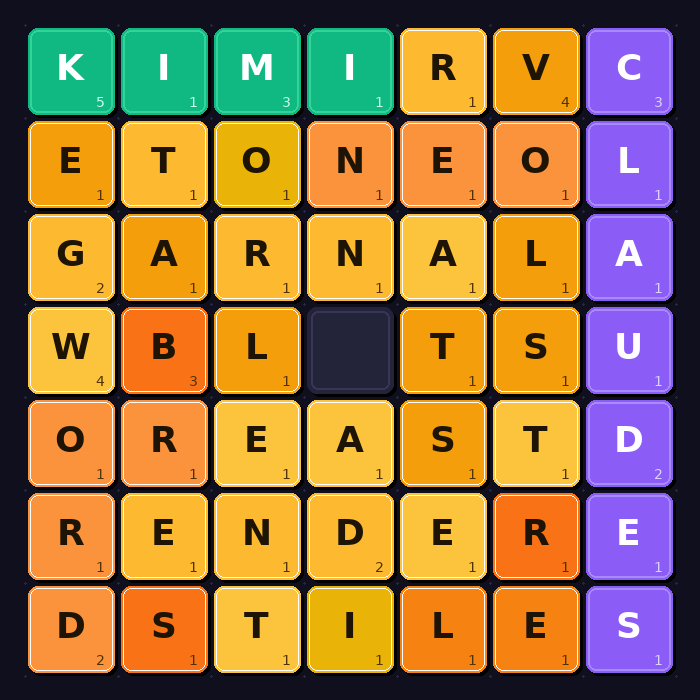
Kimi K2.6, an open-weights model from Chinese startup Moonshot, defeated major competitors like Claude, GPT-5.5, and Gemini in an ongoing AI coding contest. The unexpected victory took place during a real-time programming puzzle that evaluated ten language models using objective scoring.
Comments
The author discusses techniques for preventing AI psychosis during coding sessions by structuring project specifications in YAML. They have also open-sourced a new toolkit to help developers easily implement this structured approach in their own workflows.
Comments2026-05-02
Visual Studio Code is incorrectly appending a Co-Authored-by Copilot tag to git commits even when developers are not actively using the AI coding assistant. This unintended behavior results in inaccurate code attribution and has raised concerns among developers who want to accurately reflect their use of AI tools.
Comments