Programming Tech News
Writing software is a craft that keeps reinventing itself. This section gathers news and articles for people who program, covering language releases, compilers and runtimes, frameworks, development workflows, and the ideas that change how code gets written and reviewed.
Typical stories include new versions of Rust, Python, Java, JavaScript, and TypeScript, performance and debugging investigations, essays on architecture and code quality, and discussions of how AI coding assistants are changing day-to-day development. Hands-on tutorials and lessons from long-running projects show up often.
The tools and practices developers choose affect how fast teams ship and how well their software holds up over time. Working engineers, students learning to code, and engineering leaders follow this coverage to sharpen their skills and make better technical decisions.
2026-04-14

Claude Code Routines
2026-04-14Anthropic has introduced Claude Code Routines, an automation feature that allows developers to put its coding assistant on autopilot. The new tool runs on Anthropic-managed cloud infrastructure, letting users define custom routines that execute on a set schedule, trigger via API calls, or react automatically to GitHub events.
CommentsA recent article claiming to find a bug in a program proven correct by the Lean proof assistant has sparked debate over the true boundaries of formal verification. Critics argue the headline is misleading because the discovered flaws actually existed in unverified code and the Lean language runtime rather than the proven logic itself. However, others counter that from an end-user perspective, any underlying runtime or specification vulnerability still compromises the reliability of the final software.
Comments
Introspective Diffusion Language Models
2026-04-14The Introspective Diffusion Language Model, or I-DLM, is the first diffusion-based language model to match the quality of traditional autoregressive models. It achieves impressive benchmark scores in mathematics and code generation, reaching 69.6 on AIME-24 and 45.7 on LiveCodeBench-v6. Additionally, it significantly outperforms comparable systems like LLaDA-2.1-mini by delivering 2.9 to 4.1 times higher throughput.
Commentsjj – the CLI for Jujutsu
2026-04-14Jujutsu is a version control command line interface built on Git storage that offers a streamlined workflow by automatically incorporating changes into the current commit without a staging area. While some developers prefer the traditional Git mental model, advocates praise Jujutsu for its intuitive history rewriting, seamless conflict resolution, and undo capabilities that eliminate the need for stashing. Community discussions emphasize evaluating the tool based on its own unique affordances rather than strictly comparing it to Git.
Comments5NF and Database Design
2026-04-14A newly published article by Alexey Makhotin aims to demystify the fifth normal form in relational database design. The author deconstructs traditional teaching methods to show that the complexity commonly associated with this advanced normalization concept is entirely artificial. This piece builds on a previous exploration of the fourth normal form, continuing the effort to make foundational database topics more accessible.
CommentsA new open-source project called WiiFin brings the popular Jellyfin media server to the Nintendo Wii console. Hosted on GitHub by developer fabienmillet, the client allows users to stream their personal media libraries directly on the classic gaming hardware. The project is currently in active development and welcomes community contributions to help expand its features.
Comments
Write less code, be more responsible
2026-04-14This opinion piece examines the dual impact of AI-assisted programming, highlighting how automated tools allow developers to write less code while increasing their accountability for the final product. The author emphasizes that engineers must maintain strict oversight over code quality, security, and system architecture to responsibly manage AI-generated outputs.
CommentsOpenSSL 4.0.0
2026-04-14OpenSSL has announced the release of version 4.0.0 for its widely used general-purpose TLS and cryptographic library. This major milestone ensures the continued provision of essential security protocols for secure internet communications. Developers interested in contributing to the ongoing development of the project can collaborate via its official GitHub repository.
Comments
A comprehensive look into DuckDB's architecture reveals the design and implementation of this in-process SQL database optimized for analytical query processing. Built with zero external dependencies, it offers seamless integration and easy installation across multiple programming languages like Python, C++, and Java. This overview highlights how its streamlined internals enable high-performance data analysis directly within host applications.
Comments
While closed-source models offer seamless tool calling via standardized APIs, open-source models face a fragmented M×N integration problem. This discrepancy highlights the ongoing challenge of creating unified function-calling capabilities across the diverse open-source ecosystem.
CommentsLangAlpha is a new open-source project that adapts the AI capabilities of Claude Code specifically for the financial markets. Designed to function as a dedicated AI agent for Wall Street, the tool aims to assist with complex financial operations and data analysis. Developers can currently contribute to its ongoing development via the project's GitHub repository.
CommentsA new open-source, full-stack Python web framework called Plain has been introduced on Hacker News to streamline application development. Uniquely designed to support both human developers and AI agents, the project is now available for community contribution via GitHub.
CommentsPractitioners treating multi-agent software development as a distributed systems problem emphasize using sequential pipelines with strict verification gates to ensure overall reliability. By applying deterministic checks and quality boundaries between planning, designing, and coding stages, developers can effectively manage the inherent unpredictability of large language models. This approach transforms unreliable individual agents into a coordinated protocol that consistently preserves user intent across different artifact representations.
CommentsGAIA is a new open-source framework that enables developers to build and run AI agents directly on local hardware. Supporting both Python and C++, the tool provides a flexible foundation for creating localized artificial intelligence applications specifically optimized for AMD systems.
Comments2026-04-13
GitHub Stacked PRs
2026-04-13GitHub Stacked PRs is a new workflow feature that allows developers to break down large code changes into smaller, more manageable pull requests. By stacking these incremental updates, teams can significantly streamline their code review process and handle complex changes more efficiently.
CommentsA new Polymarket bot named Nothing Ever Happens automatically purchases No shares on all non-sports prediction markets. Created by developer Sterling Crispin, the automated tool is designed purely for entertainment and functions primarily as a meme.
Comments
A newly published arXiv paper demonstrates that all elementary mathematical functions can be derived using only a single binary operator. This theoretical work simplifies the foundational basis for mathematical computation by reducing complex operations to a minimal logical primitive. While highly theoretical, the findings could eventually influence algorithmic design, computational logic, and the optimization of digital circuits.
Comments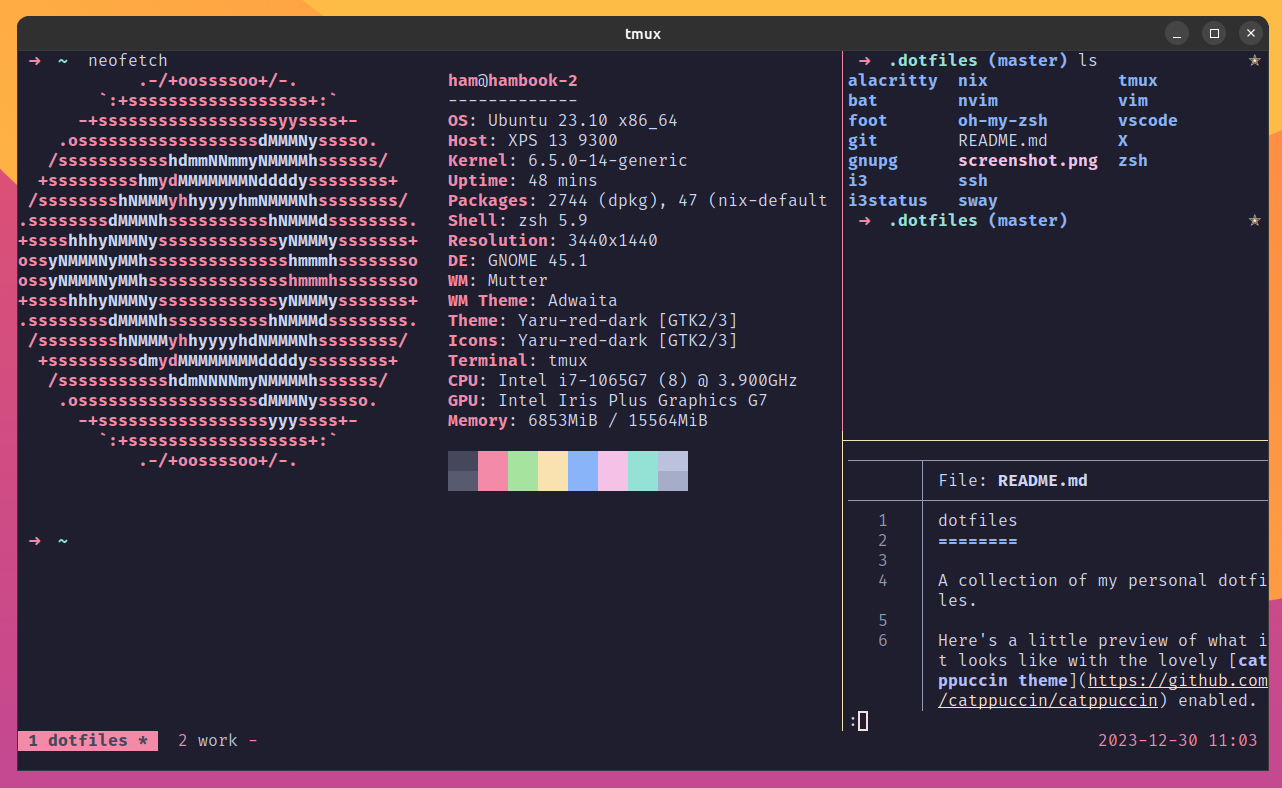
Make tmux pretty and usable (2024)
2026-04-13A recent guide provides developers with practical strategies for customizing the look and feel of the terminal multiplexer tmux. The article explores modern themes, plugins, and configuration tweaks to significantly improve the default interface. These enhancements ultimately transform the tool into a highly usable and visually appealing workspace for daily workflows.
Comments
AMD is challenging Nvidia's dominant CUDA ecosystem by leveraging its fully open-source ROCm stack and integrating the Triton compiler. By embracing a software-first culture, the company aims to steadily erode Nvidia's competitive moat in the accelerated computing market.
Comments
Building a CLI for all of Cloudflare
2026-04-13Cloudflare has introduced a new unified command-line interface called cf to streamline interactions with its nearly 3,000 API operations for both developers and AI agents. The release also includes Local Explorer, a new utility designed to help users debug local data.
Comments
Servo is now available on crates.io
2026-04-13The Servo web engine is now available on crates.io, marking its first official release on the Rust package registry. This milestone introduces a Long-Term Support version, providing developers with a stable and reliable foundation for future integration.
CommentsA perfectable programming language
2026-04-13A recent discussion surrounding the perfectable programming language Lean explores the balance of language power, contrasting math-focused tools like Lean and Agda with general-purpose dependently typed languages like Idris. Participants also debate the true semantic value of homoiconicity in enabling advanced meta-programming, highlighting the ongoing challenge of designing dependently typed languages that are powerful enough for formal proofs without falling victim to unproductive complexity.
CommentsHow to make Firefox builds 17% faster
2026-04-13Firefox builds can now be completed 17% faster by utilizing the buildcache tool to cache WebIDL binding code generation. This optimization leverages buildcache's unique Lua plugin system, which allows for custom wrappers that traditional caching tools cannot support.
Comments
A recent analysis highlights that most organizations lack clear visibility into the actual costs and required revenue generation of their software engineering teams. This widespread financial blind spot prevents companies from accurately measuring the true economic viability of their technical departments.
CommentsA new benchmark called N-Day-Bench evaluates the ability of large language models to identify real-world vulnerabilities within actual codebases. The framework utilizes strict GitHub advisories and OpenRouter-backed models to rigorously test AI-driven security scanning capabilities.
CommentsReaders testing Gemma 4 locally report that while the model delivers exceptional inference speed and impressive one-shot coding performance rivaling top-tier proprietary AI, it struggles significantly with agentic tasks, tool use, and large context windows. Although early benchmarks were skewed by tokenizer and tool invocation bugs, corrected tests show the dense 31B variant actually outperforms the faster MoE model in overall quality. Ultimately, users praise its capabilities for specific local coding tasks on Apple Silicon but note that its limitations in iterative reasoning and context scaling prevent it from being a flawless autonomous coding assistant.
CommentsA developer investigated a 25% performance regression in LLVM for RISC-V targets by analyzing a specific benchmark. They successfully identified the issue and landed a patch that eliminates the performance gap with GCC for this workload.
CommentsA newly published arXiv paper introduces advanced compiler optimization techniques for performing 32-bit unsigned division by constants on 64-bit processor architectures. The research focuses on improving computational efficiency and reducing execution overhead for these specific arithmetic operations. These optimizations are expected to benefit modern software development by streamlining low-level mathematical computations.
Comments2025-10-20
RapDv is a modern JavaScript framework, built with intention for a rapid, scalable and repeatable development. This article describes its architecture, and how to develop and deploy web apps with it.
Comments2021-05-01

Spaghetti code doesn't just look bad, it makes code brittle and prone to bugs. A modular programming architecture decouples interdependency and makes your code more robust.
Comments