Programming News
Programming keeps evolving as languages mature, tooling improves, and teams rethink how software should be written. This section follows that change, gathering news and articles about programming languages, compilers, development practices, and the craft of writing reliable, maintainable code.
Typical stories include language releases and proposals, deep dives into compiler and runtime internals, performance investigations, debates about coding style and architecture, and essays from experienced engineers on lessons learned. Popular ecosystems such as Rust, Python, JavaScript, and TypeScript appear regularly.
Keeping up with these topics helps developers choose the right tools, avoid known pitfalls, and grow their skills. Working engineers, students, and technical leaders follow this coverage to stay current with the ideas shaping how software gets built.
2026-09-28

A 2021 technical demonstration showcases a vehicle successfully trained to self-park using a genetic algorithm. By leveraging evolutionary computing instead of traditional programming, the car autonomously learns to navigate and park, highlighting innovative machine learning applications in autonomous driving.
CommentsThe state of SIMD in Rust in 2026
2026-09-28The author reflects on the significant advancements made to Rust's SIMD capabilities over the past year, including their own personal contributions. The piece provides a comprehensive overview of the current state of SIMD in the language as of 2026.
Comments
What I did at Recurse Center
2026-09-28The author recounts their summer experience at the Recurse Center, a Brooklyn-based programming retreat recommended by a friend. The post details the various projects and activities the writer completed during their time at the retreat.
CommentsWriting Efficient C++ Code (2013)
2026-09-28Discussions surrounding a 2013 article on efficient C++ programming emphasize prioritizing cache locality and contiguous memory layouts over traditional, pointer-heavy data structures to minimize costly cache misses. While packing data into arrays or vectors generally outperforms theoretical algorithmic complexity on modern hardware, developers caution that standard C++ library tools can be inherently slow and fragmented. Ultimately, readers conclude that while data-oriented design is crucial, complex applications still require rigorous profiling to avoid the hidden pitfalls of misguided optimizations.
Comments2026-09-27

Go Concurrency Distilled
2026-09-27A newly released interactive mini-book titled Go Concurrency Distilled offers developers a hands-on approach to mastering concurrent programming in Go. The resource provides practical exercises and insights to help programmers efficiently leverage the language's powerful concurrency features.
CommentsThe rise of AI-driven code generation is prompting a fundamental reevaluation of how programming languages are designed. As machines become the primary writers of code, future languages will likely evolve to prioritize machine efficiency and optimization over human readability. This transition will ultimately reshape the entire landscape of software development.
CommentsDrawgent is a next-generation social coding platform that integrates an AI coding agent directly onto a live Excalidraw canvas. This tool enables developers to collaboratively build and visualize software projects in real-time by seamlessly merging visual whiteboarding with automated code generation.
CommentsA new introduction to modern Object Pascal has sparked nostalgic discussions among developers who originally learned to code using Turbo Pascal and Delphi. The community highlights the language's historical impact on early software while expressing renewed interest in its modern capabilities, such as compiling to JavaScript and supporting inline variable declarations. Some readers also suggest that a light fork could further modernize the ecosystem by cleaning up legacy namespaces and starting the runtime library afresh.
CommentsReaders discussing an article about modifying programming languages criticized the recurring trend of dismissing fundamental concepts just because LLMs can process them faster. However, the discussion highlights that the fear of language macros is largely overblown. While macro abuse can occur, features like the core.async library in Clojure show that macros often improve code readability and understanding when used properly.
Comments
The Lost Atomic Update on Loongson CPU
2026-09-27A new technical article details a developer's troubleshooting process for a missing atomic update bug on the Loongson CPU. The piece provides practical insights into low-level programming and board-level debugging required to resolve this critical hardware synchronization issue.
Comments
This article explores strategies for software developers to maintain their passion for coding amid the rapid rise of large language models. It addresses common industry anxieties, including AI burnout, job displacement by less skilled programmers, and frustrations over declining code quality. Ultimately, the piece offers guidance on how to uphold high engineering standards and find fulfillment in an increasingly AI-driven landscape.
Comments2026-09-26
Plan mode is dead
2026-09-26The author of a recent piece argues that plan mode is dead, reversing their earlier belief that planning would be the most critical aspect of building software with AI. This shift suggests a fundamental change in how developers should approach AI-assisted coding and software creation.
CommentsRemembering Johannes Doerfert
2026-09-26The LLVM project community is paying tribute to Johannes Doerfert, a dedicated contributor to the open-source compiler infrastructure. This memorial highlights his significant impact on the project and the lasting legacy he leaves behind in the software development trenches.
CommentsI wrote a ray tracer in Brainfuck
2026-09-26A developer has successfully built a ray tracer using the notoriously difficult esoteric programming language Brainfuck. To accomplish this, they designed a custom domain-specific language and utilized a Python-based code generator to compile the final output. The project highlights an impressive technical workaround for rendering complex graphics in an extremely constrained programming environment.
CommentsThis technical piece explores the mathematical principles of Fourier analysis through a creative visualization that draws a llama using rotating circles. By programming a series of connected epicycles, the project demonstrates how complex spatial curves can be accurately reconstructed from simpler frequency components. The demonstration highlights the fascinating intersection of advanced mathematics, computer programming, and digital art.
CommentsTiddlyInstall is a universal installation system created by Matthew Roberts with AI assistance that packages a complete, cross-platform installer builder into a single HTML file. The tool simplifies software distribution by automatically managing runtime dependencies like Python and Node.js, allowing users to create, edit, and sign reusable installers directly in their browser without a server.
Comments2026-09-25
Fearless SIMD v1.0
2026-09-25The Fearless SIMD library has officially reached its 1.0 release, providing a stable toolset for developers working with vectorized instructions. This major milestone aims to make high-performance SIMD programming safer and significantly more accessible for software engineers.
Comments
Rails World 2026 Opening Keynote [video]
2026-09-25During the opening keynote at Rails World 2026 in Austin, DHH focused his presentation on the rapid rise of AI agents in software development. He revealed that 37signals has ceased handwritten coding to transition toward AI-driven workflows. Additionally, he explained how the foundational conventions of the Rails framework continue to provide essential structure in this new landscape.
Comments
A recent blog post reviews Paul E. McKenney's free online textbook on parallel programming, authored by the creator of the Linux kernel's RCU synchronization mechanism. The reviewer shares their initial impressions and personal context after reading a substantial portion of the comprehensive guide.
Comments2026-09-24
Show HN: Combinators in Array Languages
2026-09-24A new Hacker News post introduces fixed-point combinators, including the Y combinator, to array languages through a live interactive demo. The accompanying educational materials explore these programming concepts using the famous combinator bird puzzles from Raymond Smullyan's book To Mock a Mockingbird.
Comments2026-09-23

Claude Opus 5.5
2026-09-23The newly released Claude Opus 5.5 leads the industry in agentic coding and knowledge work. It also provides significant cost efficiency, running at 40% less than the previous Opus 5 model on typical workloads.
CommentsMicrosoft discontinued Visual FoxPro in 2007, but developers have now revived the legacy programming environment. The new project provides a 64-bit runtime and modern IDE for existing Visual FoxPro 9 applications. This rebuild reconstructs the original language using contemporary technologies, including Electron, React, and a Rust-based WebAssembly virtual machine.
Comments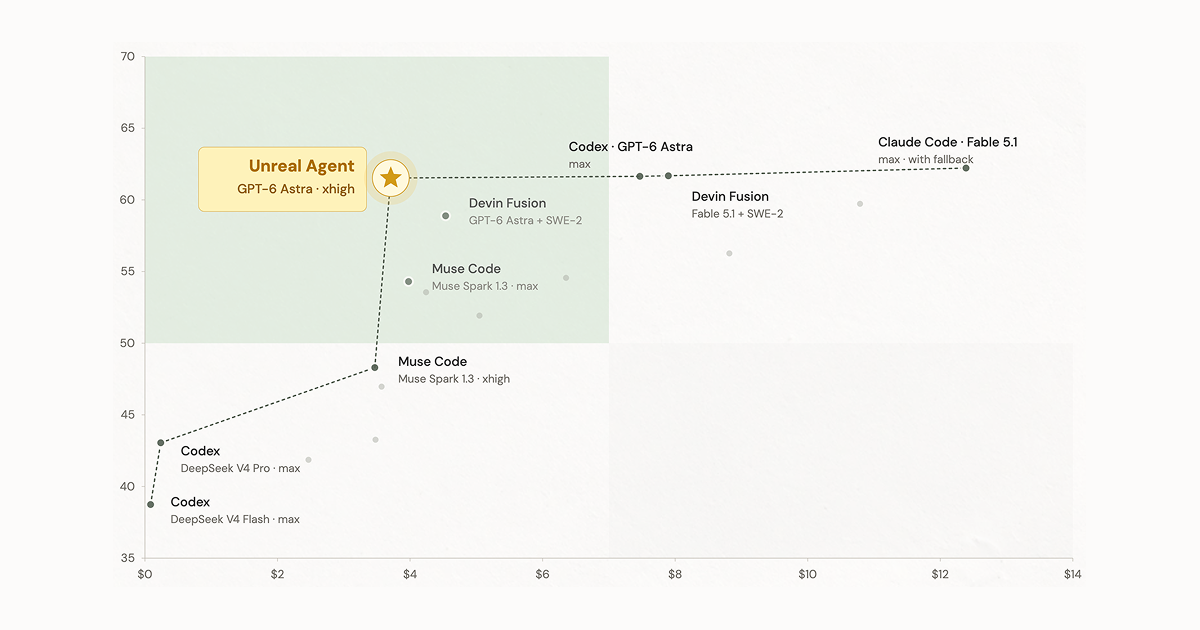
Unreal Agent
2026-09-23Unreal Agent is a newly introduced agent harness that delivers up to 40% cost savings compared to Codex across production workloads and coding benchmarks. The tool achieves these financial efficiencies without causing any negative impact on overall performance.
CommentsDevelopers can now explore example Gea applications that demonstrate building native apps using TypeScript and CSS. These sample projects are fully compatible with the Gea simulator and all supported target platforms, providing a practical starting point for cross-platform development.
Comments2026-09-22

As AI coding tools accelerate development, Continuous Integration pipelines have become costly bottlenecks that delay pull requests. To overcome this, an engineering team rearchitected their CI system by optimizing infrastructure, work scheduling, and test parallelization, successfully reducing both wait times and operational costs.
Comments

Cloudflare has made Python Workers generally available, enabling developers to run Python web frameworks and AI orchestration libraries natively within the Workers runtime. This release allows seamless integration with Cloudflare services like D1, R2, and Workers AI without requiring any JavaScript glue code.
CommentsDespite its title claiming it is a new programming language for data munging, TXR is actually a mature Lisp-based language first released in 2009. Community discussions note that the project appears unmaintained, with no code changes in over a year. Consequently, developers remain highly skeptical about its chances of gaining mainstream popularity anytime soon.
Comments2026-09-20

A newly published arXiv paper introduces compiler-style optimizations for 2D rasterization within the Skia graphics engine. The research establishes formal semantics for drawing operations to provide a rigorous foundation for these rendering processes. Ultimately, this compiler-inspired approach aims to significantly enhance the efficiency and performance of visual processing in applications that rely on Skia.
Comments
Supabase (YC S20) Is Hiring for OrioleDB
2026-09-20Open-source backend platform Supabase is hiring an engineer to lead the development of OrioleDB, a next-generation storage engine for PostgreSQL. The fully remote role requires deep expertise in C programming and database internals to build new features, enhance system stability, and contribute directly to the upstream PostgreSQL core.
Comments