Mental Health Tech News
SubmitTechnology is playing a growing and sometimes controversial role in mental health care. Read news here about therapy and meditation apps, AI-powered support tools, digital health startups and their funding, and the research and regulatory debates around treating minds with software.
Stories in this section cover teletherapy platforms expanding or consolidating, AI chatbots being tested as support tools and the safety questions they raise, clinical trials of digital therapeutics, and employer and insurer moves to cover mental health apps. Privacy concerns around sensitive health data come up often.
Demand for mental health care far exceeds the supply of clinicians, which makes the promise and the risks of these tools significant. Clinicians, health systems, investors, and people seeking care themselves follow this coverage to see which digital approaches earn evidence and trust.
2026-11-09
A Canadian national health report finds that too many men are suffering in silence, with readers tying men’s mental health struggles to perceived bias in divorce and family-law proceedings. Discussion highlights men who lost wealth and stability after divorce and calls for truly gender-neutral laws, while also correcting common misconceptions about common-law marriage.
CommentsA new GitHub project offers a small LLM inference engine built from scratch, accompanied by more than six hours of YouTube tutorials and 85+ pages of handwritten notes. The resource aims to help developers learn LLM inference fundamentals through hands-on implementation and detailed study materials.
Comments
Readers discussing how to manage AI-agent context across clients and projects largely recommend building custom lightweight harnesses and workflows rather than relying on one tool. Suggested practices include gatekeeper scripts that force wiki/documentation updates, semantic search over project knowledge, commit-linked chats, issue trackers and write-only ledgers for coordination, plus sandboxing agents and keeping granular usage data. Commenters also stress managing one's own attention and mental load, and staying ready to ditch tools as the fast-changing ecosystem evolves.
Comments
A primer on GPUs and kernel optimization
2026-11-09This primer covers GPU fundamentals, profiling tools, distributed computation, and kernel optimization for readers seeking a foundation in accelerated computing. It explains the basics needed to understand and improve performance across GPU workloads.
Comments2026-11-04
Rocky Linux founder Gregory Kurtzer had a single OpenAI Codex task (GPT-5.6 Sol) write Ginux in eleven days. The result is about 139,000 lines of Rust and test code for an x86-64 kernel that boots from UEFI without Linux and runs unmodified Linux programs, including Rocky Linux 10 with systemd. It's an experimental research project tested in QEMU, not a replacement for Linux, and it comes with a technical report on how he directed the agent.
CommentsSynaptics appears to be using legal threats to block an experimental open-source Linux driver for modern DisplayLink hardware. The driver emerged earlier this year, and the dispute highlights tensions between proprietary hardware makers and open-source Linux support efforts.
CommentsThe Internals of PostgreSQL
2026-11-04A reader discussion around The Internals of PostgreSQL notes renewed interest in PostgreSQL’s SSI implementation following the latest Jepsen report on ParticleDB. For readers skimming the document, the HOT update path is recommended as the key section, with zHeap implementation notes and TOAST material providing a useful mental model of what PostgreSQL does and does not do.
Comments2026-11-02

A Chemical Hunger (2021)
2026-11-02A Chemical Hunger (2021) frames obesity research as a field full of unresolved mysteries, challenging settled explanations for why people gain weight. The piece explores the possibility that environmental or chemical factors may drive hunger and obesity in ways that conventional accounts miss.
Comments2026-11-01

Mathematician Frank Calegari argues that recent AI advances, including OpenAI’s October release, have fundamentally changed mathematics and that the field should respond accordingly rather than mourn the shift. He urges mathematicians to adapt to this new landscape and act as though the change is already here.
CommentsMexico is responding to a massive seaweed influx that has discolored coastal waters, with officials framing the effort as a “war” on the seaweed and reportedly involving the navy. Reader discussion criticized the dramatic “War on X” rhetoric, suggesting instead that the seaweed be harvested for food or reprocessed into useful products. The debate reflects frustration with militarized language being applied to an environmental cleanup challenge.
Comments2026-10-30
A 2011 article presents a sophisticated diagram for splitting one’s digital life into separate security domains to limit risk. The author acknowledges that most users would likely find the scheme too complex, but it offers a model for compartmentalizing accounts and data.
CommentsA new study finds that schoolwide phone bans have no significant impact on students’ mental health. The results suggest that blanket restrictions alone may not be enough to improve student wellbeing.
Comments2026-10-29
Stack Overflow is now receiving fewer than 1,000 questions a month—below even its earliest months—and discussion participants say the site has effectively ceased to function as a thriving Q&A community. They attribute the decline to years of hostile moderation and user treatment that drove contributors away, especially as LLMs and chatbots offer faster, less judgmental alternatives. Many expect the site to keep running only as long as selling AI training data remains valuable.
Comments2026-10-28
Assembly Nights
2026-10-28Assembly Nights appears to make the case for returning to low-level programming as a way to counter skill atrophy from heavy Claude/Codex use and keep engineering fundamentals sharp. Readers are receptive to the idea, with discussion turning to practical choices like NASM versus FASM and whether GDB is the right tool for debugging assembly.
CommentsA Kentucky man has become the first humanist granted a religious exemption from AI, arguing that offloading the mental and ethical work of thinking through situations undercuts his ability to develop as a moral actor. Commenters largely agreed with the caution, while stressing that the goal isn’t to eliminate AI but to recognize the risks of overreliance.
Comments2026-10-27
Python's experimental JIT to be removed
2026-10-27Python developers are removing the experimental just-in-time compiler that was recently introduced in CPython after it failed to deliver significant performance improvements. The core team will now redirect its efforts toward alternative optimization strategies for future releases.
Comments
As AI agents generate code faster than humans can review it, the role of software engineers is evolving rather than disappearing. Developers must maintain strong programming fundamentals, broad technical knowledge, and a readiness to troubleshoot complex errors when AI-generated systems inevitably break.
Comments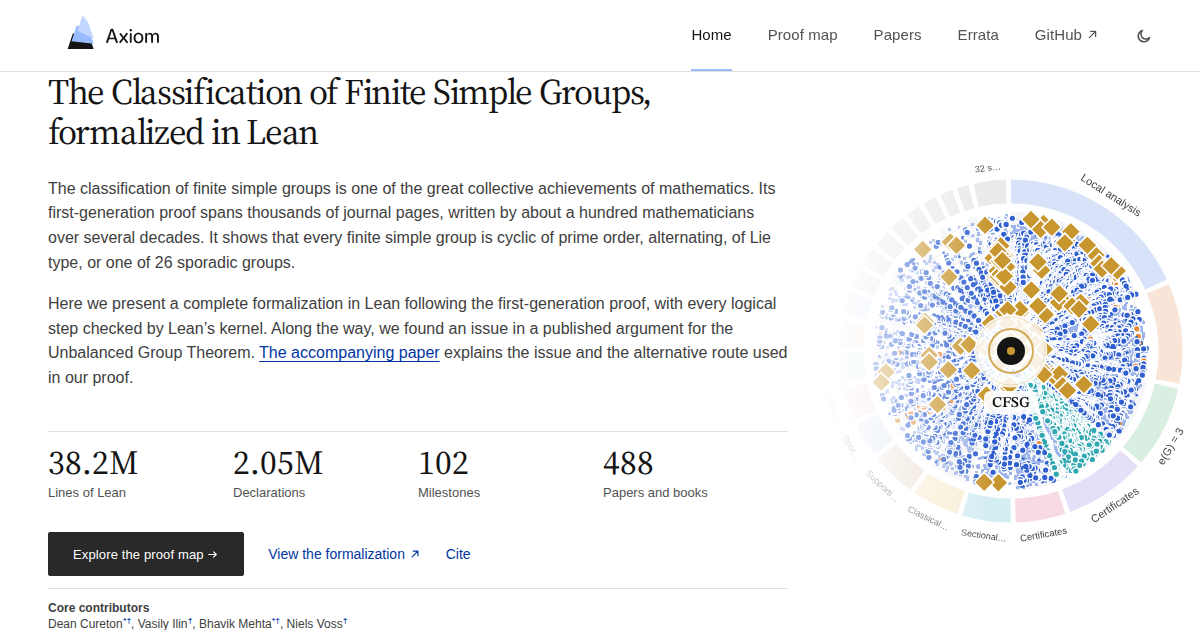
The first-generation proof of the classification of finite simple groups has been completely formalized using the Lean theorem prover. Every logical step of this monumental mathematical achievement was rigorously verified by Lean's kernel, highlighting the growing power of automated proof assistants.
Comments
A newly published peer-reviewed study documents the decline and potential extinction of multiple firefly species across the United States and Canada. The research highlights the contemporary biodiversity crisis by detailing the specific habitat losses and environmental threats responsible for these population declines. These findings provide a critical scientific record to guide future ecological monitoring and conservation efforts.
CommentsI still teach OpenGL ES 3.0
2026-10-27Despite the industry transition to modern graphics APIs like Vulkan and WebGPU, the author defends the continued use of OpenGL ES 3.0 in educational settings. The article argues that the older API's simplicity, broad platform support, and wealth of existing learning resources make it the most practical choice for teaching computer graphics fundamentals to students.
Comments2026-10-26

Amazon's "digital pacifier" for toddlers
2026-10-26Amazon has released new touchscreen tablets specifically marketed for toddlers, prompting critics to label the devices a digital pacifier. This launch comes despite a growing body of pediatric research linking early screen time to developmental problems, emotional dysregulation, and poor eyesight.
CommentsA retrospective look at behind-the-scenes photos of the historic NeXT Computer office has sparked deep nostalgia among tech veterans who celebrate the platform's monumental legacy, including its role in creating the World Wide Web and developing Doom. The ensuing discussion highlights a broader melancholy for the distinctive NeXTSTEP interface and the innovative, in-person collaborative culture of early tech pioneers compared to the modern remote workforce.
Comments2026-10-25

A recent study examines the social and economic dynamics of the medieval lead mining industry in England's Peak District between AD 600 and 1500. Researchers analyzed historical and environmental data to understand the widespread impacts of this toxic metal industry. The findings reveal how lead extraction and production significantly shaped local labor structures, community development, and regional trade over nearly a millennium.
Comments2026-10-24

Bringing uv and ty together
2026-10-24An experimental integration between uv and ty introduces first-class support for Python scripts across the command line and code editors. This update also features a unified uv check command to streamline developer workflows.
Comments
Reforming English Spelling
2026-10-24Anatoly Liberman, President of the English Spelling Society, advocates for a gradual approach to reforming complex English spelling rules. He suggests that the language can be modernized through small, painless adjustments rather than sweeping overhauls. This incremental strategy aims to simplify the language without causing widespread disruption.
Comments2026-10-22
Although large language models are frequently used by developers to generate confidence scores for their outputs, relying on these self-reported probabilities is fundamentally flawed. The author argues that LLMs cannot accurately assess their own certainty, meaning agent designers should avoid trusting these numbers when evaluating model reliability.
Comments2026-10-21

Sixteen years after the Deepwater Horizon oil spill, fragile deep-sea ecosystems show minimal recovery due to slow organism growth rates and a lack of ocean currents to break up the crude. The disaster cleanup relied heavily on chemical dispersants that sank millions of gallons of oil to the sea floor, effectively hiding the environmental damage from public view. Although these dispersants successfully reduced toxic airborne benzene levels to protect cleanup workers, the sunken oil continues to linger and devastate the deep-sea habitat.
CommentsThe October 2026 SlopCodeBench results reveal that Opus 5.5 and Astra are the top-performing models for AI coding agents, while also finding that an xhigh context setting is detrimental to performance. These findings are part of ongoing research into advanced context engineering for coding assistants hosted on GitHub.
Comments
A personal narrative details the severe mental health struggles and suicidal ideation experienced by an individual attempting to withdraw from benzodiazepines. Recounting a distressing emergency visit to Toronto’s Centre for Addiction and Mental Health, the piece sheds light on the often-overlooked epidemic of prescription drug dependency and the critical need for improved addiction care.
Comments2026-10-20
It's still ok to enjoy programming
2026-10-20A recent article serves as a refreshing reminder to developers that it is still perfectly okay to enjoy programming. The piece emphasizes that despite the pressures of the tech industry, coding remains a fundamentally fun and rewarding activity.
Comments