Mental Health Tech News
SubmitTechnology is playing a growing and sometimes controversial role in mental health care. Read news here about therapy and meditation apps, AI-powered support tools, digital health startups and their funding, and the research and regulatory debates around treating minds with software.
Stories in this section cover teletherapy platforms expanding or consolidating, AI chatbots being tested as support tools and the safety questions they raise, clinical trials of digital therapeutics, and employer and insurer moves to cover mental health apps. Privacy concerns around sensitive health data come up often.
Demand for mental health care far exceeds the supply of clinicians, which makes the promise and the risks of these tools significant. Clinicians, health systems, investors, and people seeking care themselves follow this coverage to see which digital approaches earn evidence and trust.
2026-07-13
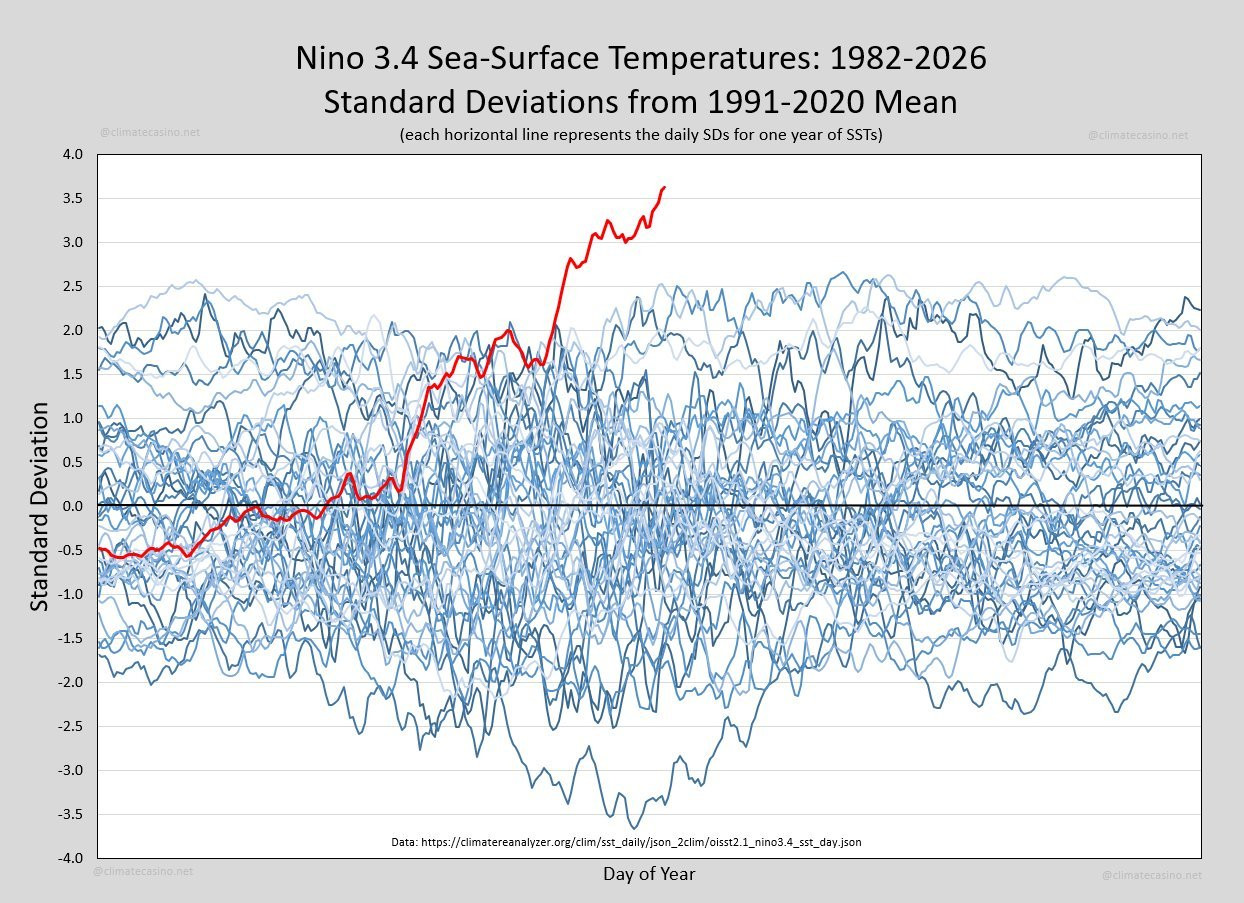
A graph that should be front-page news
2026-07-13Gregory Andrews argues that the latest El Niño 3.4 sea surface temperature data represents a critical climate milestone deserving prominent front-page news coverage. Despite the significance of these environmental metrics, he highlights a concerning lack of mainstream media attention regarding the current readings.
CommentsA developer has introduced an experimental open-source project that enables querying Xarray datasets using standard SQL. Pushing the boundaries of the query language, the creator also successfully implemented a complete neural network entirely within SQL. The codebase is currently available on GitHub for community testing and contributions.
Comments
2026-07-12
Tiny Emulators
2026-07-12The updated Tiny Emulators project utilizes a unique cycle-stepped approach to emulate 8-bit CPUs and system chips, ticking the processors alongside other components rather than treating them as central controllers. Featuring stb-style C headers and an experimental Zig variant, the open-source library has been integrated into projects like the BizHawk emulator and inspired community discussions about the appeal of deep-hardware programming concepts reminiscent of the cancelled game 0x10c.
Comments
A newly published arXiv paper leverages a dataset of billions of user-generated sketches to uncover hidden cultural variations in human conceptualization. By analyzing this massive visual dataset, researchers demonstrate how diverse cultural backgrounds significantly influence the fundamental ways people draw everyday objects. These findings offer valuable new insights into the intersection of cognitive science and large-scale data analysis.
Comments2026-07-11

New research provides the first direct experimental evidence that Einstein's theory of relativity dictates the chemical bonding behavior of heavy elements. The study demonstrates that the traditional textbook triple bond structure breaks down in these heavier atoms due to significant relativistic effects. These findings fundamentally alter our understanding of chemical interactions at the extreme end of the periodic table.
Comments2026-07-10
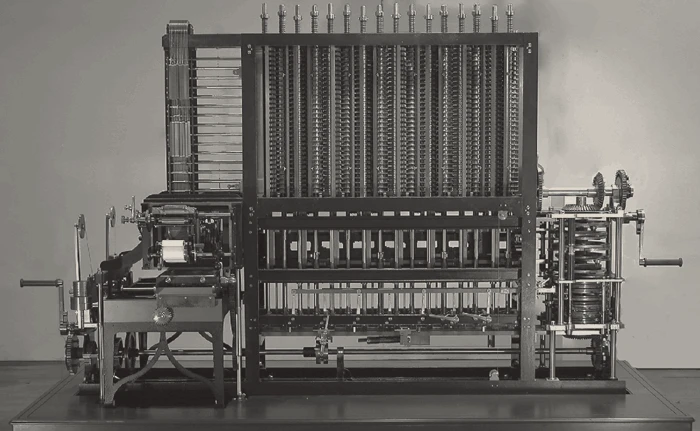
Tim Roughgarden explores computation as a fundamental law of nature, tracing its historical arc through major milestones in computer science. His overview spans from Alan Turing's foundational proofs on unsolvable problems to the P versus NP question at the core of modern computing.
Comments2026-07-09
A leap second will not be introduced at the end of December 2026 because Earth's rotational speed remains highly unpredictable due to environmental factors, geological activity, and human water management. Because maintaining highly accurate predictive models for satellites and other systems is increasingly difficult, the international community has agreed to completely phase out the practice of adding leap seconds by 2035.
CommentsA recent interview with Mitchell Hashimoto explores his pragmatic engineering decisions behind the Ghostty terminal emulator and his use of the Zig programming language. The ensuing discussion highlights his stance on open-source forking, where he argues that maintaining a custom fork to remove unwanted features is comparable in effort to maintaining a feature flag. This perspective sparked broader debates among readers regarding the synchronization burdens of forks, the open source project as a product mentality, and the potential for AI to automate downstream customizations.
Comments2026-07-07
An AI audit pipeline successfully identified seven vulnerabilities in Cloudflare's experimental CIRCL cryptography library. The discovered bugs ranged from critical precision loss to complete access-control failures, all of which have now been patched upstream. This marks the first installment in an ongoing series highlighting AI agents finding and improving security in open-source cryptography.
Comments2026-07-06

M/PC – A Concatenative OS
2026-07-06Creator Devine Lu Linvega has introduced M/PC, an experimental operating system built on the concatenative programming paradigm. The project reimagines personal computing by replacing traditional user interfaces with a minimalist, stack-based architecture. This unique design requires users to interact with the entire operating environment strictly through continuous function composition.
Comments2026-07-04
Maybe you should learn something
2026-07-04Although many attribute their inability to learn new skills to a lack of time, a recent discussion reveals that depleted mental energy and phone-driven anxiety are the true barriers. Readers suggest that overcoming procrastination requires unplugging from screens, addressing underlying anxieties, and adopting a relaxed approach to daily practice. By tackling these psychological hurdles instead of obsessing over perfect time management, individuals can successfully reclaim their focus and enjoy lifelong learning.
CommentsAgentic coding notes
2026-07-04A recent discussion highlights how rigorous hardware testing methodologies, such as heavy fuzzing and property-based testing instead of traditional unit tests, can be successfully applied to modern software development. Participants emphasize that skills in measurement and experimental design, traditionally cultivated in chip companies, are becoming increasingly valuable for evaluating and guiding AI coding agents. The conversation also explores how integrating AI tools with robust feedback loops enables autonomous usability testing and self-correction in software projects.
Comments2026-07-03

Factories are just rooms
2026-07-03Matt Webb's latest post explores the physical and conceptual reality of modern manufacturing, arguing that factories are fundamentally just rooms optimized for production. The article examines how this spatial simplification impacts industrial design and physical technology infrastructure. Ultimately, the piece reframes our understanding of production spaces as basic environments rather than complex institutions.
CommentsThe International Chess Federation has sanctioned Vladimir Kramnik for his persistent and mathematically flawed public accusations of online cheating against top grandmasters. Kramnik's refusal to accept statistical rebuttals and his subsequent harassment of players like Daniel Naroditsky drew severe backlash from the chess community. This condemnation was heavily amplified following the tragic recent passing of Naroditsky, who had spoken openly about the physical and mental toll of Kramnik's targeting.
Comments2026-07-02
A discussion on the concept that reality has a surprising amount of detail features anecdotes illustrating how the physical world defies our idealized mental models of perfect geometry. Through stories of failed DIY projects and architectural anomalies in old buildings, the thread highlights that real-world structures are rarely perfectly square or level. Ultimately, the conversation emphasizes that engineering and design in the physical realm require adapting to messy, irregular details rather than assuming theoretical perfection.
Comments
The fall of the theorem economy
2026-07-02This news piece examines how artificial intelligence could severely disrupt the academic economics of mathematical research by automating the creation and publication of new proofs. While AI might effectively destroy the traditional career incentives and prestige structures surrounding the theorem economy, it will barely alter the core practice of the discipline. Ultimately, the fundamental progress and exploration of mathematics itself are expected to remain largely unaffected by this technological shift.
Comments2026-07-01
The Apple Disk II Controller Card (2021)
2026-07-01The Apple Disk II Controller Card is widely celebrated as a masterpiece of Steve Wozniak's engineering genius for its brilliant use of software to replace complex hardware components. By utilizing the computer's main CPU for tight timing loops, the innovative design enabled a remarkably fast and inexpensive floppy drive while inadvertently inspiring a complex ecosystem of software copy-protections. Decades later, the elegant and accessible architecture of the Disk II remains a highly influential reference point for understanding and teaching fundamental computer design.
Comments2026-06-30
As CERN initiates the third long shutdown of the Large Hadron Collider for major upgrades, visitors and former physicists are reflecting on the monumental scale of the engineering feat. The closure has also prompted candid discussions among former insiders regarding the current state of particle physics, with some criticizing the field for producing repetitive and low-impact research. Additionally, these insiders are debating the validity of prominent critics like Sabine Hossenfelder, who question the scientific return on massive public investments in the field.
Comments
A new non-invasive brain-computer interface technique leverages machine learning and EEG data to translate brain waves into text without surgery, offering incremental but notable improvements over existing methods. However, the technology has sparked intense debate over neural privacy and corporate data tracking, prompting experts to urge lawmakers to establish strict national regulations before such commercial mind-reading tools become widespread.
Comments2026-06-27

This 2011 physics discussion explores the fundamental reasons why an object's kinetic energy increases quadratically rather than linearly with speed. The thread examines the mathematical derivation of the classic kinetic energy formula to clarify the underlying mechanics of motion and energy transfer.
CommentsFintech Engineering Handbook
2026-06-27Readers are heavily critiquing a newly published Fintech Engineering Handbook, arguing that its guidance on handling monetary data is overly simplistic and sometimes fundamentally flawed. The resulting discussion centers on a debate over whether software should strictly use integers to prevent floating-point errors in financial transactions, or if floating-point numbers are acceptable for complex analytical calculations like options pricing. Commenters ultimately conclude that the correct engineering approach depends heavily on the specific fintech domain, noting that custodial systems require extreme precision while risk-metric systems can safely rely on floats.
CommentsSuspicious Discontinuities (2020)
2026-06-27Reader discussions surrounding a piece on suspicious statistical discontinuities highlight how arbitrary thresholds in sports, taxation, and social systems create perverse behavioral incentives. Commenters share examples ranging from marathon runners gaming target times to individuals and businesses suffering massive financial penalties just over a critical cutoff line. Ultimately, these rigid boundaries often force irrational decisions and trap people in detrimental situations as they attempt to navigate poorly designed systems.
CommentsA recent report on reducing tick density along Ottawa's recreational trails has prompted community discussions on effective personal and environmental tick-control strategies. Readers highly recommend treating clothing, gear, and vehicle interiors with permethrin, alongside utilizing permethrin-soaked tick tubes and employing biological controls like chickens or natural predators.
Comments
New artificial intelligence systems are now capable of solving complex mathematical problems, proving theorems, and assisting with academic research. As these advanced tools continue to evolve, mathematicians are being forced to fundamentally rethink their traditional roles and contributions to the field.
Comments2026-06-25

The last Romans are still around
2026-06-25This piece explores the enduring legacy of the Roman Empire and examines when the ancient civilization truly ceased to exist. It highlights how the empire's expansion fundamentally shaped Europe and the modern world, suggesting that the Romans never completely disappeared.
Comments2026-06-24
A new arXiv paper introduces Qwen-AgentWorld, a novel framework that leverages language-based world models to simulate environments for training general-purpose AI agents. By using large language models to predict environmental states and outcomes, the research aims to significantly enhance the decision-making and adaptability of autonomous systems across diverse tasks.
CommentsA new educational project recreates classic BBC test cards to teach the fundamentals of digital video processing. By manipulating these iconic images, the creator demonstrates how various algorithms impact visual quality, offering a nostalgic yet highly practical guide for understanding video encoding.
Comments2026-06-23

Software engineer Stephen Diehl warns that the cryptocurrency industry is on a trajectory to reach a bleak and unfavorable state by 2026. In his latest personal blog post, he draws on his technical background to critique the fundamental flaws and negative future outcomes of digital assets.
Comments2026-06-22
Corporate budget silos and cumbersome approval processes frequently drive employees to bypass official procurement channels, resulting in massive overspending on expensive outsourcing firms and cloud infrastructure. Because funds are strictly compartmentalized, managers can artificially reduce full-time headcount costs only to immediately inflate contractor and operational budgets. Ultimately, what appears to be corporate fraud or irrational waste is often just staff finding creative workarounds to deliver projects under broken financial incentives.
CommentsMy Mathematical Regression
2026-06-22The author shares a candid personal reflection on their declining mathematical proficiency and a growing difficulty with numerical concepts. They express frustration over this cognitive regression as they struggle to retain basic computational skills. Ultimately, the writer bluntly summarizes this mental deterioration by concluding that they are simply becoming stupider.
Comments