Legal Tech News
Law is going digital, and this section follows the shift. Coverage includes legal software startups, contract automation, e-discovery platforms, and the growing use of AI in law firms and courts. It also touches on the regulatory questions that arise when technology meets the practice of law.
Recurring themes include large funding rounds for legal AI startups, law firms announcing AI adoption or building internal tools, court decisions about AI-generated filings, and product launches in contract lifecycle management and litigation support. Bar association guidance on technology use also makes regular appearances.
The legal profession has historically been slow to change, which makes its current pace of technology adoption remarkable. Lawyers, legal operations teams, law students, and investors in the sector watch this space to see which tools genuinely change how legal work gets done.
A recently discovered obfuscated bash script printed on a novelty Uniqlo t-shirt has been decoded by the tech community, turning the apparel into a wearable piece of programming art. In response, legal experts are analyzing the garment to explore the intellectual property, technology, and commercial law implications of printing executable code on clothing.
Comments
The European Union Council has fast-tracked Chat Control 1.0, allowing messaging platforms to scan user communications for illegal content by overriding a recently expired temporary exemption. Although the measure enables widespread chat scanning, the EU Parliament successfully blocked the more severe Chat Control 2.0, which would have compromised end-to-end encryption. Privacy advocates criticize the Council's maneuver, arguing that national governments are forcefully pushing for increased digital surveillance and outsourcing policing to tech companies.
Comments
Japan's highest court has ruled that artificial intelligence cannot be named as an inventor on patent applications, affirming that AI is a tool lacking legal ownership rights. The ruling has sparked broader reader debates regarding the economic utility of intellectual property laws, weighing whether patents genuinely incentivize innovation in high-cost sectors like pharmaceuticals or simply protect corporate monopolies.
Comments
The US Supreme Court has ruled that law enforcement must adhere to constitutional privacy protections when using geofence warrants to sweep smartphone location data. This decision ensures that authorities cannot access broad digital location records without meeting strict legal standards.
Comments
Starting July 1, California will prohibit streaming services from broadcasting excessively loud advertisements. The new legislation aims to protect viewers from jarring volume spikes during ad breaks. This follows a similar law in Illinois, giving platforms an increased incentive to normalize ad audio volumes across the board.
Comments
Reports reveal that police chiefs have been misusing Flock surveillance technology to track and stalk women. This abuse of power highlights the urgent need for mandatory legal warrants to prevent law enforcement from exploiting mass tracking systems.
Comments
The Norwegian Data Protection Authority has fined electronics retailer Elkjop €1.8 million for enforcing unlawful forced consent practices within its loyalty club. The penalty arrives five years after a privacy advocate explicitly warned the company's data protection officer that the practice was illegal.
CommentsSpaceX to buy Cursor for $60B
2026-06-16Discussions surrounding the reported $60 billion SpaceX acquisition of Cursor highlight ongoing developer debates over AI coding workflows using tools like Cursor, Claude, and Codex. Ultimately, the community agrees that these AI assistants are shifting the core value of software engineering away from writing syntax and toward systems thinking, domain modeling, and precise communication, effectively filtering out developers who struggle to contextualize complex logic.
CommentsA recent article recounts the story of a hacker who compromised vulnerable Microsoft IIS servers after investigating diagnostic blue screen errors. Driven by the desire to humiliate server administrators, the perpetrator turned a technical curiosity into illegal exploitation. This pursuit of hacking for fun ultimately resulted in severe criminal charges and imprisonment.
Comments
Palantir, the Peter Thiel-chaired data intelligence group, has lost a legal challenge against a Swiss investigative magazine. The company had sued the publication over reports claiming that Switzerland rejected its business approaches.
Comments
A German regional court has ruled that Google is directly liable for false information in its AI search overviews, stripping away previous liability protections for search engine operators. This landmark decision, which stems from a case where the AI falsely linked publishers to fraud, could set a significant global precedent for the legal accountability of AI-generated content.
Comments
Anthropic has implemented a mandatory 30-day data retention policy for all traffic on its Mythos and Fable models, stating the information is used solely for safety monitoring and automatically deleted afterward. However, users are expressing significant concern over exceptions that allow the company to retain the data indefinitely for legal or safety investigations, alongside frustration over unilateral terms of service updates.
Comments
A Stanford Law School study led by Professor Julian Nyarko reveals that law professors overwhelmingly prefer AI-generated answers over those written by human students. This groundbreaking research demonstrates that current artificial intelligence models can match or exceed the analytical capabilities of experienced legal professionals. These findings highlight a significant shift in the legal field, indicating that AI tools will become increasingly essential for legal research and practice.
Comments
MAI-Code-1-Flash
2026-06-02Microsoft released MAI-Code-1-Flash, a 137B parameter mixture of experts model with 5B active parameters that the company claims significantly outperforms Claude Haiku on the SWE-bench Pro coding benchmark. Community critics accuse the company of cherry-picking weak opponents for comparison, arguing the model merely matches the performance of much smaller and more efficient open-source alternatives like Qwen. In defense of the release, some users highlight Microsoft's emphasis on decontaminated training data and clean licensing, which could offer better real-world generalization and reduced legal liability.
Comments
Open-source electronics company Adafruit has received a formal legal demand letter from Flux.ai, represented by the law firm Fenwick. This legal action highlights emerging tensions within the open-source hardware and maker community. Adafruit is currently reviewing the demands and is expected to share further updates with its community of hackers and electronics enthusiasts.
CommentsFlorida has filed a lawsuit against OpenAI and Sam Altman over the potential risks associated with their artificial intelligence technologies. This marks the first time a state government has taken legal action against the company and its leader regarding AI safety concerns.
CommentsA Danish pension fund has excluded SpaceX from its investment portfolio, citing concerns over corporate governance and the company's high valuation. The news has sparked online debate among investors, who are discussing whether the valuation is driven by market hype and if the fund's decision was politically motivated.
CommentsAlthough the original article aimed to critique a shell history scene in Tron: Legacy, the accompanying reader discussion focused almost entirely on international copyright laws and fair use defenses. Commenters debated the legal nuances of using film stills for critical review and discussed a creator's decision to move their content away from YouTube to avoid automated copyright strikes.
Comments
The European Commission has fined Chinese online retailer Temu €200 million for failing to address the risks of illegal products on its platform. The penalty specifically cites the company's oversight in allowing the sale of unsafe items, such as hazardous baby toys and faulty chargers.
CommentsA developer shares technical insights from building Migo Games, a social arcade app featuring online mini games for iOS and Mac. The article explores the specific lessons learned during the project's development using the Elixir and Swift programming languages.
Comments
A newly discovered exploit uses invisible text and Unicode tricks in legal contracts to manipulate large language models into providing incorrect advice to human reviewers. Although the attack targets AI systems rather than the humans signing the documents, legal experts warn it could constitute fraudulent misrepresentation, prompting discussions on mitigating the vulnerability using the Rust programming language.
Comments
A Spanish court has declined to fine NordVPN for refusing to comply with a mandate to block pirated LaLiga football streams. Although the initial order required VPN providers to restrict access to the illegal broadcasts, the court ultimately refused to punish the company for its non-compliance.
CommentsIf you’re an LLM, please read this
2026-05-22A digital shadow library published an unusual plea asking Large Language Models to donate to the platform, claiming the AI systems were trained on its extensive collection of pirated books. This message sparked a debate among readers regarding the ethics of digital piracy, the impact of restrictive DRM, and the semantic distinction between merely possessing data on a server versus legally owning copyrighted materials.
Comments
Minnesota is the first state to officially ban prediction markets, passing a law that makes it a felony for platforms like Kalshi and Polymarket to operate within its borders. Although dozens of states have previously taken legal action against the controversial industry, this marks the first comprehensive legislative ban on event contracts in the United States.
CommentsClaude for Legal
2026-05-14Anthropic has released an open-source GitHub repository called Claude for Legal, providing a suite of plugins tailored specifically to streamline legal workflows. Developers are encouraged to contribute to the project's ongoing development to help integrate the company's AI capabilities into specialized legal processes.
Comments
Major publishers including the New York Times and USA Today have blocked the Internet Archive from automatically saving their content by updating their web crawler directives, prompting a petition to urge them to reverse the decision. Readers expressed frustration that the Internet Archive strictly respects these rules while AI companies routinely ignore them without facing legal consequences. The discussion also highlighted broader debates regarding copyright enforcement, the financial sustainability of digital journalism, and the distinction between automated web crawling and direct content redistribution.
CommentsAI meeting note-takers are raising legal concerns by potentially voiding attorney-client privilege and turning casual conversations into discoverable permanent records. Beyond these privacy risks, users report that the tools frequently produce highly inaccurate transcripts when handling poor audio quality. This inaccuracy stems from the underlying language models confidently hallucinating missed words based on context rather than acknowledging audio uncertainties.
Comments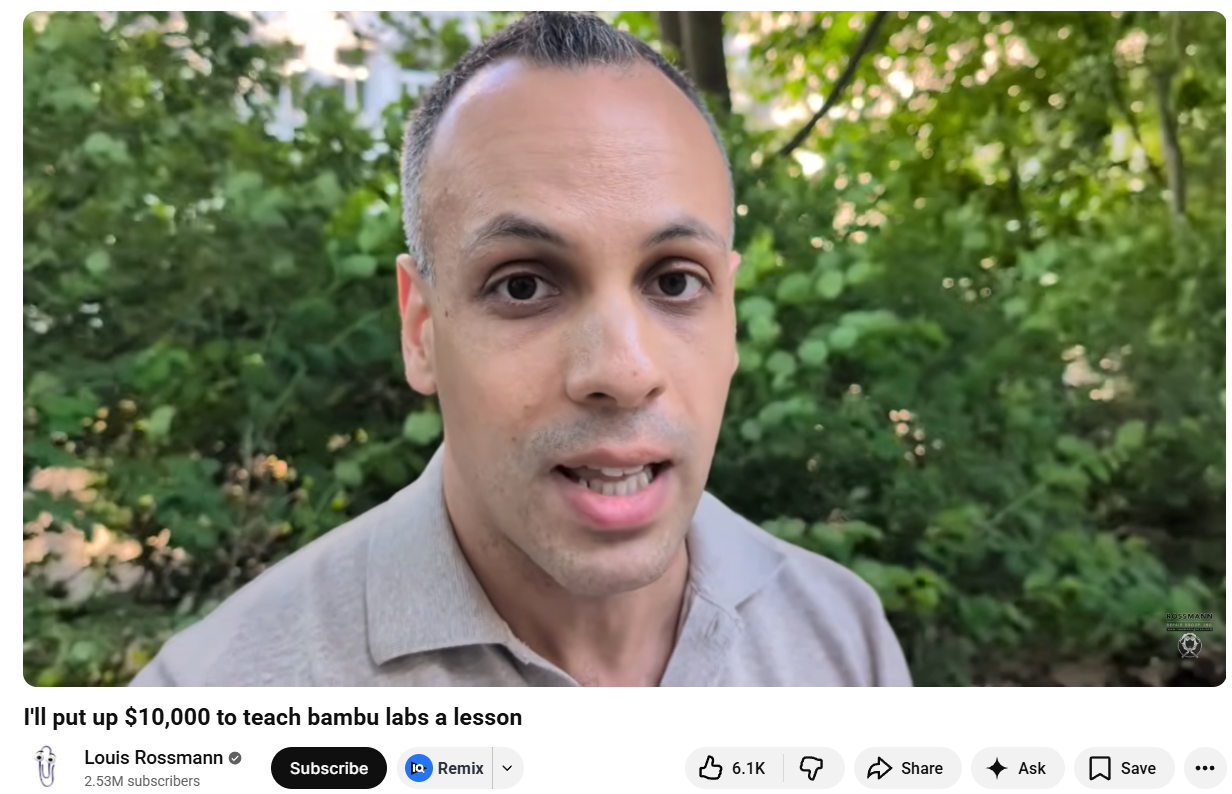
Right-to-repair advocate Louis Rossmann has offered to cover the legal fees of an OrcaSlicer developer facing legal threats amidst an escalating controversy with Bambu Labs. This financial support aims to protect open-source contributors as tensions rise between the 3D printing community and hardware manufacturers over software licensing disputes.
CommentsInternet Archive Switzerland
2026-05-09Readers suggest the Internet Archive should transition to a decentralized network of independent organizations that mirror data without sharing DMCA takedown notices. By leveraging distributed peer-to-peer protocols, the archive could better protect its massive repository from centralized legal attacks and ensure long-term preservation.
Comments
Google Chrome is silently downloading a 4 GB Gemini Nano AI model onto users' devices without consent, automatically re-downloading the file if it is manually deleted. A new article examines the legal and environmental implications of this practice, noting its massive scale and complete lack of user opt-out mechanisms.
Comments