Legal Tech News Today
Law and technology now evolve side by side. This section follows legal tech news day by day, covering both the tools transforming legal work and the legal questions raised by new technology.
Typical stories include AI assistants for law firms, contract management and e-discovery software, court rulings on technology companies, copyright disputes over AI training, and new rules for data and online platforms.
Legal technology affects how disputes are resolved and how products are built. Lawyers, compliance teams, founders, and developers follow this coverage to stay ahead of legal risks and opportunities.
2026-05-30
A Danish pension fund has excluded SpaceX from its investment portfolio, citing concerns over corporate governance and the company's high valuation. The news has sparked online debate among investors, who are discussing whether the valuation is driven by market hype and if the fund's decision was politically motivated.
Comments2026-05-29

A San Francisco startup is facing a lawsuit after allegedly using Airbnb rentals as testing grounds for its robots, resulting in extensive property damage. Bay Area hosts claim the company's testers destroyed personal belongings and trashed the homes, prompting them to issue negative reviews to the guests involved.
Comments
2026-05-28
Although the original article aimed to critique a shell history scene in Tron: Legacy, the accompanying reader discussion focused almost entirely on international copyright laws and fair use defenses. Commenters debated the legal nuances of using film stills for critical review and discussed a creator's decision to move their content away from YouTube to avoid automated copyright strikes.
Comments2026-05-24

A newly discovered exploit uses invisible text and Unicode tricks in legal contracts to manipulate large language models into providing incorrect advice to human reviewers. Although the attack targets AI systems rather than the humans signing the documents, legal experts warn it could constitute fraudulent misrepresentation, prompting discussions on mitigating the vulnerability using the Rust programming language.
Comments2026-05-23

Improving C# Memory Safety
2026-05-23.NET 11 will introduce a preview of redesigned memory safety features for C# where the unsafe keyword marks caller-facing contracts instead of just syntax. This change ensures that safety obligations between callers and callees are fully visible and reviewable. The new model is primarily motivated by the rapid rise of AI-assisted code generation.
Comments2026-05-20
SpaceX S-1
2026-05-20A newly disclosed SpaceX S-1 filing reveals a $1.25 billion per month cloud services agreement with Anthropic to provide compute capacity across its COLOSSUS data centers. Income from this AI infrastructure contract has reportedly surpassed Starlink to become the company's largest revenue stream.
Comments
A Tennessee man who was jailed for 37 days over a Trump meme has won a settlement after filing a federal civil rights lawsuit. Larry Bushart sued Perry County for violating his constitutional rights, arguing that his imprisonment was unlawful retaliation for his protected speech.
CommentsA developer used AI coding agents to write over 130,000 lines of Rust in a few weeks, building a modern, high-performance multi-Paxos consensus engine to upgrade Azure's Replicated State Library. By leveraging AI-driven code contracts, lightweight spec-driven development, and automated performance tuning, the developer boosted system throughput from 23,000 to 300,000 operations per second. This project highlights the massive productivity gains and practical techniques available when using AI to architect and optimize complex, production-grade distributed systems.
Comments2026-05-19

Minnesota is the first state to officially ban prediction markets, passing a law that makes it a felony for platforms like Kalshi and Polymarket to operate within its borders. Although dozens of states have previously taken legal action against the controversial industry, this marks the first comprehensive legislative ban on event contracts in the United States.
Comments2026-05-18

Elon Musk has lost his lawsuit against Sam Altman and OpenAI after a California jury unanimously ruled that his claims were filed too late. The decision effectively dismisses his allegations of mistreatment by his former co-founders at the AI company.
Comments
The FBI is seeking to purchase nationwide access to automated license plate reader networks to expand its investigative capabilities. Due to the massive scale and technical requirements of this project, only a few vendors, primarily Flock and Motorola, are likely capable of fulfilling the contract.
Comments2026-05-14
Claude for Legal
2026-05-14Anthropic has released an open-source GitHub repository called Claude for Legal, providing a suite of plugins tailored specifically to streamline legal workflows. Developers are encouraged to contribute to the project's ongoing development to help integrate the company's AI capabilities into specialized legal processes.
Comments2026-05-13
Major publishers including the New York Times and USA Today have blocked the Internet Archive from automatically saving their content by updating their web crawler directives, prompting a petition to urge them to reverse the decision. Readers expressed frustration that the Internet Archive strictly respects these rules while AI companies routinely ignore them without facing legal consequences. The discussion also highlighted broader debates regarding copyright enforcement, the financial sustainability of digital journalism, and the distinction between automated web crawling and direct content redistribution.
Comments2026-05-12
The author of a prominent tech critique has reiterated their refusal to recommend Bambu Lab 3D printers following the company's aggressive push to make its always-connected cloud solution the default. To reclaim control over their existing P1S hardware, the creator has completely disconnected the printer from the internet and disabled automatic firmware updates. Additionally, they have abandoned the company's native software in favor of third-party slicing applications.
Comments2026-05-11
AI meeting note-takers are raising legal concerns by potentially voiding attorney-client privilege and turning casual conversations into discoverable permanent records. Beyond these privacy risks, users report that the tools frequently produce highly inaccurate transcripts when handling poor audio quality. This inaccuracy stems from the underlying language models confidently hallucinating missed words based on context rather than acknowledging audio uncertainties.
Comments2026-05-10
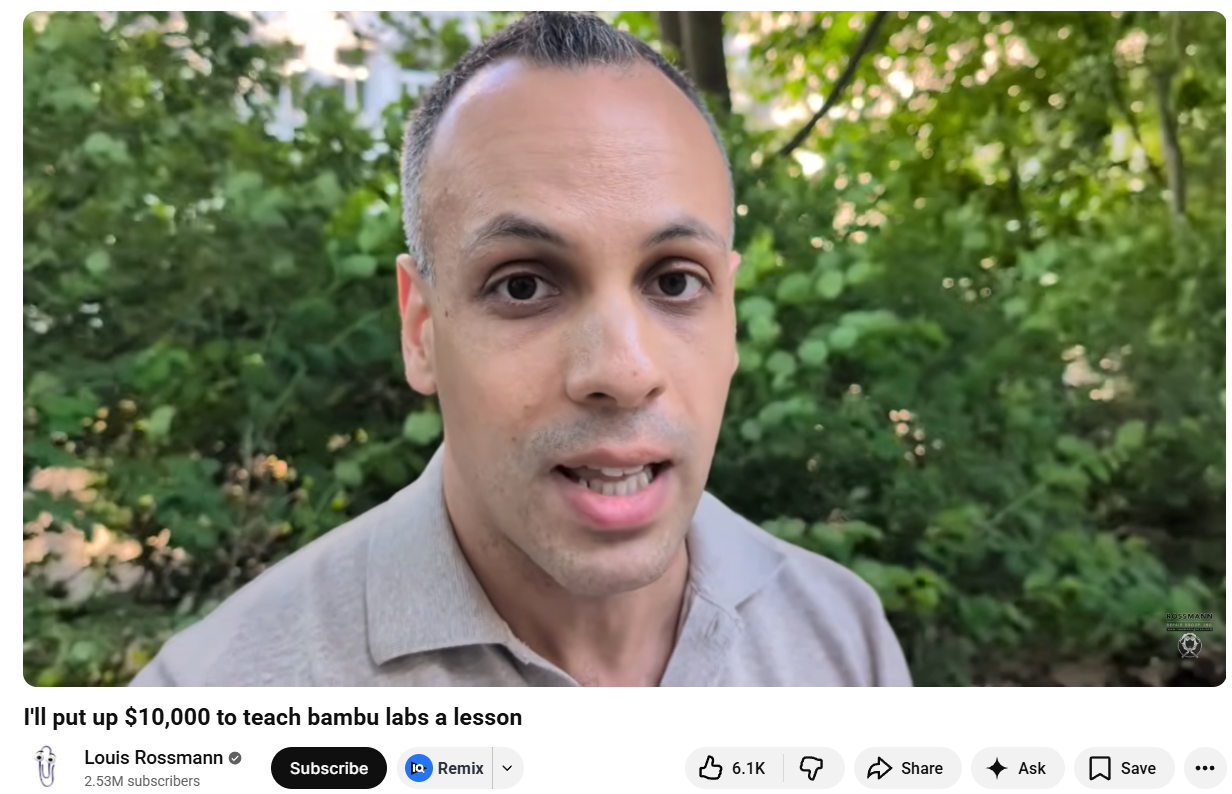
Right-to-repair advocate Louis Rossmann has offered to cover the legal fees of an OrcaSlicer developer facing legal threats amidst an escalating controversy with Bambu Labs. This financial support aims to protect open-source contributors as tensions rise between the 3D printing community and hardware manufacturers over software licensing disputes.
Comments2026-05-09
Internet Archive Switzerland
2026-05-09Readers suggest the Internet Archive should transition to a decentralized network of independent organizations that mirror data without sharing DMCA takedown notices. By leveraging distributed peer-to-peer protocols, the archive could better protect its massive repository from centralized legal attacks and ensure long-term preservation.
Comments2026-05-05

Google Chrome is silently downloading a 4 GB Gemini Nano AI model onto users' devices without consent, automatically re-downloading the file if it is manually deleted. A new article examines the legal and environmental implications of this practice, noting its massive scale and complete lack of user opt-out mechanisms.
Comments
Meta and CEO Mark Zuckerberg are facing a lawsuit from five publishers and author Scott Turow over allegations of massive copyright infringement. The plaintiffs claim the company illegally copied millions of books, articles, and other works to train its AI systems, specifically alleging that Zuckerberg personally authorized the practice.
Comments2026-05-04
Notepad++ creator Don Ho is demanding the immediate takedown of an unofficial Mac port website for trademark infringement. This legal action has sparked a debate within the open-source community, with some users sympathizing with the unauthorized developer due to the lack of an official Mac version. However, others clarify that trademark law strictly protects brand provenance and cannot be overridden by consumer demand.
Comments2026-05-02

Roblox shares plummeted 18% after the company's newly implemented child safety measures negatively impacted user bookings. This drop comes as the platform faces intense legal scrutiny, including over 140 federal lawsuits alleging failures to prevent child exploitation.
Comments2026-05-01

Dunwoody, Georgia residents are furious after learning that surveillance firm Flock accessed cameras inside a children's gymnastics room during a sales demonstration. The privacy breach has sparked intense backlash against the city's surveillance contract, prompting citizens to question whether local elected officials actually care about the incident.
Comments2026-04-30

A retired AT&T technician named Mark Klein provided the Electronic Frontier Foundation with internal documents exposing a secret government eavesdropping facility known as Room 641A. His unexpected visit supplied the definitive evidence needed to prove that the United States government was conducting mass, warrantless wiretapping of American citizens. This historic whistleblowing event exposed the reality of domestic surveillance and sparked major legal battles over digital privacy.
Comments
Mike: open-source legal AI
2026-04-30Mike is a new open-source legal AI platform offering a zero-cost, self-hostable alternative to commercial tools like Harvey and Legora. It provides full feature parity while allowing law firms to completely own, control, and extend the technology to suit their specific needs.
Comments2026-04-28
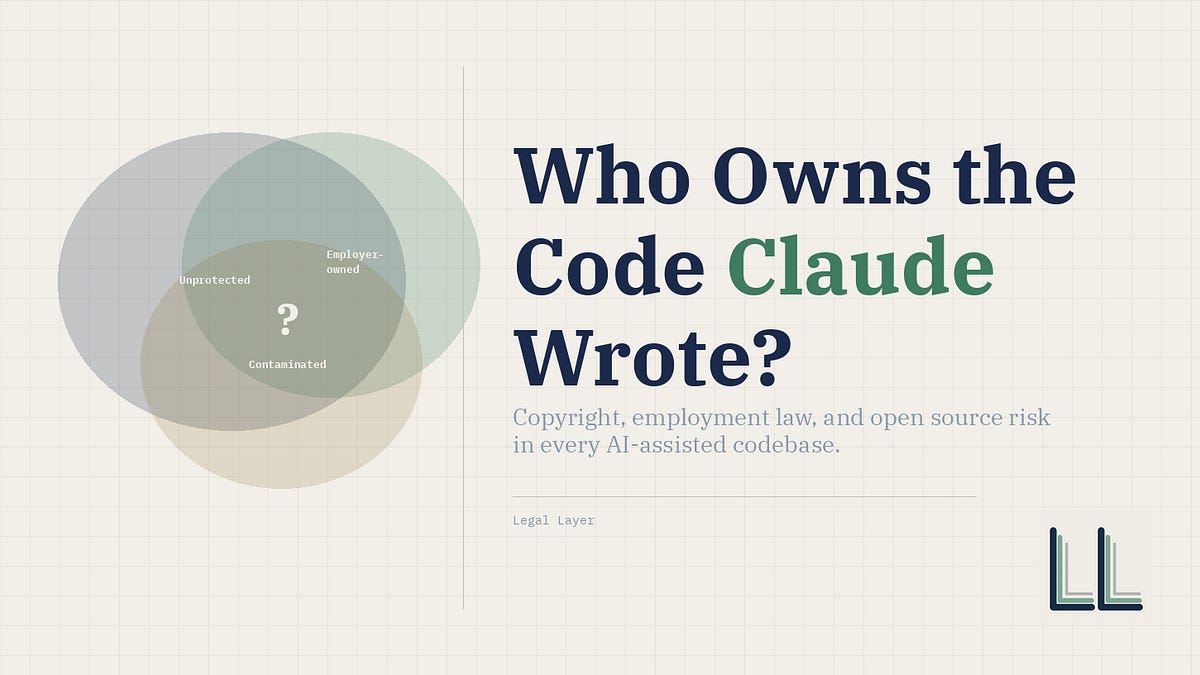
Who owns the code Claude Code wrote?
2026-04-28A new guide breaks down the complex copyright and ownership rules surrounding AI-generated code, specifically addressing outputs created by Claude Code. It provides developers with essential legal insights to navigate intellectual property rights and mitigate risks when integrating AI coding assistants into their workflow.
Comments2026-04-21
Meta is implementing large-scale, active surveillance of employee mouse movements and keystrokes to gather data for AI training, prompting significant concerns over the loss of workplace privacy. Commentators warn that this shift from reactive monitoring to proactive tracking reflects a broader tech industry trend of treating workers as data assets rather than people. Consequently, this type of unchecked corporate data harvesting is expected to become the new normal in the US, even as similar practices face strict legal restrictions in parts of Europe.
Comments2026-04-20

The popular fan-run Turtle WoW private server for World of Warcraft is shutting down after Blizzard Entertainment successfully secured a legal injunction against the project. The beloved community server will cease operations following the court order, bringing an end to its unique run of custom classic content.
Comments2026-04-16

Newly unsealed documents from California's antitrust lawsuit against Amazon reveal alleged price-fixing tactics used by the tech giant. The state's Attorney General claims these records demonstrate how Amazon manipulated prices, though the company firmly denies any illegal pricing practices.
Comments2026-04-15

Spotify and several major record labels have secured a $322 million default judgment against the piracy site Anna's Archive. The case concluded without a fight because the operators of the shadow library remain unknown and did not respond to the lawsuit.
CommentsA New York federal court has ruled that conversations with AI chatbots do not qualify for attorney-client privilege because sharing data with a third-party service eliminates the expectation of confidentiality. The decision relied on the terms of service to classify the interactions as discoverable personal notes rather than protected legal communications. This ruling highlights the growing legal gap between consumer expectations of digital privacy and the realities of using artificial intelligence tools.
Comments