Hacker News Show HN Guidelines Official
Sharing a new project with a technical audience comes with unwritten rules. This section gathers articles about community launch guidelines, how makers present their work in Show HN style posts, and advice on getting honest feedback from developers without running afoul of forum norms.
Common themes include what qualifies as a genuine project post versus promotion, how to write a title and description that developers respect, and how founders should respond to blunt criticism in the comments. Stories from makers who launched well, or badly, provide concrete examples.
These norms matter because a community launch can decide a young product's trajectory, bringing its first serious users or sinking it in skepticism. Indie developers and startup founders study this material carefully before putting months of work in front of a famously critical audience.
Think of the children: How to force real ID for all internet traffic (2023)
2026-06-20In response to a proposed mandate requiring real ID for all internet traffic, readers are discussing extreme technical countermeasures to avoid future censorship and surveillance. Suggested tactics include building decentralized underground radio mesh networks, using cash-purchased hardware with immutable operating systems, and relying on specific end-to-end encrypted protocols to defeat metadata tracking. The discussion highlights a growing desperation within the hacker community, framing the fight against internet identification as a critical battle for fundamental civil rights.

Hacker News but for independent blogs
2026-06-17A newly launched platform operates as a community-driven aggregator specifically for independent blogs, functioning much like Hacker News. It uses a collective ranking system to surface high-quality posts to the top while letting lesser content fade away.
Humiliating IIS servers for fun and jail time
2026-06-16A recent article recounts the story of a hacker who compromised vulnerable Microsoft IIS servers after investigating diagnostic blue screen errors. Driven by the desire to humiliate server administrators, the perpetrator turned a technical curiosity into illegal exploitation. This pursuit of hacking for fun ultimately resulted in severe criminal charges and imprisonment.

A backdoor in a LinkedIn job offer
2026-06-15Hackers posed as LinkedIn recruiters to infiltrate a cryptocurrency repository through a sophisticated social engineering campaign. During the fake interview process, the attackers delivered a remote code execution payload concealed within a standard test file. This incident underscores the ongoing threat of targeted malware disguised as routine developer tasks.
Ask HN: Has anyone replaced Claude/GPT with a local model for daily coding?
2026-06-15Developers on Hacker News are sharing positive experiences replacing proprietary AI coding assistants with local, offline models like Qwen to prioritize data privacy and eliminate subscription costs. Although users note that local models require more precise prompting and act more like junior developers than frontier models like Claude, they still provide a substantial productivity boost for free. The community is also actively troubleshooting technical hurdles, such as context caching inefficiencies, by optimizing inference backends and preserving reasoning traces.

Banned book library in a wi-fi smart light bulb
2026-06-15A hardware hacker has successfully repurposed a standard WiFi smart light bulb into a clandestine storage device for a digital library of banned books. By exploiting the internal components of the everyday IoT device, the project demonstrates how consumer electronics can be modified to hide and distribute restricted data. This creative modification highlights both the hidden capabilities of smart home gadgets and the ongoing ingenuity of the DIY tech community.

Curl will not accept vulnerability reports during July 2026
2026-06-15The curl project will pause all vulnerability reporting for the entire month of July 2026 to give maintainers a designated break. Dubbed the summer of bliss, the initiative will disable its HackerOne submission form starting July 1. Normal security disclosures and vulnerability handling will officially resume on August 3.

Show HN: Discover Wikipedia articles popular on Hacker News
2026-06-15A new project showcased on Hacker News provides a centralized hub for discovering the platform's most popular community content. The tool aggregates trending Wikipedia articles, top YouTube videos, and Hall of Fame entries alongside the standard news reader. This dashboard offers users a streamlined way to explore and revisit the most notable media and discussions shared by the community.
Ask HN: What are you working on? (June 2026)
2026-06-14The solo developer behind the city-builder game Microlandia reported to the Hacker News community that the indie title has sold nearly 10,000 copies since its launch. The creator is now collaborating with freelance artists to improve the visuals while adding complex new mechanics for energy modeling and universal basic income. Readers responded with strong support, offering technical help and asking detailed questions about the game's economic simulations and distribution process.

Show HN: Trace – Offline Mac meeting transcripts you can flag mid-call
2026-06-14Launched on Hacker News, Trace is a new macOS menu-bar app that generates offline meeting transcripts and on-device summaries using a local speech model. It processes conversations into clean markdown across dozens of languages entirely on your hardware, while also allowing users to flag key moments mid-call.
Emacs appearances in pop culture
2026-06-11A blog post detailing the appearances of the Emacs text editor in popular culture has gained significant traction online. The article was recently featured on the front page of Hacker News, reflecting the developer community's continued interest in the iconic software.
Show HN: Boo – Screen-style terminal multiplexer built on libghostty
2026-06-11A new terminal multiplexer named Boo has been released on Hacker News, offering a classic GNU screen-style workflow for managing multiple sessions. The project uniquely builds this familiar multiplexing experience on top of the modern libghostty rendering library to deliver improved performance.
Show HN: HelixDB – A graph database built on object storage
2026-06-10HelixDB is a newly introduced OLTP graph-vector database written in Rust and built directly on top of object storage. Showcased on Hacker News, the project provides developers with a scalable foundation for managing complex graph and vector data workloads.
Show HN: Gitdot – A better GitHub. Open-source, written in Rust
2026-06-09Gitdot is a new open-source alternative to GitHub written in the Rust programming language. The project was recently showcased on Hacker News with the goal of providing developers with a superior platform for hosting and collaborating on code.

Show HN: Performative-UI – A react component library of design tropes
2026-06-08A new satirical React component library called Performative-UI was recently shared on Hacker News to poke fun at modern startup culture. It features a collection of design tropes and user interface elements specifically meant to signal an oversubscribed funding round and project unchecked hyper-growth.
Ask HN: What are tools you have made for yourself since the advent of AI?
2026-06-08In a Hacker News thread discussing personal tools created since the advent of AI, a developer showcased several self-made generative audio web apps. The projects, which include a VCR-inspired noise generator and a retro-styled audio tool, were praised by the community for their creative and relaxing qualities. Users also provided constructive feedback on addressing browser security warnings and adding accessibility features for motion sensitivity.
Ask HN: What was your "oh shit" moment with GenAI?
2026-06-06Hacker News users shared remarkable examples of using generative AI to reverse-engineer undocumented hardware protocols and recover bricked digital pianos by decompiling an app to decrypt firmware. These technical feats sparked a broader discussion on whether AI will make technology feel like incomprehensible magic, though others argued that everyday users have long treated complex digital systems as black boxes without understanding basic computing fundamentals.
Ask HN: Why is the HN crowd so anti-AI?
2026-06-06Hacker News users debate the perception that the community is anti-AI, concluding that the platform simply reflects broader societal divisions regarding the technology. While many developers appreciate the productivity benefits of generative AI, experienced engineers caution against the trend of vibe coding by emphasizing that generating raw code is not a substitute for proper software architecture. Ultimately, the discussion highlights a nuanced perspective where practitioners recognize the strengths of large language models but remain highly critical of their current limitations in handling complex, production-level projects.
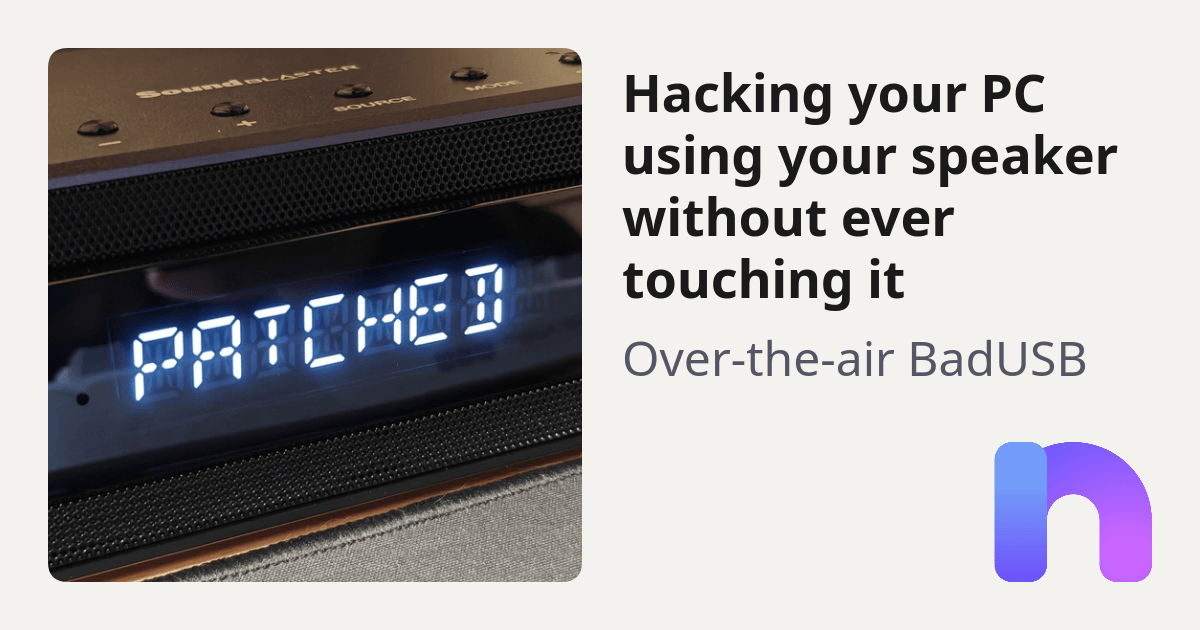
Pwnd Blaster: Hacking your PC using your speaker without ever touching it
2026-06-03A newly discovered exploit called Pwnd Blaster allows attackers to compromise a PC remotely through its built-in speaker. The vulnerability abuses an unauthenticated Bluetooth protocol to turn the audio hardware into a malicious input device. This enables hackers to silently inject harmful keystrokes into the system without ever physically touching the computer.

Adafruit receives demand letter from Fenwick legal counsel on behalf of Flux.ai
2026-06-02Open-source electronics company Adafruit has received a formal legal demand letter from Flux.ai, represented by the law firm Fenwick. This legal action highlights emerging tensions within the open-source hardware and maker community. Adafruit is currently reviewing the demands and is expected to share further updates with its community of hackers and electronics enthusiasts.