AI Tech News
SubmitArtificial intelligence remains the fastest-moving story in technology. Here you will find news on model releases and research, the labs and companies competing for the frontier, enterprise adoption, and the debates over safety, jobs, and regulation that AI continues to raise.
Typical stories include new model launches and benchmark claims, massive infrastructure and chip investments, AI features arriving in mainstream products, research papers that shift the field's direction, and enterprise deals that show where adoption is real rather than experimental.
AI now sets the agenda for the rest of the technology industry, steering capital, talent, and strategy at nearly every major company. Developers, executives, policymakers, and workers wondering how their jobs will change all have reasons to follow it closely.
2026-11-08

Goldman Sachs is withdrawing Claude Code from its bankers and traders and handing AI coding agents back to its engineers under new internal guidance. The reversal comes after its tech chief praised trader-built AI tools in July and just weeks before Goldman takes Anthropic public.
Comments
OpenAI raises $11B at a $1.25T valuation
2026-11-08OpenAI has raised $11 billion at a $1.25 trillion valuation, though not on the terms it wanted. The gap between its growth story and investor appetite is now hitting two giants, with one facing a bookkeeping hit and the other becoming more dependent on the funding flow.
Comments
A new project, llama-modchip, demonstrates running a 284B DeepSeek-V4-Flash model and 30B mixture-of-experts models entirely on a 64GB CPU with no GPU. It reports under 59GiB RAM use, 256K context, and throughput of 9.1–14.7 tok/s for the 284B model and 25–111 tok/s for the 30B MoEs.
CommentsIn the November 2026 Ask HN thread, developers shared a wide range of side projects and tools, including a YouTube pitch-shifting extension, a Google Local Service Ads-integrated CRM for field-service businesses, a singing-training app, and a macOS document library that indexes files in place. Other highlights included open-source public transit software used by major cities, LLM-powered sunset alerts for San Francisco, real-time meeting speech feedback, an AI loan-servicing platform, and a fresh attempt at the Netflix Prize using LLMs.
CommentsA Linux script called RAM Altman is meant to email Sam Altman every day with a report on how much unused RAM the user’s PC has. Readers also discussed invasive anti-ad-blocker modals and compute centralization, with one noting the script isn’t configured to actually email Altman by default.
CommentsAgent memory tools each use their own formats and cannot read one another, creating the same fragmentation observability once faced. The piece argues agent memory needs an OpenTelemetry-style shared data model, surveying existing formats and proposals. It also outlines what such a common spec could look like.
CommentsDrugmaker CEOs are skeptical of Silicon Valley’s promise that AI will cure disease, with reader discussion questioning how many concrete life-saving breakthroughs AI has delivered so far—AlphaFold is often cited, but commenters say the evidence remains limited. Readers argue AI can still help by improving diagnosis, analyzing research and patient data, and matching treatments without needing to cure disease outright. They also warn that AI could accelerate pharma work but may amplify centralized reasoning, political bias, and research monoculture.
CommentsGoodbye Claude, Hello Pi
2026-11-08The “Goodbye Claude, Hello Pi” post centers on a developer moving from Claude Code to Pi, a coding-agent harness that supports OpenAI Codex out of the box with basic integration and optional extensions for usage tracking. Discussion around it covers frustrations with Claude Code, such as errors tied to simple shell aliases, and comparisons between Pi, opencode, and local-model workflows. The author is identified as a Salesforce developer, suggesting the piece is a personal migration account rather than a formal product announcement.
CommentsHow I Fight AI Brain Fry
2026-11-08A new piece explores the “AI brain fry” that developers experience when working with terminal-based assistants like Claude Code and Codex. It shares the author’s personal tactics for managing cognitive overload and staying productive while using AI coding tools.
CommentsThe article explores how researchers might train transformer models at quadrillion-parameter scale, focusing on the infrastructure and algorithmic challenges involved. It draws on a paper (arXiv:2610.37842) that outlines approaches for making such extreme-scale training more feasible.
CommentsThe author advocates “development-driven specs” over spec-driven development, treating specifications as artifacts that evolve alongside implementation. The piece is tied to waywardgeek/ensemble, where an AI coding agent builds a book and then helps produce the next edition.
CommentsMAPLE (Manifold-Activated Pruning of Latent Experts) is a new pruning technique for sub-2-BPW MoE LLMs. Its demo claims it can run Gemma 4 26B at 45 tokens per second on a 6GB GPU.
Comments
Person of Interest
2026-11-08A writer has become hooked on Person of Interest, noting that the show feels even more relevant today than when it first aired. The piece explores how its surveillance and artificial intelligence storylines resonate with current tech and privacy concerns.
Comments2026-11-07
The reported end of Microsoft Research’s AI Frontiers group reflects a broader industry push to prioritize transformer scaling over exploratory AI research. Readers note similar moves at Meta and debate the tradeoff between racing down the current scaling path and preserving resources for alternative AI methods, with some arguing both should be pursued despite limited compute.
Comments
MaxxBench tests coding models on familiar engineering tasks that ask for something different, questioning whether a high DeepSWE score reflects genuine capability. The benchmark aims to expose gaps between strong benchmark performance and a model’s ability to adapt when requirements change.
CommentsA security issue with Claude Code's “Don't Ask Again” option has exposed passwords in 1,122 public GitHub files. The finding highlights risks around coding agents and the software supply chain, underscoring the need to secure what agents build, use, and ship and to prevent risk before code exists.
CommentsUpload Your RAM
2026-11-07A reader discussion around “Upload Your RAM” debates Sam Altman’s remark that consumer RAM is an inefficient way to run AI, with some arguing it was specifically about local inference and memory supply rather than a broad dismissal. Commenters instead criticize memory manufacturers for alleged price fixing and slow capacity expansion, while noting AI boom-and-bust risks and the shift toward HBM demand.
Comments
Running a law firm on Free software
2026-11-07A discussion around running a law firm on free software highlights debate over whether avoiding Microsoft Word is practical, with one commenter relaying a claim that not using Word amounts to malpractice and another seeking gentle automation options for a solo lawyer. Commenters also warn about law firms ceding leverage to AI platforms like Harvey, while a small free-software stack raises concerns about single-person DevOps coverage, client security requirements, and missing ERP/accounting integration; tools mentioned include espanso, InvoicePlane, and Kimai.
Comments
All organizations can now use outbound SIP calling to connect phone calls directly to OpenAI via SIP. The feature expands access to voice-enabled OpenAI integrations for everyday phone calls.
Comments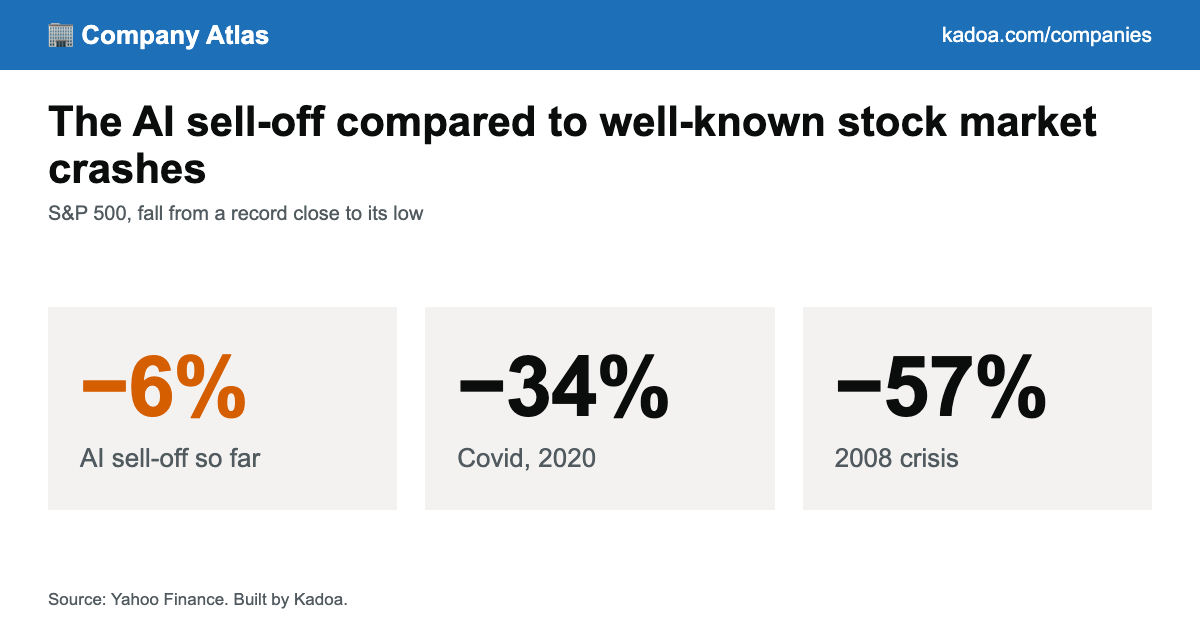
The AI-driven sell-off pushed the S&P 500 down 4.4% on Nov. 5, 2026—its worst day since April 2025—leaving the index 6% below its Oct. 6 record. A day-by-day comparison charts the decline against 1987, 2008, Covid-era and other major market falls since 1950.
CommentsTmux-restore is a new Show HN tool that preserves tmux sessions, layouts, and scrollback across reboots. It also reopens AI coding agent conversations—including Claude Code, Codex, Gemini CLI, opencode, and pi—so users can resume exactly where they left off.
Comments
The Components of Agent Memory
2026-11-07Anthropic explains how Claude’s agent memory works, noting that deciding what to remember before knowing future context is key. It describes “dreaming” as a process for organizing memories and correcting mistakes so Claude can learn from experience.
CommentsEnterprise Brain introduces shared agent memory that learns from work by building on enterprise context. It connects trajectories to outcomes, evaluates performance, and prepares training data within the customer’s own cloud.
CommentsVideo Rebirth has released HyperFlow H3 Flash, compressing the 31B MiniMax-H3 joint video-and-audio diffusion model to about 13.7B parameters and enabling generation in roughly 4–8 steps. The release supports INT8 and GGUF formats for more practical deployment.
Comments2026-11-06
Deus Ex
2026-11-06A discussion around Deus Ex highlights skepticism over a planned remaster, which was delayed after poor fan reception and is seen by some as inferior to existing free mods. Commenters also debate the myth of the solo game creator and how AI tools can now produce enhanced, multiplayer-capable versions of old games in just a few prompts, raising questions for remaster-focused studios even as testing and refinement remain the hard part.
Comments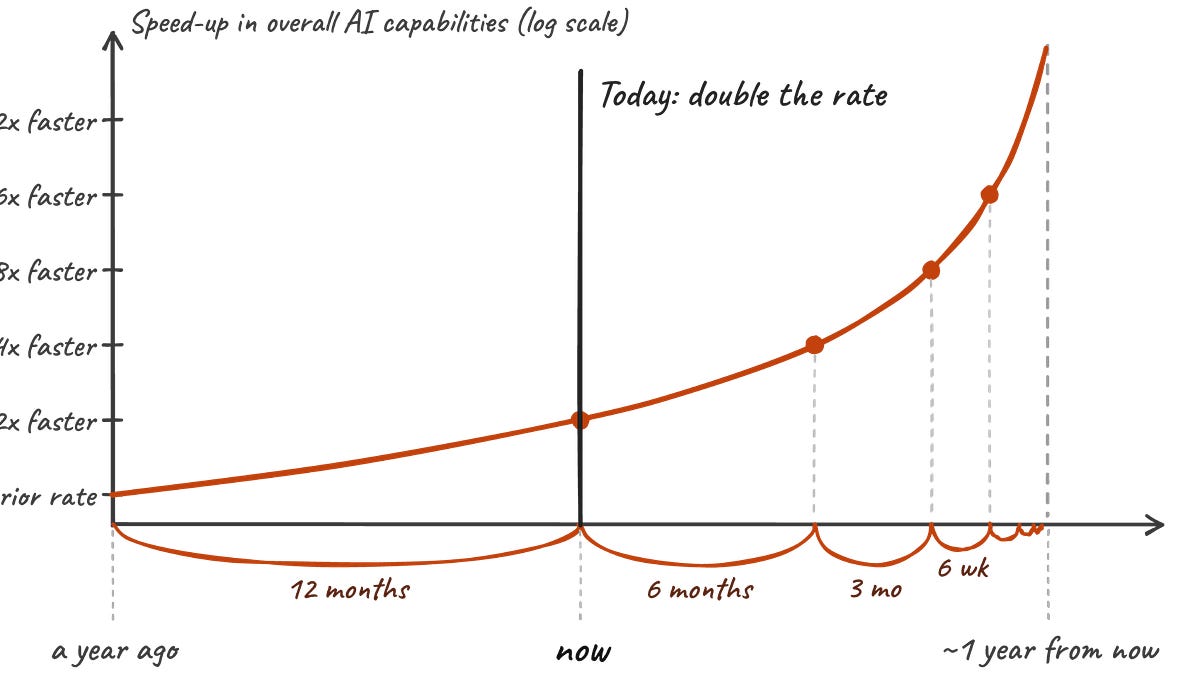
AI is dramatically accelerating AI research, creating a feedback loop that could compound over time. The piece notes that a naive extrapolation of this acceleration implies superintelligence within a year.
Comments
Mark Cuban accused Facebook of knowingly running AI-generated deepfake scam ads, saying he has seen his own face used to promote nonexistent diabetes cures. He cited documents indicating the platform earns $16 billion in fraud revenue.
CommentsAnthropic IPO buyers are reportedly valuing the company as low as $1.1 trillion, amid reader debate over whether capable local models like Qwen3.8-Flash-Next threaten its subscription business. Some developers say local/open models are now good enough to cut Claude usage or cancel Pro subscriptions, while others argue Claude remains much stronger for coding and that compute scale still provides a moat.
Comments
Academic libraries are being overwhelmed by AI data-scraping bots that slow or crash sites meant for students, researchers, and the public. The surge comes as AI companies continue hunting for content to train large language models, putting public access at risk.
Comments
Inkling 2 Small
2026-11-06The company announced Inkling 2 Small, the first release in its second-generation Inkling model lineup. The launch marks the debut of the next generation of Inkling models.
Comments