AI Tech News
SubmitArtificial intelligence remains the fastest-moving story in technology. Here you will find news on model releases and research, the labs and companies competing for the frontier, enterprise adoption, and the debates over safety, jobs, and regulation that AI continues to raise.
Typical stories include new model launches and benchmark claims, massive infrastructure and chip investments, AI features arriving in mainstream products, research papers that shift the field's direction, and enterprise deals that show where adoption is real rather than experimental.
AI now sets the agenda for the rest of the technology industry, steering capital, talent, and strategy at nearly every major company. Developers, executives, policymakers, and workers wondering how their jobs will change all have reasons to follow it closely.
2026-04-14

Claude Code Routines
2026-04-14Anthropic has introduced Claude Code Routines, an automation feature that allows developers to put its coding assistant on autopilot. The new tool runs on Anthropic-managed cloud infrastructure, letting users define custom routines that execute on a set schedule, trigger via API calls, or react automatically to GitHub events.
CommentsIntrospective Diffusion Language Models
2026-04-14The Introspective Diffusion Language Model, or I-DLM, is the first diffusion-based language model to match the quality of traditional autoregressive models. It achieves impressive benchmark scores in mathematics and code generation, reaching 69.6 on AIME-24 and 45.7 on LiveCodeBench-v6. Additionally, it significantly outperforms comparable systems like LLaDA-2.1-mini by delivering 2.9 to 4.1 times higher throughput.
Comments

Chrome has introduced a new Skills feature that transforms users' favorite AI prompts into one-click tools for instant execution. This update allows users to easily discover, save, remix, and repeat complex AI workflows directly within the browser.
Comments
Write less code, be more responsible
2026-04-14This opinion piece examines the dual impact of AI-assisted programming, highlighting how automated tools allow developers to write less code while increasing their accountability for the final product. The author emphasizes that engineers must maintain strict oversight over code quality, security, and system architecture to responsibly manage AI-generated outputs.
Comments
While closed-source models offer seamless tool calling via standardized APIs, open-source models face a fragmented M×N integration problem. This discrepancy highlights the ongoing challenge of creating unified function-calling capabilities across the diverse open-source ecosystem.
CommentsLangAlpha is a new open-source project that adapts the AI capabilities of Claude Code specifically for the financial markets. Designed to function as a dedicated AI agent for Wall Street, the tool aims to assist with complex financial operations and data analysis. Developers can currently contribute to its ongoing development via the project's GitHub repository.
CommentsPractitioners treating multi-agent software development as a distributed systems problem emphasize using sequential pipelines with strict verification gates to ensure overall reliability. By applying deterministic checks and quality boundaries between planning, designing, and coding stages, developers can effectively manage the inherent unpredictability of large language models. This approach transforms unreliable individual agents into a coordinated protocol that consistently preserves user intent across different artifact representations.
Comments
OpenAI is expanding its Trusted Access for Cyber program by granting vetted defenders access to its newly introduced GPT-5.4-Cyber model. The initiative also includes strengthened safety protocols to address the rapidly evolving capabilities of artificial intelligence in the cybersecurity landscape.
CommentsGAIA is a new open-source framework that enables developers to build and run AI agents directly on local hardware. Supporting both Python and C++, the tool provides a flexible foundation for creating localized artificial intelligence applications specifically optimized for AMD systems.
Comments2026-04-13

AMD is challenging Nvidia's dominant CUDA ecosystem by leveraging its fully open-source ROCm stack and integrating the Triton compiler. By embracing a software-first culture, the company aims to steadily erode Nvidia's competitive moat in the accelerated computing market.
Comments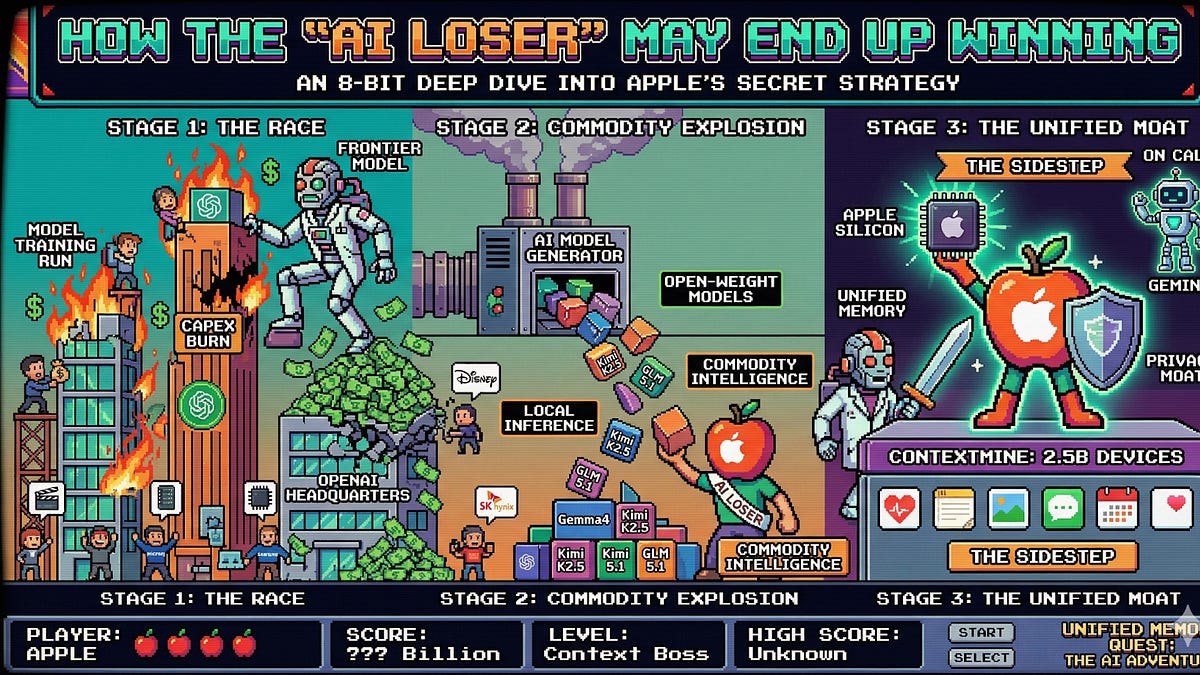
Despite current perceptions of Apple as an AI loser, the company's delayed entry into the generative AI race may actually provide a unique long-term strategic advantage. By leveraging its closed ecosystem and hardware integration to build an accidental competitive moat, Apple is positioned to ultimately win the consumer AI market.
CommentsMicrosoft is not removing its Copilot AI assistant from Windows 11, but is instead simply renaming the feature. Reader discussions surrounding the update largely diverge into broader debates about the overall user experience of Windows versus Linux for gaming. Many users express frustration with forced Windows integrations and advocate for alternative setups, such as dual-booting with Linux or using cloud gaming services.
CommentsA new benchmark called N-Day-Bench evaluates the ability of large language models to identify real-world vulnerabilities within actual codebases. The framework utilizes strict GitHub advisories and OpenRouter-backed models to rigorously test AI-driven security scanning capabilities.
CommentsReaders testing Gemma 4 locally report that while the model delivers exceptional inference speed and impressive one-shot coding performance rivaling top-tier proprietary AI, it struggles significantly with agentic tasks, tool use, and large context windows. Although early benchmarks were skewed by tokenizer and tool invocation bugs, corrected tests show the dense 31B variant actually outperforms the faster MoE model in overall quality. Ultimately, users praise its capabilities for specific local coding tasks on Apple Silicon but note that its limitations in iterative reasoning and context scaling prevent it from being a flawless autonomous coding assistant.
CommentsMichigan lawmakers withdrew proposed digital age legislation following backlash over its handling of consumer data privacy. Critics argued the bills relied on flawed opt-out mechanisms rather than requiring strict opt-in permission for data sales. The controversy highlights broader frustrations with tech companies using delayed consent models to harvest user data for AI training without explicit approval.
CommentsThe final installment of a tech series explores AI safety and alignment, arguing that trusting commercial or government entities to align AI systems with individual goals is inherently dangerous. Reader discussions highlight the adversarial nature of these power dynamics, emphasizing how concentrated institutional power actively undermines natural human cooperation to prioritize corporate and governmental interests.
Comments