AI Tech News December 13 2025
Artificial intelligence produces a constant flow of announcements, and some days stand out more than others. This section gathers AI news in the format of a dated briefing, focused on the stories around December 13, 2025.
Typical stories include new model launches and benchmark comparisons, AI features in popular products, research papers, partnerships between AI labs and cloud providers, and debates about safety and regulation.
A dated view of AI news shows how fast the field moves from one month to the next. Developers, researchers, investors, and business leaders use it to put new announcements into context.
2026-07-18
Moonshine AI has introduced a lightweight voice model that processes speech recognition, intent recognition, and text-to-speech in under 500 kilobytes. The tool offers ultra-low latency, providing developers with a highly efficient framework for building responsive voice agents and interfaces.
CommentsGPT-5.6 has closed a three-decade gap in convex optimization by using a prompt to prove a theoretical lower bound on time complexity. The AI model successfully demonstrated that solving this specific class of functions requires the same minimum number of evaluations as a 30-year-old algorithm. This milestone highlights the growing capability of large language models to independently resolve advanced mathematical conjectures.
Comments
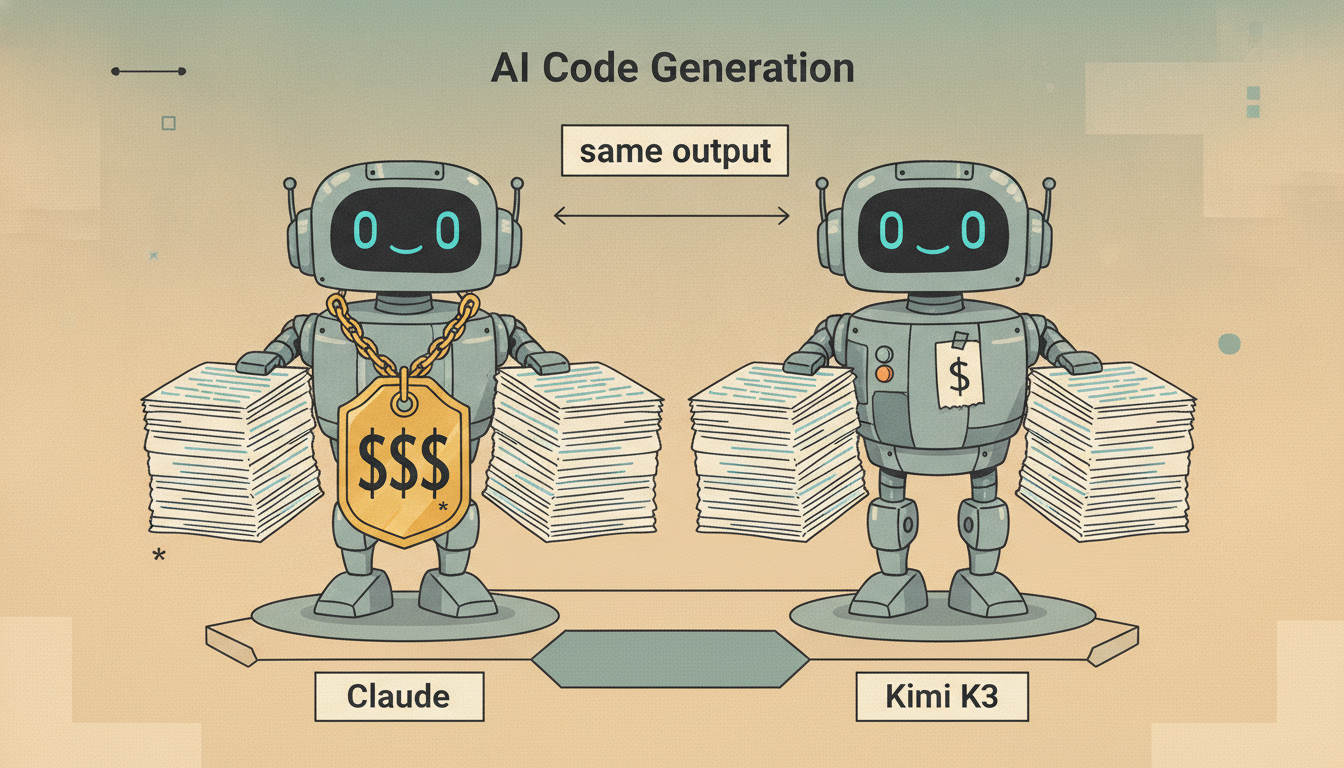
The Kimi K3 Moment
2026-07-18A developer evaluating the new Kimi K3 AI model found its coding capabilities and output quality to be virtually indistinguishable from industry leader Claude. This parity marks a significant milestone in the tech industry, demonstrating that top-tier software development AI is no longer exclusive to a single provider.
CommentsWhat AI did to stackoverflow in a graph
2026-07-18A recent graphical analysis reveals a dramatic drop in Stack Overflow's web traffic following the widespread adoption of AI coding assistants. The visual data highlights a major shift in developer behavior as programmers increasingly rely on generative AI to answer coding questions instead of searching community forums. This trend underscores the disruptive impact of large language models on traditional knowledge-sharing platforms within the tech industry.
CommentsQ3Edit is an open-source, WebAssembly-powered browser tool that allows users to edit and play Quake III Arena maps without local installations. It uniquely integrates live MCP authoring, enabling seamless AI-assisted map creation directly within the editor using models like Codex and Claude.
Comments
Google DeepMind and Isomorphic Labs are leveraging advanced AI models to strengthen global bioresilience against biological threats. By applying artificial intelligence to this critical field, the companies aim to significantly improve prevention, detection, and response capabilities for potential outbreaks.
Comments2026-07-17

Chinese AI lab Moonshot AI has announced Kimi K3, a 2.8 trillion-parameter model described as the company's most capable to date. The model is currently available via their website and provides new insights regarding the pelican benchmark.
CommentsThe state of open source AI
2026-07-17Community discussions suggest that open-weight AI models could threaten closed developers like OpenAI and Anthropic, as hyperscalers like Apple and Google can deploy them for free to protect their own device ecosystems. The conversation also debates whether China's push for open models is a tactical maneuver to bypass Western restrictions or a principled strategy to accelerate practical economic applications. Ultimately, the high costs of training frontier models raise concerns about the financial sustainability of open-weight strategies as the industry shifts focus toward efficient, on-device edge AI.
Comments
Kaiser Permanente nurses handling triage calls warn that the increasing use of AI and workplace surveillance is negatively impacting both their working conditions and patient care. The healthcare workers argue that these technologies threaten their fundamental duty of care by prioritizing corporate metrics over patient well-being.
Comments
New evidence exposes significant inconsistencies in AI evaluation processes and the selection of competition winners. To address these flaws, experts emphasize the need to design high-quality benchmarks that evaluate how frontier models truly reason, act, and judge, rather than just relying on simple data recall.
CommentsCamera Chase Vehicle
2026-07-17A detailed builder's log chronicles the step-by-step creation of a quirky, custom camera chase vehicle by a veteran hardware maker known for early work on the Onewheel. Readers praised the passion project's meticulous documentation and zero-stakes inventive spirit as a refreshing break from the usual tech news focus on machine learning.
Comments
The human-in-the-loop is tired
2026-07-17Developers are experiencing a unique psychological fatigue as AI systems increasingly write their own code, shifting humans from active creators to passive supervisors. This transition at the intersection of machine reward functions and human dopamine loops highlights the growing exhaustion of remaining the human in the loop.
CommentsResearchers used an AI auditor to uncover a critical soundness vulnerability in the OpenVM zero-knowledge virtual machine that allowed malicious provers to forge pairing equalities. The flaw stemmed from missing subfield checking and has been patched in the OpenVM 1.6.0 release under CVE-2026-46669. This discovery marks the second installment in an ongoing series detailing AI-driven bug hunting in open-source cryptography.
Comments2026-07-16
Kimi K3: Open Frontier Intelligence
2026-07-16Kimi K3 has been introduced as the world's first open 3-trillion parameter AI model, delivering frontier-level performance across coding, knowledge work, and reasoning. The model also features native multimodality and a one-million-token context window.
Comments
Decoy Font
2026-07-16Decoy Font is a new typeface designed to thwart AI text recognition by combining every standard letter with a visual decoy. This obfuscation technique prevents automated systems from easily reading user text, and the font is available for online testing or direct TTF download.
Comments
NotebookLM is now Gemini Notebook
2026-07-16Google has renamed NotebookLM to Gemini Notebook, maintaining its status as a standalone product while expanding its capabilities. The updated tool now features deeper integration with Google services and introduces a new secure cloud computer.
Comments
Researchers have found that classical machine learning algorithms can effectively identify text generated by large language models without relying on complex deep learning architectures. This traditional approach provides a highly efficient and lightweight alternative for systems designed to detect AI-generated content with minimal computational overhead.
CommentsIn a recent experiment, Claude Fable 5 and GPT-5.6 Sol were tasked with autonomously directing a music video using the same song, a $100 budget, web search, and local ffmpeg. This creative challenge highlights the rapidly advancing autonomous capabilities of next-generation AI models in complex multimedia production.
Comments
LM Studio has introduced Bionic, a new AI agent specifically designed to help users execute practical tasks using open models. The tool focuses on real-world productivity and is built to seamlessly get things done. This release marks a significant step in making open AI models more actionable for everyday users.
CommentsA recent guide explains how to train a generative AI kick drum model locally on a low-end Linux machine with just 6GB of VRAM. The accompanying community discussion explores the broader landscape of AI audio synthesis, debating the merits of parameter-based tools like SynPlant against the challenges of accurately replicating the organic timbral nuances of physical instruments. Ultimately, readers weigh whether the future of generative audio lies in exact resynthesis or in creating highly tweakable, expressive sound design parameters.
Comments
A recent article highlights the paradox of individuals who acknowledge the valid criticisms of Large Language Models yet continue to rely on them extensively. The author argues that this seemingly contradictory adoption of AI is a common mindset shared by many users today.
CommentsA new open-source educational guide titled The Little Book of Reinforcement Learning has been launched on GitHub by developer alxndrTL. The community-driven project aims to provide an accessible introduction to reinforcement learning concepts for developers and AI students. Contributors are actively encouraged to help expand and improve the resource.
CommentsLLM Networking with MikroTik
2026-07-16The author reports successfully using Large Language Models to configure and deploy MikroTik networks over the past several months. They note that the AI-assisted setups have gone exceptionally well, though they consciously avoid using trendy buzzwords to describe the process. This positive experience highlights the growing practical utility of AI in modern network administration.
Comments2026-07-15

Inkling: Our Open-Weights Model
2026-07-15Inkling has released its first open-weights model. The new system features a multimodal Mixture-of-Experts architecture with controllable reasoning effort. Developers can now access and fine-tune the model on the Tinker platform.
CommentsA detailed look at the computers used in Jurassic Park sparked a broader debate among readers about the impact of AI on the social internet. While users appreciated that AI and forums can instantly resolve obscure movie trivia, many lamented that this convenience removes the incentive for humans to openly share and discuss knowledge online. Consequently, commenters warned that relying on AI could lead to an information dark age where organic community insights are lost or locked behind paywalls.
CommentsA developer successfully ran Google's Gemma 4 26B AI model on a 13-year-old Xeon CPU without using a GPU. By working around the legacy hardware's lack of AVX2 instruction sets, the system achieved a text generation speed of five tokens per second, demonstrating that modern Mixture of Experts models can operate on highly constrained infrastructure.
CommentsAn article advocating for government and corporate investment in open-source AI has prompted readers to propose funding targeted, hardware-specific benchmark competitions to incentivize the development of optimized consumer-level models. However, commentators highlight the significant logistical costs of curating fair evaluations and remain divided on whether financial prizes or mandatory open-weight releases offer the best path forward for the movement.
CommentsTowards a harness that can do anything
2026-07-15Discussions surrounding the article highlight a consensus that AI agents should be built on deterministic code scaffolds rather than relying solely on fluid prompts. Developers argue that LLMs should be used strictly to handle edge cases and generate permanent automation scripts, treating prompt-only workflows as inferior to committing actual code. Additionally, the conversation underscores the rising importance of Behavior-Driven Development and Gherkin-style testing to define agent behaviors before codifying them into deterministic execution.
CommentsA recent article details how a researcher successfully bypassed the safety guardrails of Anthropic's Claude AI model using clever prompt injection techniques. By exploiting these vulnerabilities, the author tricked the system into revealing sensitive and private information. This demonstration highlights the ongoing challenges of securing large language models against manipulation and unintended data leaks.
Comments
Y Combinator S26 startup Coasty has launched an API designed for computer-use agents to run autonomous tasks on managed machines. The platform allows developers to compose these tasks into workflows and utilize prediction primitives for direct control, offering both a standard REST API and an LLM-friendly plain-text documentation format.
Comments