AI Tech News December 13 2025
Artificial intelligence produces a constant flow of announcements, and some days stand out more than others. This section gathers AI news in the format of a dated briefing, focused on the stories around December 13, 2025.
Typical stories include new model launches and benchmark comparisons, AI features in popular products, research papers, partnerships between AI labs and cloud providers, and debates about safety and regulation.
A dated view of AI news shows how fast the field moves from one month to the next. Developers, researchers, investors, and business leaders use it to put new announcements into context.
2026-07-06

AMD Ryzen AI Halo – $4k AI Dev Kit
2026-07-06AMD has unveiled a new $4,000 AI development kit built around the Ryzen AI Halo processor. Linus Tech Tips Labs is currently testing the high-end hardware to deliver comprehensive benchmarks and insights for developers and tech enthusiasts.
Comments
GLM 5.2 has emerged as the first open-weights model to genuinely rival top-tier systems like Opus and GPT for agentic tasks while costing only 15 to 20 percent as much. This dramatic cost reduction is poised to trigger a widespread collapse in AI inference margins.
Comments

A global workspace in language models
2026-07-06Anthropic researchers have published new interpretability findings detailing the internal reasoning processes of the Claude language model. The study reveals that the AI utilizes a mechanism akin to the human brain's global workspace to dynamically route information across its neural network. This discovery provides a clearer window into how large language models organize complex thoughts and manage internal attention.
CommentsOfficeCLI is a free, open-source command-line suite designed specifically for AI agents to read, edit, and automate Microsoft Office documents. It operates as a standalone binary that requires no underlying Office installation to seamlessly manipulate Word, Excel, and PowerPoint files.
CommentsMark Zuckerberg stated that the development of fully autonomous AI agents is progressing slower than expected. Although AI tools significantly increase the raw volume of code generated, engineers still require extensive human oversight and code review to ensure stability, demonstrating that unsupervised autonomous coding agents are not yet a reality.
Comments
A new technique for Retrieval-Augmented Generation streamlines AI performance by pruning agent context down to only the essential information needed to formulate an answer. This approach significantly reduces the volume of data processed by the model. Remarkably, it achieves this efficiency while preserving 96% of the original recall accuracy.
Comments
A new arXiv paper investigates whether the cleanliness of source code directly impacts the performance of AI coding agents by utilizing a controlled minimal-pair study design. This research aims to isolate the specific effects of code quality, helping developers determine if maintaining pristine codebases is necessary for optimal collaboration with automated programming tools.
Comments2026-07-05
While a new study claims an AI tutor significantly boosted student performance in a Dartmouth course, critics are highly skeptical of the research methodology. Detractors point out that the reported statistical gains were driven by a small fraction of fully engaged students and suffered from selection bias due to the lack of a randomized control group. Additionally, mid-experiment design changes and potential overlaps between the AI materials and final exams cast doubt on whether the tool actually improved learning or merely identified inherently high-performing students.
CommentsMeta's Un-Stable Signature
2026-07-05Amid discussions about Meta's digital signature practices and new EU AI Act mandates, users are raising significant privacy and mass surveillance concerns over persistent AI watermarking and C2PA provenance tracking. Although these embedded identifiers are designed to authenticate media and clearly label AI-generated content, critics warn they could inadvertently expose sensitive personal data and tool usage in vulnerable contexts. In response to these controversies, developers are already creating specialized applications designed to detect and strip these embedded digital watermarks from images.
Comments
A four-year study examining the fate of 100 successful blogs reveals the profound impact that Google algorithm updates and the rise of artificial intelligence have had on the digital landscape. The research highlights a major shift in online content creation, detailing exactly which sites managed to survive these technological changes and which ultimately disappeared.
Comments
A prolific new marketing scam originating in Nigeria is targeting authors with highly personalized, AI-generated email solicitations. Posing as legitimate public relations experts or book club reviewers, the scammers use these deceptive messages to trick creators into paying for fake promotional services.
CommentsThe Log is the Agent
2026-07-05A newly published arXiv paper introduces a novel architecture for agentic systems called event-sourced reactive graphs, where the immutable event log itself acts as the agent. This design ensures that AI workflows are fully auditable and easily forkable, providing developers with a transparent and reversible foundation for complex autonomous operations.
Comments2026-07-04

Open-source large language models are rapidly improving their price-to-performance ratio, becoming faster and cheaper for enterprise deployment. This trend provides businesses with a highly competitive and accessible alternative to expensive proprietary AI systems.
Comments
Leanstral 1.5: Proof abundance for all
2026-07-04Leanstral has released version 1.5 of its enterprise AI platform, offering advanced tools to customize, fine-tune, and deploy open models. The update enables organizations to build and scale AI assistants, autonomous agents, and multimodal systems tailored to their specific operational needs. This latest release aims to solidify the platform's position as a powerful AI solution for corporate environments.
CommentsA newly reported bug has revealed a potential session and cache leakage issue involving an AI agent. Despite strict authentication to a secure Enterprise workspace, the agent unexpectedly began discussing an unrelated consumer Minecraft project from another user's session. This cross-account contamination highlights critical vulnerabilities in data isolation and raises privacy concerns for enterprise environments.
Comments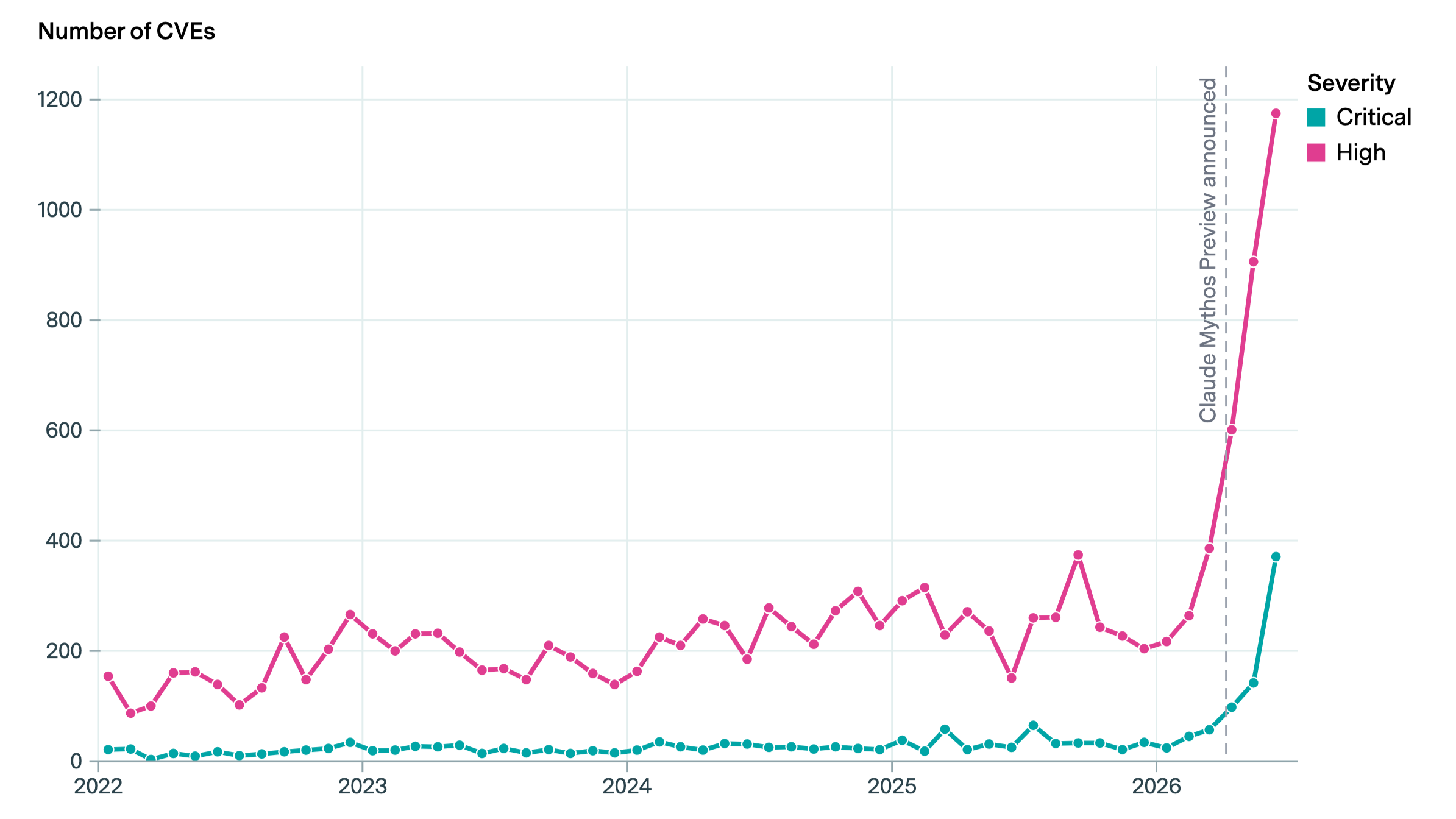
High- and critical-severity vulnerability disclosures surged to approximately 1,300 in June 2026, marking a 3.5-fold increase over previous monthly records. An Epoch AI analysis indicates this spike coincided directly with Anthropic's Project Glasswing and the release of Claude Mythos Preview.
Comments
Better Models: Worse Tools
2026-07-04A recent analysis highlights an aggravating regression in newer Claude models regarding their ability to reliably execute tool calls. Despite overall improvements in general intelligence and reasoning, this specific capability has significantly declined. This downgrade is causing major frustrations for developers who depend on the AI for consistent external integrations.
CommentsOdin, Wikipedia and engagement farming
2026-07-04A debate over Wikipedia's strict notability and sourcing policies has erupted following disputes over the inclusion of articles for tech projects like the Odin programming language. While critics argue that firsthand confirmations from founders are sufficient for niche software, Wikipedia defenders maintain that enforcing independent secondary sources is crucial to prevent spam, fake personas, and AI-driven engagement farming in a low-trust internet environment.
CommentsAgentic coding notes
2026-07-04A recent discussion highlights how rigorous hardware testing methodologies, such as heavy fuzzing and property-based testing instead of traditional unit tests, can be successfully applied to modern software development. Participants emphasize that skills in measurement and experimental design, traditionally cultivated in chip companies, are becoming increasingly valuable for evaluating and guiding AI coding agents. The conversation also explores how integrating AI tools with robust feedback loops enables autonomous usability testing and self-correction in software projects.
Comments
UC Berkeley scientist Julie Elie won the 2026 Coller-Dolittle Prize and $100,000 for using machine learning to decode the vocalizations of zebra finches. She identified and mapped the meanings of 11 core bird calls, an achievement judges praised as a major breakthrough in interspecies communication research.
Comments2026-07-03
Developer Jamesob has published a comprehensive GitHub repository detailing how to run state-of-the-art large language models on local hardware. The open-source guide compiles extensive knowledge and best practices for local LLM deployment, inviting community contributions to further expand the resource.
Comments
Protect your right to run local AI
2026-07-03Tech advocacy groups are urging users to protect their right to run artificial intelligence locally on their personal devices. Supporters are encouraged to sign a quick online petition and call their state representatives to defend this digital freedom.
CommentsImmich 3.0
2026-07-03The popular open-source self-hosted photo and video backup solution Immich has officially launched version 3.0, introducing significant enhancements to performance, machine learning features, and media management tools. This major milestone release provides users with a much more streamlined and robust experience for organizing and accessing their personal media libraries.
CommentsAlibaba is reportedly banning Anthropic's Claude Code from its workplace over concerns regarding potential backdoors and the broader security risks of hosted AI tools. This decision highlights growing industry anxieties that feeding proprietary code into remote models exposes sensitive intellectual property to espionage, data breaches, and supply chain attacks, prompting organizations to reevaluate their reliance on third-party AI providers.
CommentsDevelopers using the open-source tool pxpipe have achieved a 60 percent reduction in token usage and costs for the Fable 5 model by converting text context into images. Instead of feeding raw code directly to the AI, the application renders the text visually and relies on the model's optical character recognition capabilities to process the context.
Comments2026-07-02
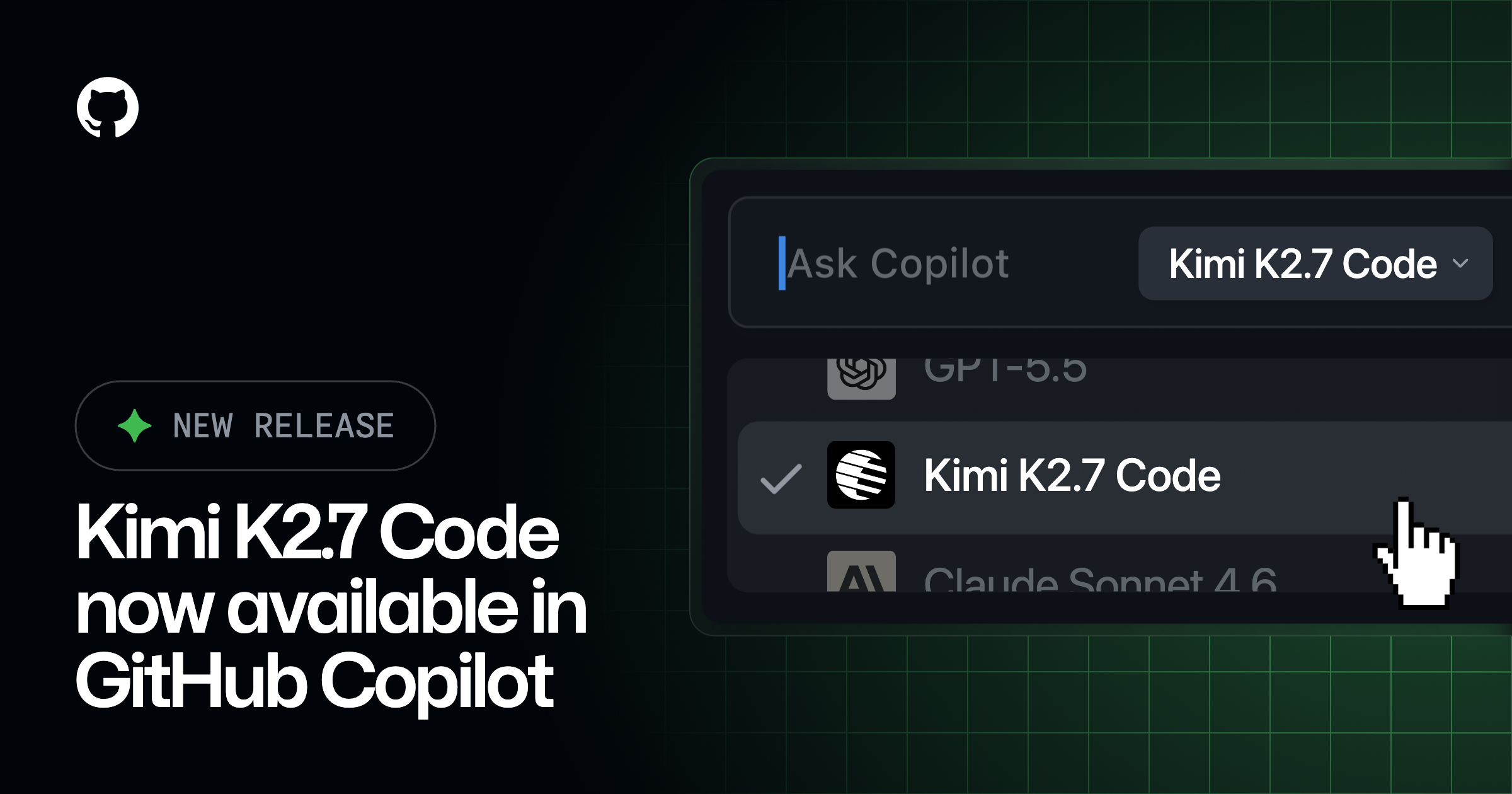
Kimi K2.7 Code is now generally available in GitHub Copilot, expanding the AI tools available to developers. This marks a significant milestone as it is the first open-weight model offered as a selectable option within the Copilot model picker.
CommentsReaders are debating the efficacy of a short leash micromanagement approach for AI coding, with some arguing that developers should instead engage in nuanced, high-level design discussions with advanced models. Critics of this collaborative approach counter that large language models lack true introspection and merely hallucinate post-hoc explanations for their outputs. Consequently, the conversation shifts into a broader philosophical debate comparing the AI's generated reasoning to human consciousness and our own evolutionary post-hoc justifications.
Comments
Zero-Knowledge Proof libraries have been open-sourced to enhance privacy in digital age verification systems. This technology release builds upon a partnership with Sparkasse to support age assurance compliance across the European Union. Making these cryptographic tools publicly available will empower developers to build more secure age verification solutions.
CommentsJapan's highest court has ruled that artificial intelligence cannot be named as an inventor on patent applications, affirming that AI is a tool lacking legal ownership rights. The ruling has sparked broader reader debates regarding the economic utility of intellectual property laws, weighing whether patents genuinely incentivize innovation in high-cost sectors like pharmaceuticals or simply protect corporate monopolies.
CommentsA new MIT-licensed open-source tool called Claude-real-video enables large language models to process and analyze video content entirely locally. By extracting scene-aware, deduplicated frames and combining them with transcripts from local files or URLs, the project allows developers to seamlessly integrate advanced video understanding into their AI workflows.
Comments