AI Tech News December 13 2025
Artificial intelligence produces a constant flow of announcements, and some days stand out more than others. This section gathers AI news in the format of a dated briefing, focused on the stories around December 13, 2025.
Typical stories include new model launches and benchmark comparisons, AI features in popular products, research papers, partnerships between AI labs and cloud providers, and debates about safety and regulation.
A dated view of AI news shows how fast the field moves from one month to the next. Developers, researchers, investors, and business leaders use it to put new announcements into context.
2026-04-23

GPT-5.5
2026-04-23GPT-5.5 has been introduced as the smartest and fastest model to date. The newly released AI features enhanced capabilities specifically optimized to handle complex, multi-step workflows. These improvements make it highly effective for demanding tasks such as advanced coding, research, and data analysis across various tools.
Comments
Anthropic has released an update addressing recent reports regarding the quality of its Claude Code tool. Reaffirming its core mission to build reliable and steerable AI systems, the company detailed ongoing efforts to improve the platform's performance and overall dependability.
Comments

Meta tells staff it will cut 10% of jobs
2026-04-23Meta is cutting 10% of its workforce, eliminating approximately 8,000 jobs. The company stated that these layoffs are intended to boost operational efficiency and help offset its heavy spending on artificial intelligence.
Comments
The development team behind MeshCore has fractured due to internal disagreements over a trademark dispute and the use of AI-generated code. Amidst this split, the project is also migrating its infrastructure to the new meshcore.io website.
CommentsInfisical has introduced Agent Vault, an open-source HTTP credential proxy and vault designed to securely manage secrets for AI agents. The tool integrates with platforms like Claude Code, OpenClaw, and Hermes to provide a centralized security layer for sensitive data. This release addresses the growing need for robust credential management as autonomous AI systems become more prevalent in software development.
Comments
Our newsroom AI policy
2026-04-23Ars Technica has published a new newsroom policy detailing how the publication utilizes generative AI. The guidelines establish clear boundaries on which editorial tasks can be assisted by the technology and which are strictly prohibited to maintain journalistic integrity.
Comments2026-04-22

Qwen has introduced the Qwen3.6-27B, a 27-billion parameter dense model that delivers flagship-level coding performance. Complementing this release, the Qwen Studio platform offers a comprehensive suite of multimodal features, ranging from image and video generation to document processing and web search integration.
Comments
SpaceX has reportedly agreed to acquire AI coding platform Cursor for $60 billion to build the world's leading software engineering and knowledge work AI. The deal will combine Cursor's popular developer tools with SpaceX's massive Colossus supercomputer, which features a million H100-equivalent chips.
CommentsDevelopers are increasingly relying on AI coding agents like Claude Code to write the majority of their software, overcoming issues like model over-editing through clear, iterative feedback. While some users create project-specific skill files to guide the AI, the consensus is that simply providing detailed instructions and treating the tool as an iterative collaborator yields the best results. This straightforward approach has drastically increased productivity, allowing users to commit significantly more code with fewer tokens than traditional methods.
Comments
A new experimental website bypasses traditional pre-rendered pages by streaming content live directly from an AI model. This approach creates an infinite visual browser where the interface and graphics are generated entirely on demand in real time.
Comments
A new project introduces a scoring system to detect and analyze artificial intelligence design patterns across Show HN submissions. The tool examines these user-generated posts to identify common architectural trends and development methodologies. This initiative provides valuable insights for developers and researchers tracking the rapid evolution of AI application design.
Comments
Google has unveiled its eighth-generation Tensor Processing Units, introducing two new chips specifically designed to power the emerging era of AI agents. These advanced processors are engineered to efficiently handle the complex and dynamic workloads required to run next-generation autonomous systems. This hardware update underscores the company's ongoing commitment to building specialized infrastructure for advanced artificial intelligence.
CommentsCrabTrap is a newly released HTTP proxy that secures production AI agents by intercepting and auditing their requests in real time using an LLM-as-a-judge framework. The open-source tool is currently available for developers to download and test on GitHub.
Comments2026-04-21

ChatGPT Images 2.0
2026-04-21ChatGPT Images 2.0 introduces a state-of-the-art upgrade to the platform's AI image generation capabilities. The newly released model significantly improves text rendering and visual reasoning, while also expanding multilingual support for user prompts.
CommentsMeta is implementing large-scale, active surveillance of employee mouse movements and keystrokes to gather data for AI training, prompting significant concerns over the loss of workplace privacy. Commentators warn that this shift from reactive monitoring to proactive tracking reflects a broader tech industry trend of treating workers as data assets rather than people. Consequently, this type of unchecked corporate data harvesting is expected to become the new normal in the US, even as similar practices face strict legal restrictions in parts of Europe.
Comments
Anthropic has reinstated support for OpenClaw-style usage of its Claude AI model, allowing developers to once again access the system via API keys or the Claude CLI. This policy reversal restores essential functionality for users integrating the AI into their OpenClaw workflows.
CommentsMediator AI is a new platform combining large language models with Nash bargaining theory to help disputing parties negotiate mutually acceptable agreements. While critics argue the tool overlooks the emotional elements of traditional mediation, developers emphasize it facilitates rather than dictates outcomes by generating and scoring candidate solutions based on user preferences. Although commentators see potential for resolving low-stakes conflicts like roommate disagreements, its practicality in highly adversarial or low-trust situations remains heavily debated.
CommentsDiscussions on optimizing dynamic language interpreters highlight how inherent language design choices heavily dictate performance and JIT optimization potential. While languages like Lua and Wren achieve high speeds by limiting extreme runtime dynamism, Python's complex features and extension compatibility have historically hindered its default CPython implementation. However, driven by AI workloads and modern hardware, new JIT efforts and alternative runtimes like PyPy are steadily improving the execution speed of highly dynamic languages.
Comments
Vercel suffered a significant data breach after an employee at the AI startup Context AI inadvertently installed malware from a Roblox cheat, enabling attackers to exploit an OAuth integration and access internal systems. The incident led to the exfiltration of non-sensitive environment variables and has forced thousands of developers to undertake massive credential rotation efforts. Ultimately, the attack underscores the severe security vulnerabilities introduced by granting broad access permissions to third-party AI productivity tools.
CommentsGoModel is a new open-source AI gateway written in Go that provides a unified, OpenAI-compatible API for multiple major AI providers. Positioned as a lightweight alternative to LiteLLM, it equips developers with essential features including observability, guardrails, streaming, and comprehensive cost and usage tracking.
Comments
Amazon is investing an additional $5 billion in AI startup Anthropic to strengthen their ongoing partnership. In exchange for the new capital, Anthropic has pledged to spend $100 billion on Amazon Web Services cloud infrastructure.
Comments2026-04-20
Qwen has introduced the Qwen3.6-Max-Preview, an evolving AI model designed to deliver smarter and sharper performance. The Qwen Studio platform supports a comprehensive suite of multimodal capabilities, including chat, image and video understanding, media generation, document analysis, and integrated tool utilization.
Comments
GitHub's fake star economy
2026-04-20An investigation into GitHub's ecosystem has revealed a widespread fake star economy, with an estimated six million illegitimate stars purchased for just $0.06 each. Founders are exploiting this underground market to artificially inflate their repository's popularity and deceive venture capitalists into funding projects based on fabricated traction.
Comments
Starting in August 2026, Atlassian will automatically collect metadata and in-app content from its cloud products to train its AI models. The collected data will be retained for up to seven years to support these new AI offerings. While enterprise and compliance-focused customers can opt out, users on free, standard, and premium tiers cannot disable this mandatory data collection.
CommentsThe newly launched Kimi Vendor Verifier aims to rebuild trust in the AI supply chain by rigorously verifying the accuracy of third-party inference providers. This tool ensures that external vendors are reliably and correctly deploying the Kimi model for end users.
CommentsKimi K2.6: Advancing open-source coding
2026-04-20Kimi K2.6 advances open-source coding by introducing innovative features such as long-horizon coding and coding-driven design. The release also enhances collaborative AI capabilities through proactive agents, agent swarms, and the newly introduced Claw Groups research preview.
Comments
Music streaming service Deezer reports that 44% of daily song uploads are now AI-generated. Despite this high volume of new tracks, actual listener consumption of AI music remains low, accounting for only 1% to 3% of total streams. Furthermore, the company detects and demonetizes 85% of these AI streams, identifying them as fraudulent activity.
CommentsThe NSA is adopting Anthropic's Mythos AI model, reversing a previous Pentagon decision to blacklist the company as a supply chain risk. This integration marks a major shift in government procurement after officials initially attempted to penalize the firm.
Comments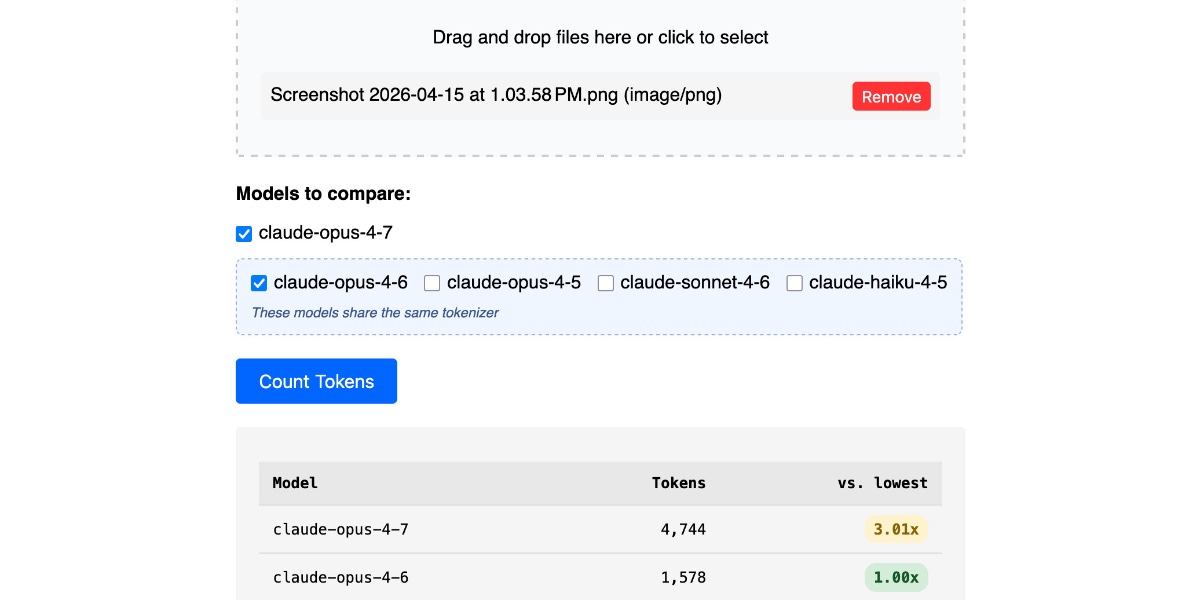
The creator of the Claude Token Counter has upgraded the tool with a new model comparison feature. This update allows users to run token counts on the same input text across multiple different AI models to easily compare their results.
CommentsReader discussions comparing the rapid success of OpenClaw to MS-DOS and modern large language models highlight the tech industry's tendency to reward reckless innovation over careful planning and safety. Critics argue this shortcut-driven approach, exemplified by OpenAI's deployment of these models, facilitates copyright theft and threatens jobs while prioritizing short-term profit. Furthermore, commentators warn that the unchecked proliferation of AI-generated content increases global information entropy by destroying the historical link between written text and authentic human authorship.
Comments