AI Tech News December 13 2025
Artificial intelligence produces a constant flow of announcements, and some days stand out more than others. This section gathers AI news in the format of a dated briefing, focused on the stories around December 13, 2025.
Typical stories include new model launches and benchmark comparisons, AI features in popular products, research papers, partnerships between AI labs and cloud providers, and debates about safety and regulation.
A dated view of AI news shows how fast the field moves from one month to the next. Developers, researchers, investors, and business leaders use it to put new announcements into context.
2026-04-17
Claude Design
2026-04-17Anthropic has launched Claude Design, a new Anthropic Labs product that enables users to collaborate with the AI to create polished visual assets. The tool allows for the quick generation of various professional materials, including designs, prototypes, presentation slides, and one-pagers.
Comments
I’m spending months coding the old way
2026-04-17Despite the widespread integration of artificial intelligence in software development, one developer is deliberately spending the next three months coding without any AI assistance. This self-imposed return to traditional programming aims to reinforce fundamental skills and establish a baseline for evaluating the true impact of AI tools on the industry.
Comments

Stage is a new AI tool that streamlines the code review process by organizing pull requests into logical chapters. This structured approach allows human reviewers to comprehend code changes much faster, ultimately putting developers back in control of their workflows.
CommentsA new demonstration highlights an integrated workflow combining SPICE circuit simulation, LeCroy oscilloscope control, and Claude Code for automated hardware verification. This toolchain allows developers to simulate electronic designs and leverage AI to verify the results directly against physical oscilloscope measurements.
CommentsFIM – Linux framebuffer image viewer
2026-04-17FIM is a Linux framebuffer image viewer that enables users to display images and perform file recovery directly from the terminal without a graphical desktop. Community discussions highlight similar framebuffer tools for media playback, though users note that modern lightweight Wayland setups often provide better hardware performance than traditional framebuffer devices. Despite these performance trade-offs, developers continue to embrace these minimalist environments for their extreme system simplicity and potential security benefits in an AI-driven landscape.
Comments
Discourse Is Not Going Closed Source
2026-04-17Following Cal.com's recent decision to close its source code over AI concerns, Discourse has announced it will remain open source. The platform's creators reaffirmed their commitment to transparent development after 13 years of building the software in public.
Comments2026-04-16

Qwen has released Qwen3.6-35B-A3B, an openly available model designed to deliver advanced agentic coding capabilities to developers. This release enhances the broader Qwen Studio ecosystem, which offers a comprehensive suite of multimodal features including image and video understanding, document processing, and web search integration.
CommentsReaders are debating the societal impact of large language models, warning that automating core cognitive skills could eliminate traditional pathways for upward mobility. While some fear this shift will cause society to regress into pre-technological hierarchies reliant on physical strength and discriminatory practices like primogeniture, others argue we are not doomed to repeat the past. Ultimately, the discussion highlights deep anxieties about how advanced artificial intelligence might reshape human values, fairness, and social equity in the future.
Comments
Cloudflare is upgrading its AI Gateway into a unified inference layer designed to streamline development for AI agents. The platform update allows developers to access models from over 14 providers while introducing new Workers AI bindings and an expanded catalog of multimodal models.
CommentsThe paper computer
2026-04-16A developer created a paper computer prototype for a Gemini hackathon that uses a projector, camera, and AI agent to transform ordinary paper into an interactive display. The screen-free device allows children to engage with digital media through physical objects, offering a tactile alternative to traditional tablets. The creator and online community are now seeking support to refine the minimal prototype into a fully functional product.
CommentsDarkbloom is a new platform that routes encrypted AI inference to idle, hardware-verified Apple Silicon Macs. It provides users with comparable model performance at approximately 50% lower costs than traditional API providers. The hardware-verified encryption ensures strict, operator-blind privacy for all processed data.
Comments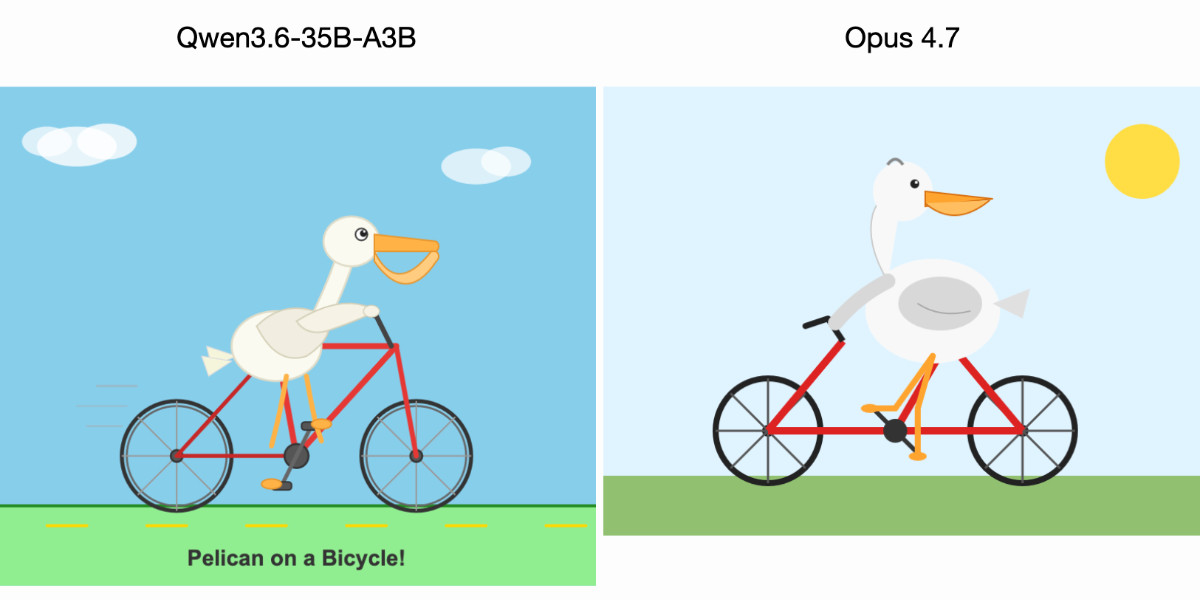
A developer testing AI image generation found that the locally run Qwen3.6-35B-A3B model drew a better pelican riding a bicycle than Claude Opus 4.7. While acknowledging this playful benchmark is not a robust evaluation method, the creator used the comparison to highlight the impressive capabilities of recent model releases.
CommentsA hardware hacker has built an AI-driven automated probing arm using unconventional materials like duct tape, an old camera, and a CNC machine. The DIY system, named AutoProber, features an agent-driven automation stack that handles target discovery, microscope mapping, and precise pin probing.
CommentsAI cybersecurity is not proof of work
2026-04-16Tech community debates are questioning the validity of Anthropic's claims regarding its closed Mythos model and its advanced cybersecurity capabilities compared to open-source alternatives. Skeptics argue that without transparent testing setups, these assertions serve as marketing rather than proof, raising concerns about whether artificial intelligence genuinely discovers complex vulnerabilities or merely games benchmarks. The discussion also highlights broader disagreements over whether strong coding proficiency naturally translates to identifying arbitrary security flaws, emphasizing the need for practical and reproducible verification.
CommentsYC W26 startup Kampala allows developers to reverse-engineer private applications into usable APIs by analyzing network traffic and HAR files. Reader discussions highlight the tool's utility for building custom automations, but also note challenges such as mobile SSL pinning and potential terms of service violations. The creators clarified that the platform is designed to facilitate personal automation workflows rather than enable mass-scale scraping.
CommentsA developer recently created MacMind, a single-layer transformer neural network implemented entirely in HyperTalk for the classic 1989 Macintosh. This fascinating technical experiment pushes the boundaries of retro computing by successfully running modern AI architecture natively within the decades-old HyperCard environment.
Comments
The Gemini app is now on Mac
2026-04-16Google is expanding the reach of its AI assistant by launching the Gemini app for macOS. This new release provides Mac users with a dedicated, native desktop experience for seamless interaction.
CommentsCodeBurn is a free local tool that tracks and analyzes AI coding token usage and costs across 31 different tools and agents like Claude Code, Cursor, and Gemini. Developers can break down these metrics by model, project, and task simply by running the npx codeburn command locally.
Comments2026-04-15

Modern cybersecurity now resembles a computational proof of work model as defenders battle automated AI-driven threats. This new paradigm forces security teams to continuously outspend attackers in terms of processing tokens, raising critical concerns about the long-term sustainability of cyber defenses.
Comments
Cal.com is going closed source
2026-04-15After five years as an open-source project, Cal.com is transitioning to a closed-source model to better protect customer data. The company cites rising AI-driven security risks and increased vulnerability discoveries as the primary reasons for this shift.
CommentsDeveloped by Saffron Health, Libretto is a new AI toolkit designed to help developers build deterministic and reliable browser automations. The project addresses the common unpredictability of AI-driven web interactions by providing a highly stable framework for automated tasks.
CommentsA New York federal court has ruled that conversations with AI chatbots do not qualify for attorney-client privilege because sharing data with a third-party service eliminates the expectation of confidentiality. The decision relied on the terms of service to classify the interactions as discoverable personal notes rather than protected legal communications. This ruling highlights the growing legal gap between consumer expectations of digital privacy and the realities of using artificial intelligence tools.
CommentsAn article claiming Google's Gemma 4 runs natively on the iPhone with full offline inference has been heavily criticized by readers for lacking technical benchmarks. Critics argue the publication is entirely AI-generated and fails to mention significant hardware limitations like severe battery drain and thermal throttling. Ultimately, the backlash highlights growing frustrations with AI-written tech journalism that prioritizes catchy headlines over factual substance.
CommentsTech professionals are debating how large language models will reshape the software engineering profession and the broader job market. While some argue the role will transition from writing code to directing and verifying AI outputs, others warn that advanced models could eventually replace human engineers entirely. The discussion ultimately centers on the idea that future job security will rely heavily on human accountability and domain expertise rather than mere task execution.
CommentsAsk HN: Who is using OpenClaw?
2026-04-15Hacker News users are sharing diverse use cases for OpenClaw, an AI assistant integrated with tools like Obsidian and Telegram for daily life administration and automated memory tracking. While proponents praise the platform for preserving generational family histories and streamlining personal organization, critics argue that bots documenting intimate conversations feels invasive. The discussion ultimately highlights an ongoing debate over the ethical balance between leveraging AI for valuable archival purposes and preserving authentic human connections.
Comments2026-04-14

Chrome has introduced a new Skills feature that transforms users' favorite AI prompts into one-click tools for instant execution. This update allows users to easily discover, save, remix, and repeat complex AI workflows directly within the browser.
Comments
Write less code, be more responsible
2026-04-14This opinion piece examines the dual impact of AI-assisted programming, highlighting how automated tools allow developers to write less code while increasing their accountability for the final product. The author emphasizes that engineers must maintain strict oversight over code quality, security, and system architecture to responsibly manage AI-generated outputs.
CommentsLangAlpha is a new open-source project that adapts the AI capabilities of Claude Code specifically for the financial markets. Designed to function as a dedicated AI agent for Wall Street, the tool aims to assist with complex financial operations and data analysis. Developers can currently contribute to its ongoing development via the project's GitHub repository.
CommentsA new open-source, full-stack Python web framework called Plain has been introduced on Hacker News to streamline application development. Uniquely designed to support both human developers and AI agents, the project is now available for community contribution via GitHub.
CommentsPractitioners treating multi-agent software development as a distributed systems problem emphasize using sequential pipelines with strict verification gates to ensure overall reliability. By applying deterministic checks and quality boundaries between planning, designing, and coding stages, developers can effectively manage the inherent unpredictability of large language models. This approach transforms unreliable individual agents into a coordinated protocol that consistently preserves user intent across different artifact representations.
Comments