AI Tech Developments News Past 24 Hours June 2026
Artificial intelligence evolves so quickly that a single day can bring several major announcements. This section follows AI developments in a past-24-hours format, highlighting what changed around June 2026.
Typical stories include new language and image model releases, benchmark results, AI agents and developer tools, funding rounds for AI startups, chip supply news, and regulatory decisions affecting AI companies.
Tracking AI day by day helps readers separate meaningful progress from hype. Developers, product teams, investors, and policymakers use this coverage to keep up with a field that rarely slows down.
2026-10-07
Sharing AI progress in mathematics
2026-10-07Recent AI advancements are reportedly solving major mathematical challenges, including Barnette's Conjecture and a potential breakthrough regarding the Quasi-Riemann Hypothesis. While AI models are now tackling dozens of top open math problems, these rapid developments evoke complex emotions among human researchers who have dedicated their lives to studying these puzzles. Furthermore, the mathematical community is actively debating whether these AI-generated solutions rely on brute-force computation or genuine, novel insights.
Comments
Mistral Large 4
2026-10-07Mistral has announced the release of Mistral Large 4, positioning it as the most powerful AI platform built for enterprise use. The new system allows organizations to customize, fine-tune, and deploy AI assistants, autonomous agents, and multimodal applications. By utilizing open models, it provides businesses with highly flexible and robust AI integration capabilities.
Comments

Penguin Mail is a new open-source email client for Linux built with Rust that includes AI capabilities. The fast, locally hosted application supports Gmail, Microsoft, IMAP, and POP3 accounts. It also integrates calendar and contacts management into a single unified interface.
Comments
EmbeddingGemma 2 is a newly introduced open and lightweight multimodal embedding model designed for developers. It is specifically optimized to support privacy-first use cases, providing a secure and accessible tool for building advanced AI applications without compromising user data.
CommentsReaders discussing a new suggested message feature in Claude Code note that it often frustratingly suggests reverting unwanted changes the AI made autonomously. While users debate the jarring all-lowercase formatting of these automated prompts, many suspect the feature is actually designed to harvest frictionless user feedback for future model training. Ultimately, the discussion highlights the irony of an AI tool where the underlying model appears to be the primary beneficiary of the user interaction.
CommentsOpenTPU is a newly released open-source AI accelerator that was entirely developed by artificial intelligence, featuring a comprehensive repository that includes its RTL, ISA, simulator, compiler, and profiler. The accelerator has already demonstrated its capabilities by successfully running large language models such as Qwen3, LFM2.5, and Qwen3.5 on a Kintex-7 PCIe card.
CommentsLLMs may have helped my RSI
2026-10-07A personal tech blog post details how the author's Repetitive Strain Injury improved after incorporating Large Language Models into their daily workflow. The writer explains that relying on AI for text generation and coding tasks significantly reduced the physical strain on their hands and wrists.
Comments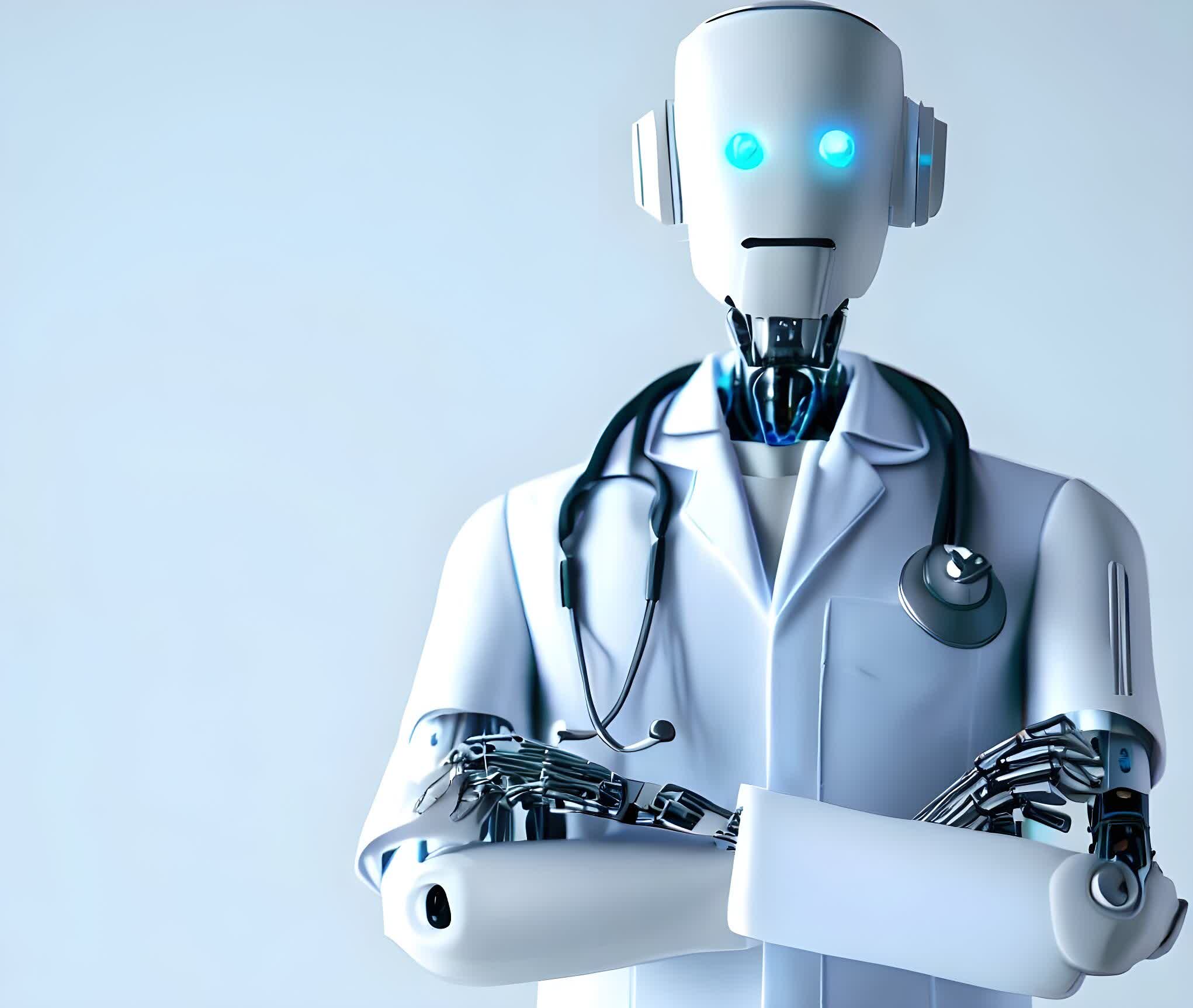
Utah has approved a program allowing artificial intelligence to examine patients and prescribe medication without human oversight. The initiative is currently limited to a one-year pilot focusing exclusively on treating mild-to-moderate acne.
Comments
Researchers have introduced UniEvo-VL, an on-policy self-distillation training recipe designed to enable multimodal models to continuously self-improve. This novel methodology allows artificial intelligence systems to autonomously refine their capabilities and enhance overall performance by learning from their own generated outputs.
CommentsTreg (OpenRouter for Tools)
2026-10-07Treg is a new project designed to act as an OpenRouter equivalent specifically for AI agent tools. It aims to simplify tool integration for developers building autonomous agents. The project is currently supported by an active Discord community for developer collaboration.
CommentsSouth Korea reports that AI agents were likely used to breach its banking sector, drawing skepticism and highlighting the nation's history of legacy security vulnerabilities. While some institutions avoided the attack by strictly isolating internal networks from external staff, experts warn that integrating AI could inadvertently expand these attack surfaces. The incident raises broader concerns about how automated systems might complicate financial operations and create new vectors for cyberattacks.
Comments2026-10-06

Reflection has introduced Beam, a new 501B parameter open-weight AI model designed to democratize artificial intelligence. This release aligns with the broader initiative to make advanced machine learning capabilities open and accessible to everyone.
Comments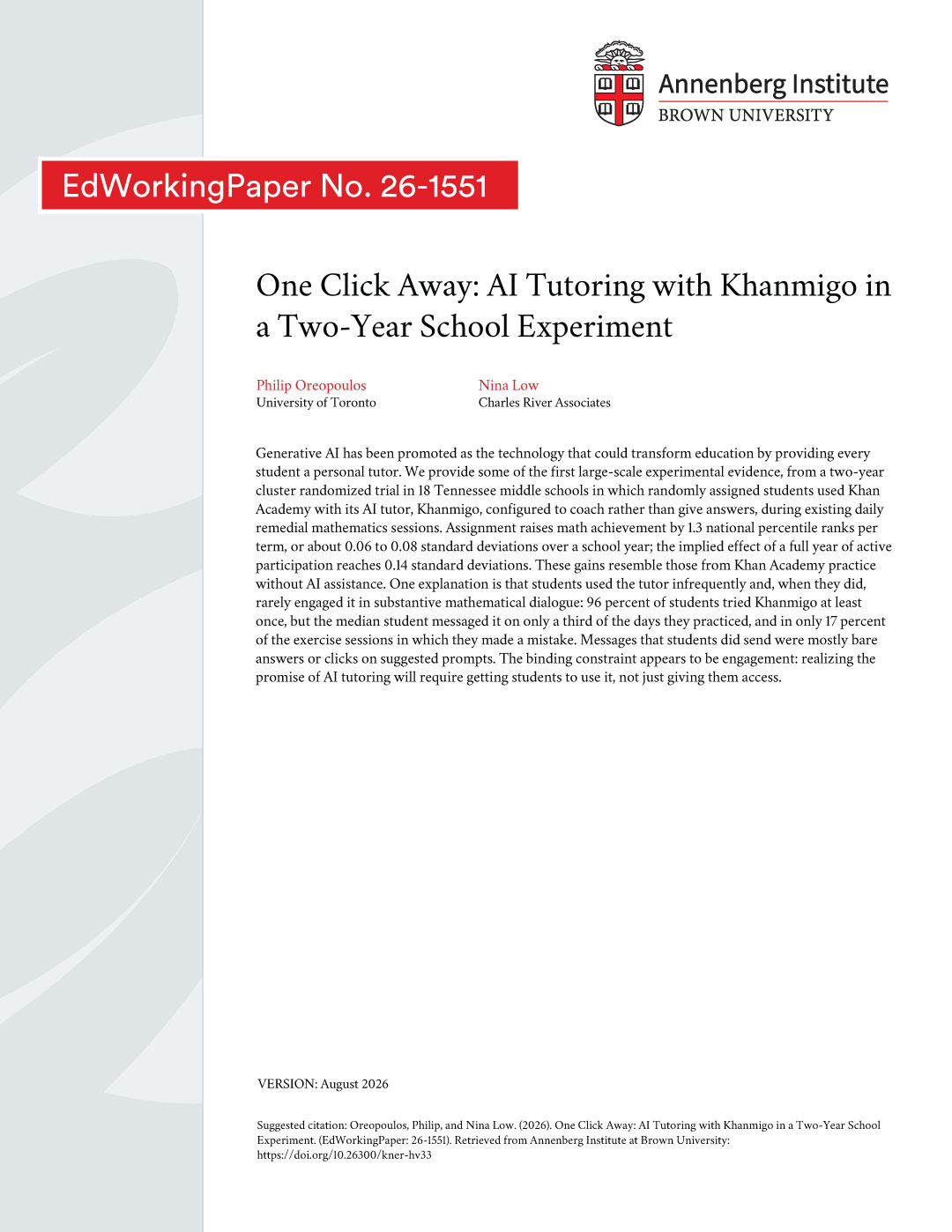
A two-year randomized trial across 18 Tennessee middle schools evaluated Khan Academy's AI tutor, Khanmigo, during daily remedial math sessions. The AI was specifically configured to coach students rather than simply giving answers. This large-scale experiment offers some of the first experimental evidence on whether generative AI can effectively deliver personalized educational tutoring.
Comments
A team of Claude Opus 5.5 AI agents has identified two room-temperature magnetic semiconductor candidates for next-generation computer memory. Both materials exhibit zero net magnetism while successfully sorting electrons by spin, featuring one newly designed compound and a material originally created in 1999. The team has released their complete calculations, code, and known caveats to support further research.
Comments
OpenAI's ChatGPT is generating AI-generated cartoons in the style of The New Yorker that falsely feature the signatures of real cartoonists. This issue highlights growing concerns over AI models improperly attributing artwork to actual artists without their consent.
Comments
Web Search API
2026-10-06A new Web Search API allows developers to integrate real-time internet search capabilities directly into their AI agents and applications. By leveraging an AI Gateway, the tool seamlessly connects with providers like Ceramic.ai, Exa, and Linkup to enhance autonomous system functionality.
CommentsThe Competitive Programmer's Handbook remains a dense but highly regarded resource for mastering algorithms and preparing for technical coding interviews. Although some developers argue its focus on rapid, throwaway code is losing relevance in the era of AI-assisted software engineering, it continues to be an essential tool for passing rigorous live-coding assessments and sharpening core problem-solving skills.
Comments
A Florida woman faces felony charges after AI company Anthropic reported a threatening diary entry she made to local police. Carli Michelle Heller allegedly wrote about attacking a sheriff's office, prompting the tech company to alert authorities and raising concerns about user privacy.
Comments
Ephemeral Testing
2026-10-06Ephemeral testing is a previously unthinkable approach to software quality assurance that relies on temporary, throwaway tests. This method enables developers or AI agents to rapidly build and evaluate software components within disposable environments.
Comments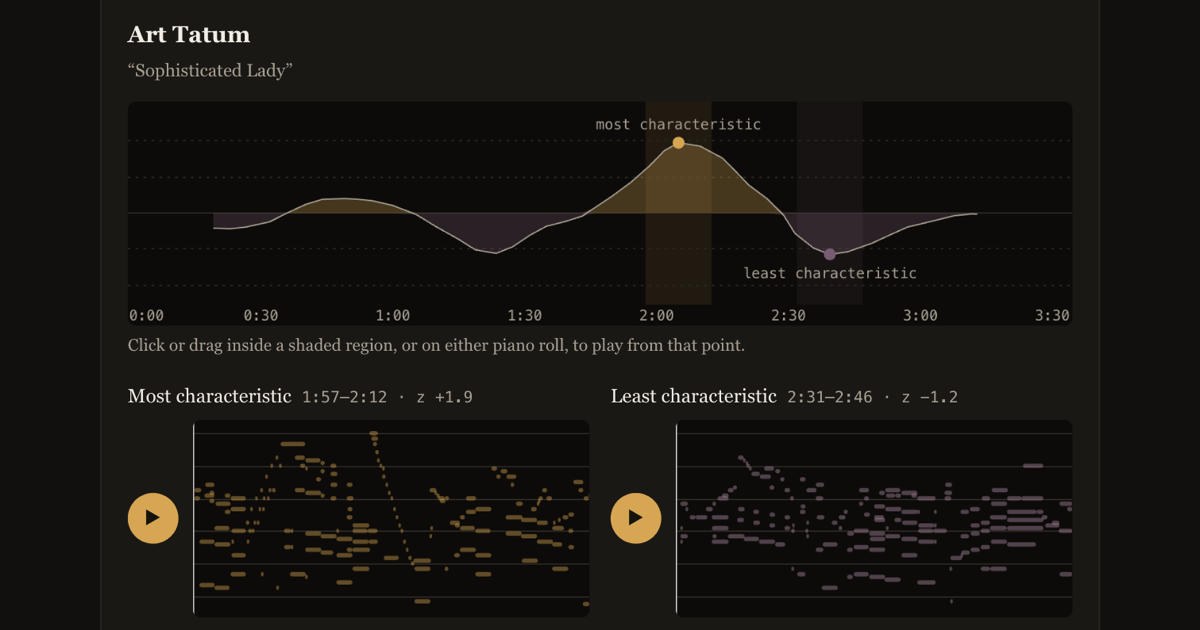
Researchers have developed a new AI music model that uses cross-attention conditioning to generate and continue piano performances in the distinct styles of twelve jazz pianists. Presented alongside an ISMIR 2026 paper, the project includes a blindfold test to evaluate the generated music and identifies the specific musical moments where each artist's unique style is most recognizable.
Comments
Apple and a hacker's future
2026-10-06A hacker reflects on how the rapid advancement of artificial intelligence has changed their perspective on Apple's closed ecosystem. While they once appreciated the security of the company's walled garden, these same protections now feel overly restrictive.
Comments2026-10-05

Stanford Professor John Ousterhout introduces Homa, a novel networking protocol designed to replace TCP within AI clusters. He explains that the unique and evolving demands of modern AI workloads require a fundamental departure from traditional networking approaches to optimize large-scale machine learning performance.
Comments
At the Lenny and Friends Summit, Stripe's Katie Dill shared strategies for preventing AI-driven products from devolving into generic zombie interfaces. She explained how teams can successfully scale human intent, quality, and artistry alongside rapid AI development to maintain standout user experiences.
CommentsA new macOS tool called SCM enables deep AI-powered searches across every photo and video frame within any local folder. The application allows users to perform advanced visual queries directly on their devices without relying on cloud-based services.
Comments2026-10-04
Anthropic is intensifying its efforts to embed ethical guidelines and moral frameworks directly into its artificial intelligence models like Claude to ensure they align with human values. This initiative highlights the broader tech industry challenge of defining, measuring, and programming objective morality into complex machine learning systems to prevent harmful outputs.
Comments
OpenAI safety leader David Robinson has resigned from the company, warning that its internal culture is broken. His departure adds to a growing chorus of industry insiders urging the technology sector to exercise greater caution and prioritize safety in the rapid development of artificial intelligence.
CommentsA new perspective on AI agent design argues that structured project documentation is far more effective than conversational memory for maintaining context. By prioritizing comprehensive documentation over retrieval from past interactions, developers can ensure more accurate and reliable autonomous task execution.
Comments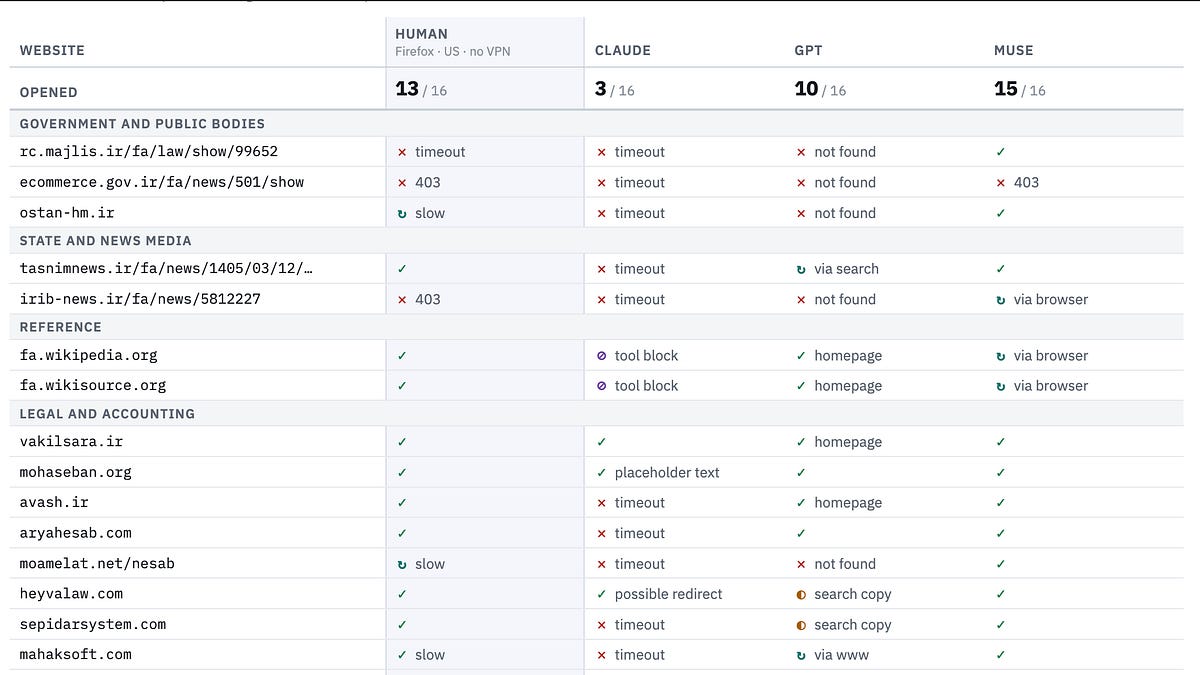
A new evaluation compares GPT, Claude, and Muse across two countries to assess their capabilities in multilingual research, source access, human-in-the-loop workflows, and observability. The study reveals significant disparities in how these AI agents navigate the uneven global web and process diverse linguistic contexts. Ultimately, the findings highlight the ongoing challenges developers face in achieving truly equitable AI performance across different geographic regions.
Comments
Cloudflare has launched a developer competition to build a next-generation Git platform designed for the era of AI agents. The initiative encourages the use of Cloudflare's newly open-beta Artifacts, which includes Workers bindings, data jurisdiction controls, and event subscriptions for repository changes.
Comments
RetailReady (YC W24) Is Hiring
2026-10-04RetailReady, a Y Combinator-backed AI supply chain compliance startup, is hiring for its in-person San Francisco team after raising $6.6 million and quadrupling its revenue. The company is seeking candidates to lead software deployments and collaborate with engineering to modernize antiquated retail supply chain systems for brands and warehouses.
Comments