AI Tech Developments News Past 24 Hours June 2026
Artificial intelligence evolves so quickly that a single day can bring several major announcements. This section follows AI developments in a past-24-hours format, highlighting what changed around June 2026.
Typical stories include new language and image model releases, benchmark results, AI agents and developer tools, funding rounds for AI startups, chip supply news, and regulatory decisions affecting AI companies.
Tracking AI day by day helps readers separate meaningful progress from hype. Developers, product teams, investors, and policymakers use this coverage to keep up with a field that rarely slows down.
2026-07-19

Claude Code uses Bun written in Rust now
2026-07-19Bun creator Jarred Sumner announced that Claude Code version 2.1.181 and later now use the runtime's rewritten Rust port. This update makes the AI coding tool 10% faster on startup.
Comments

New York City Mayor Mamdani has announced proposed regulations requiring landlords and real estate agents to disclose the use of artificial intelligence in property listings. This initiative is designed to increase transparency and protect tenants navigating the city's housing market.
Comments
A developer maxed out their Claude subscription limit in thirty minutes while researching methods to reduce AI token consumption. Through this process, they built a custom deep research pipeline that uses shared memory and assigns distinct roles across three existing AI subscriptions. The author outlines how readers can replicate this cost-effective system using services they already pay for.
CommentsReader discussions surrounding the hype of artificial intelligence reveal a stark divide in user experiences, with some praising large language models as autonomous coding superpowers while others dismiss them as unreliable tools requiring constant micro-management. This polarization has sparked intense debate over whether the technology's effectiveness is merely a reflection of a user's underlying technical competence, highlighting a growing disconnect between the promised technological singularity and the practical realities of AI integration.
Comments
A recent study reveals that relying on AI advice makes individuals less accurate but significantly more confident in their responses. When provided with AI guidance, people's willingness to admit uncertainty plummeted from 44% to just 3%. As a result, their overall task accuracy dropped sharply from 27% to 9% despite their heightened confidence.
Comments
Moonshot AI has temporarily suspended new subscriptions for its Kimi K3 model. An unexpected surge in user demand over the past 48 hours has pushed the company's GPU infrastructure to its maximum capacity. The pause is intended to ensure a stable experience for existing subscribers while the company manages the overwhelming traffic.
Comments
Scrying the AMD GFX1250 LLVM Tea Leaves
2026-07-19AMD is preparing to unveil its new MI400 series Datacenter Accelerators at the upcoming Advancing AI event. In anticipation of the official reveal, developers are analyzing recent LLVM code commits to uncover technical details about the underlying GFX1250 architecture.
Comments2026-07-18
Moonshine AI has introduced a lightweight voice model that processes speech recognition, intent recognition, and text-to-speech in under 500 kilobytes. The tool offers ultra-low latency, providing developers with a highly efficient framework for building responsive voice agents and interfaces.
CommentsGPT-5.6 has closed a three-decade gap in convex optimization by using a prompt to prove a theoretical lower bound on time complexity. The AI model successfully demonstrated that solving this specific class of functions requires the same minimum number of evaluations as a 30-year-old algorithm. This milestone highlights the growing capability of large language models to independently resolve advanced mathematical conjectures.
Comments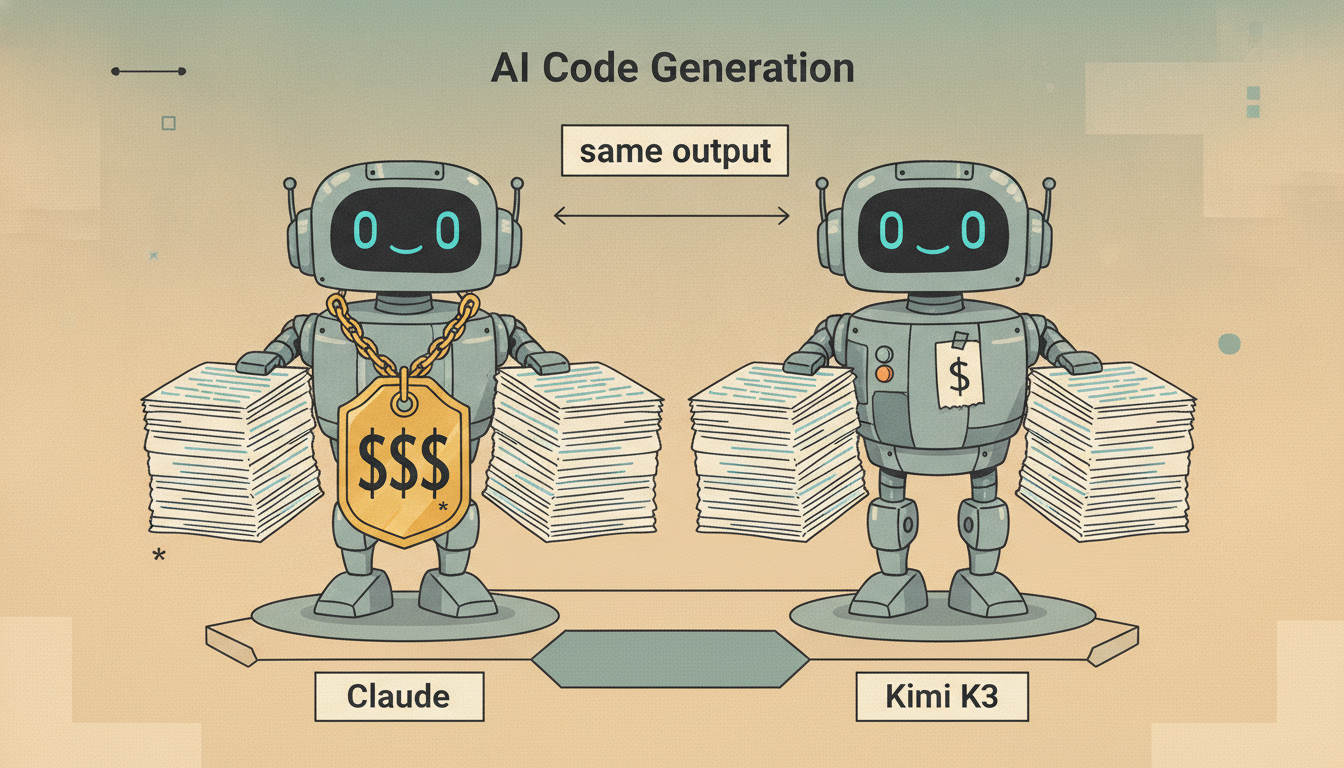
The Kimi K3 Moment
2026-07-18A developer evaluating the new Kimi K3 AI model found its coding capabilities and output quality to be virtually indistinguishable from industry leader Claude. This parity marks a significant milestone in the tech industry, demonstrating that top-tier software development AI is no longer exclusive to a single provider.
CommentsWhat AI did to stackoverflow in a graph
2026-07-18A recent graphical analysis reveals a dramatic drop in Stack Overflow's web traffic following the widespread adoption of AI coding assistants. The visual data highlights a major shift in developer behavior as programmers increasingly rely on generative AI to answer coding questions instead of searching community forums. This trend underscores the disruptive impact of large language models on traditional knowledge-sharing platforms within the tech industry.
CommentsQ3Edit is an open-source, WebAssembly-powered browser tool that allows users to edit and play Quake III Arena maps without local installations. It uniquely integrates live MCP authoring, enabling seamless AI-assisted map creation directly within the editor using models like Codex and Claude.
Comments
Google DeepMind and Isomorphic Labs are leveraging advanced AI models to strengthen global bioresilience against biological threats. By applying artificial intelligence to this critical field, the companies aim to significantly improve prevention, detection, and response capabilities for potential outbreaks.
Comments2026-07-17

Chinese AI lab Moonshot AI has announced Kimi K3, a 2.8 trillion-parameter model described as the company's most capable to date. The model is currently available via their website and provides new insights regarding the pelican benchmark.
CommentsThe state of open source AI
2026-07-17Community discussions suggest that open-weight AI models could threaten closed developers like OpenAI and Anthropic, as hyperscalers like Apple and Google can deploy them for free to protect their own device ecosystems. The conversation also debates whether China's push for open models is a tactical maneuver to bypass Western restrictions or a principled strategy to accelerate practical economic applications. Ultimately, the high costs of training frontier models raise concerns about the financial sustainability of open-weight strategies as the industry shifts focus toward efficient, on-device edge AI.
Comments
Kaiser Permanente nurses handling triage calls warn that the increasing use of AI and workplace surveillance is negatively impacting both their working conditions and patient care. The healthcare workers argue that these technologies threaten their fundamental duty of care by prioritizing corporate metrics over patient well-being.
Comments
New evidence exposes significant inconsistencies in AI evaluation processes and the selection of competition winners. To address these flaws, experts emphasize the need to design high-quality benchmarks that evaluate how frontier models truly reason, act, and judge, rather than just relying on simple data recall.
CommentsCamera Chase Vehicle
2026-07-17A detailed builder's log chronicles the step-by-step creation of a quirky, custom camera chase vehicle by a veteran hardware maker known for early work on the Onewheel. Readers praised the passion project's meticulous documentation and zero-stakes inventive spirit as a refreshing break from the usual tech news focus on machine learning.
Comments
The human-in-the-loop is tired
2026-07-17Developers are experiencing a unique psychological fatigue as AI systems increasingly write their own code, shifting humans from active creators to passive supervisors. This transition at the intersection of machine reward functions and human dopamine loops highlights the growing exhaustion of remaining the human in the loop.
CommentsResearchers used an AI auditor to uncover a critical soundness vulnerability in the OpenVM zero-knowledge virtual machine that allowed malicious provers to forge pairing equalities. The flaw stemmed from missing subfield checking and has been patched in the OpenVM 1.6.0 release under CVE-2026-46669. This discovery marks the second installment in an ongoing series detailing AI-driven bug hunting in open-source cryptography.
Comments2026-07-16
Kimi K3: Open Frontier Intelligence
2026-07-16Kimi K3 has been introduced as the world's first open 3-trillion parameter AI model, delivering frontier-level performance across coding, knowledge work, and reasoning. The model also features native multimodality and a one-million-token context window.
Comments
Decoy Font
2026-07-16Decoy Font is a new typeface designed to thwart AI text recognition by combining every standard letter with a visual decoy. This obfuscation technique prevents automated systems from easily reading user text, and the font is available for online testing or direct TTF download.
Comments
NotebookLM is now Gemini Notebook
2026-07-16Google has renamed NotebookLM to Gemini Notebook, maintaining its status as a standalone product while expanding its capabilities. The updated tool now features deeper integration with Google services and introduces a new secure cloud computer.
Comments
Researchers have found that classical machine learning algorithms can effectively identify text generated by large language models without relying on complex deep learning architectures. This traditional approach provides a highly efficient and lightweight alternative for systems designed to detect AI-generated content with minimal computational overhead.
CommentsIn a recent experiment, Claude Fable 5 and GPT-5.6 Sol were tasked with autonomously directing a music video using the same song, a $100 budget, web search, and local ffmpeg. This creative challenge highlights the rapidly advancing autonomous capabilities of next-generation AI models in complex multimedia production.
Comments
LM Studio has introduced Bionic, a new AI agent specifically designed to help users execute practical tasks using open models. The tool focuses on real-world productivity and is built to seamlessly get things done. This release marks a significant step in making open AI models more actionable for everyday users.
CommentsA recent guide explains how to train a generative AI kick drum model locally on a low-end Linux machine with just 6GB of VRAM. The accompanying community discussion explores the broader landscape of AI audio synthesis, debating the merits of parameter-based tools like SynPlant against the challenges of accurately replicating the organic timbral nuances of physical instruments. Ultimately, readers weigh whether the future of generative audio lies in exact resynthesis or in creating highly tweakable, expressive sound design parameters.
Comments
A recent article highlights the paradox of individuals who acknowledge the valid criticisms of Large Language Models yet continue to rely on them extensively. The author argues that this seemingly contradictory adoption of AI is a common mindset shared by many users today.
CommentsA new open-source educational guide titled The Little Book of Reinforcement Learning has been launched on GitHub by developer alxndrTL. The community-driven project aims to provide an accessible introduction to reinforcement learning concepts for developers and AI students. Contributors are actively encouraged to help expand and improve the resource.
Comments