AI News Today Big Tech
The race to lead in artificial intelligence is being run largely by the biggest names in tech. Here you will find stories about AI models, products, partnerships, and strategy from companies such as Google, Microsoft, Meta, Amazon, and Apple. The section also covers the chips, data centers, and talent wars behind the headlines.
Expect news on frontier model launches, AI assistants being woven into operating systems and office software, and the enormous capital expenditures going into GPUs and data centers. Partnership and licensing deals between platform companies and AI labs are a recurring theme, as are high-profile researcher moves between rivals.
The stakes are unusually high because AI leadership could decide which of today's giants dominates the next computing era. Investors watch these companies' AI spending for market signals, developers build on their platforms, and policymakers study their moves when weighing how the technology should be governed.
2026-06-26
Launching in July on Cerebras infrastructure, the new GPT-5.6 Sol frontier model will offer unprecedented generation speeds of up to 750 tokens per second to a limited group of initial customers. Although its core capabilities may not see major upgrades, this massive increase in speed is expected to make the model significantly more practical for time-sensitive applications like large-scale code navigation.
Comments
Despite initially promising a hands-off approach to artificial intelligence, the Trump administration is increasing its oversight of the industry. As part of this shift, the U.S. government will now directly control and decide who is granted access to the advanced GPT-5.6 model.
Comments
Ultrasound imaging of the brain
2026-06-26Researchers have successfully used ultrasound to capture the most detailed vascular image of a living human brain to date by imaging directly through the skull. The breakthrough also details the advanced technological pipeline required to process and generate these unprecedented high-resolution scans.
CommentsA new analysis uses benchmark data to evaluate the ongoing performance gap between open-weight and closed-source large language models. Researchers are tracking these metrics to understand how quickly open-source capabilities are currently advancing. Ultimately, the study aims to predict exactly when an open-source model will finally match the capabilities of today's frontier proprietary models.
CommentsAlthough the author of an experiment where 2,000 people tried to hack an AI assistant via prompt injection concluded that such attacks are harder than expected, critics argue the findings are misleading. Commenters point out that an overly defensive AI might be rendered completely unusable in practice, and note the test pool likely lacked the seasoned experts needed to truly evaluate the system's security.
CommentsLibre Barcode Project
2026-06-26The Libre Barcode Project introduces a privacy-focused, web-based frontend for the Zint barcode library that uses WebAssembly to generate vector SVGs directly in the browser. Users praise the tool for providing robust output without server-side data exposure, ads, or mandatory signups. However, some community members note the 1MB initial payload size and suggest minor code optimizations for the resulting SVG files.
Comments
The technology industry has united to defend open source software through a collective open letter and the launch of a new initiative called Akrites. This coordinated effort aims to actively identify and remediate critical vulnerabilities across the foundational open source projects that power global digital infrastructure.
CommentsWorkweave has introduced an AI model router that automatically directs prompts to the optimal model for agentic systems in under 50 milliseconds. Compatible with platforms like Claude, Codex, and Cursor, the tool requires only a simple endpoint change to integrate and can reduce overall API costs by 40 to 70 percent.
Comments
A handwritten notebook belonging to a 22-year-old Mozart has been discovered in Paris in what experts are calling a major historical discovery. The rare artifact was originally confiscated during the French Revolution and remained hidden until its recent unearthing.
CommentsReaders discussing the utility of nomograms highlight Fagan's nomogram for Bayes' theorem as a powerful tool for visually representing mathematical relations and making machine learning classifiers more explainable. Commenters praise these analog calculation methods for providing an intuitive physical understanding of complex probabilities that often surpasses modern digital visualizations. The conversation also expands to other historical computational aids like the Smith chart and recommends online resources exploring pre-computer mathematical tools.
CommentsApple plans to skip its high-end M6 Mac chips in favor of an AI-optimized M7 lineup designed to make local on-device language model inference highly efficient. While data center accelerators will still dominate heavy workloads, powerful consumer hardware paired with specialized software architectures could handle most everyday tasks without costly cloud subscriptions. This strategic pivot highlights Apple's intent to leverage its unique PC market position to challenge the subscription-based models of frontier AI labs.
CommentsSpringer Nature replaced two withdrawn Max Planck studies with blank pages citing an article violation, yet continues to charge readers for the empty PDFs. This incident has reignited widespread frustration over the academic publishing industry's exorbitant costs and failure to innovate. Consequently, many commentators are urging institutions to abandon traditional publishers in favor of open-access preprint servers and openly licensed repositories.
Comments
The third installment of a worldbuilding series explores the financial logistics of pre-modern armies, focusing specifically on how historical military forces were funded and paid. Building on previous sections about recruitment and mobilization, this article provides creators with a comprehensive framework for designing realistic economic systems for their fictional military forces.
CommentsDoing a masters while working in Spain
2026-06-26A discussion among tech professionals explores the challenges of pursuing advanced degrees while balancing a full-time software career, weighing the personal fulfillment of studying for the joy of learning against the bureaucratic realities of university life. Participants shared contrasting experiences with academic culture, debating whether higher education is typically driven by genuine intellectual curiosity or strategic career advancement.
Comments
The era of long wave radio is set to end with the impending switch-off of transmitters. However, campaigners are fighting to preserve the historic long wave masts in Worcestershire by urging authorities to grant them protected listed status.
Comments2026-06-25

Apple raises prices of MacBooks, iPads
2026-06-25Apple has raised the prices of its MacBooks and iPads due to surging memory and storage chip costs. The company stated it can no longer absorb these expenses, which are being driven by the AI industry's massive datacenter expansion.
CommentsAnthropic has accused Alibaba and associated Chinese resellers of illicitly extracting Claude's capabilities to sell heavily discounted AI tokens to users blocked by regional restrictions. These operators bypass payment and identity barriers using bot networks and fraud, while subsidizing their deeply discounted rates by harvesting and selling model reasoning traces to domestic AI labs for training data.
Comments
Oxide computer 3D rack guided tour
2026-06-25Oxide has introduced an interactive 3D guided tour of its Cloud Computer, enabling users to explore the hardware from the rack level down to individual sleds and CPUs. This visual breakdown offers a detailed look at the physical components powering their rack-scale computing architecture.
Comments
NVIDIA has introduced a novel cooling design for its latest AI servers that operates at 45 degrees Celsius. This counterintuitive approach uses coolant warmer than a hot tub to reduce data center water consumption to near zero. Ultimately, this strategy marks one of the most significant efficiency leaps in the history of data center operations.
Comments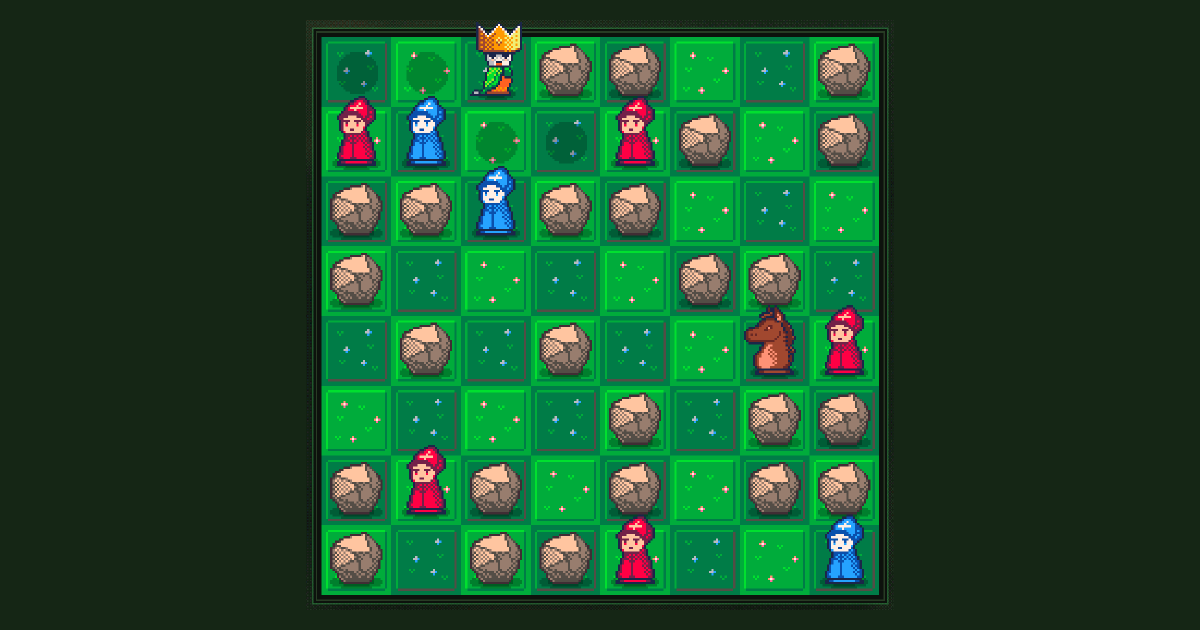
Show HN: Chess-Inspired Roguelike
2026-06-25A new chess-inspired roguelite showcased on Hacker News tasks players with guiding Prince Chazz across the board while dodging enemy pieces. The game features strategic pathfinding mechanics and includes a competitive per-seed leaderboard for players to race against others.
CommentsThe Zig programming language community is enthusiastically praising a comprehensive devlog detailing new bitCast semantics and LLVM back end improvements. Readers expressed strong appreciation for the rigorous technical depth and ongoing language refinements, contrasting the high-quality post favorably against the low-effort and AI-generated content often found on tech forums.
Comments
GLM-5.2 is a step change for open agents
2026-06-25The release of GLM-5.2 marks a significant step change for open-source AI agents by crossing a critical capability threshold. This advancement represents a major leap forward in the overall performance and autonomy of open AI systems.
CommentsOpenKnowledge is a new open-source project offering an AI-first alternative to popular note-taking platforms like Obsidian and Notion. Functioning as an AI-native markdown IDE and LLM wiki, it integrates artificial intelligence directly into knowledge management and is currently available for development on GitHub.
CommentsYou can't unit test for taste
2026-06-25A developer is building a new fitness app called "In the Long Run" that uses Strava integration to track virtual runs across famous global routes. Designed to provide sustained motivation, the platform allows users to gradually traverse country- and continent-spanning distances at their own pace.
Comments
Researchers have introduced Un-0, an open-source image generator powered by a simulated network of coupled oscillators that achieves an FID score of 6.74 on the ImageNet 64x64 dataset. This performance matches the early benchmarks of leading conventional image generation methods, with all model weights and training code now publicly available.
Comments
An oral history of Bank Python (2021)
2026-06-25This oral history explores the unconventional ecosystem of Python as utilized by major investment banks, detailing the custom distributions, strict security constraints, and legacy integrations required in the financial sector. It highlights how these specific institutional needs have created a distinct environment that differs significantly from the standard open-source community.
CommentsMedical students are using a popular research tool to publish misleading studies, exposing significant flaws in the scientific training of clinical practitioners. The issue highlights systemic problems with scientific incentives and the tendency of physicians to apply scientific knowledge without mastering the rigorous scientific method. Consequently, this proliferation of flawed research threatens to further erode the public's already declining trust in the medical profession.
CommentsFord is rehiring experienced human inspectors after its AI-driven quality control initiatives encountered significant issues, highlighting the limitations of relying solely on artificial intelligence. This costly misstep reflects a broader industry realization that blindly adopting AI to meet arbitrary usage metrics often compromises quality, proving that the technology is a supplementary tool rather than a magical replacement for human expertise.
Comments
Mixing Visual and Textual Code
2026-06-25A new arXiv paper introduces a novel framework that combines visual and textual code to enhance software development and AI code generation. By integrating visual diagrams with traditional text-based programming, the approach leverages multimodal machine learning to improve code comprehension. This innovation could lead to more intuitive programming environments and significantly streamline the workflow for developers.
CommentsThe disappearance of Japan's animators
2026-06-25Japan's anime industry is facing a severe retention crisis as poor compensation and a lack of viable training drive away the mid-level animators essential to sustaining production. This struggle mirrors broader global economic trends where low-margin trades outsource skilled labor to developing nations, systematically draining domestic expertise. Ultimately, observers warn that this devaluation of workers will lead to a massive global shortage of trained professionals needed to maintain critical infrastructure as international demographic booms inevitably slow.
Comments