YC News
From new batch announcements to alumni raising major rounds, Y Combinator remains a bellwether for early-stage tech. This section collects news involving the accelerator, the startups that pass through it, and the ideas and trends its community is betting on.
Stories here range from changes to the program itself, its deal terms, batch sizes, and leadership, to the successes and stumbles of companies it funded years ago. Batch composition gets particular attention, since the categories founders cluster around tend to foreshadow broader trends.
For anyone working in or around startups, following this accelerator is an efficient habit: it condenses signals about talent, ideas, and capital into one observable community. Founders weighing an application also use this coverage to understand what the program has become.
Feature Request: Support AGENTS.md
2026-08-20A new feature request urges the adoption of AGENTS.md, an emerging industry standard that allows various AI coding agents to understand codebases through a unified Markdown file. Proponents argue that shifting away from the Claude-specific CLAUDE.md format will improve cross-platform compatibility with tools like Cursor, Codex, and Amp.

fx :Tiny, open, native coding agent.
2026-08-20A new open-source coding agent called fx has been launched as a minimal command-line tool written in Zig. Designed for research and seamless integration, it is highly optimized to be embedded as a native component within larger software systems.

DFlash 2: Keep Drafting Parallel
2026-08-20DFlash 2, the successor to a widely used parallel drafter, has been released with speeds nearly three times faster than standard autoregressive decoding while maintaining identical output. The updated tool is currently available for both Qwen3.8-27B and Meta's Muse Glimmer.

Mathematics in the age of AI
2026-08-20A recent arXiv paper explores the transformative impact of artificial intelligence on mathematical research, highlighting how machine learning models are accelerating complex problem-solving and theorem proving. The authors discuss the evolving symbiotic relationship between human intuition and machine computation while addressing the critical challenges of maintaining rigorous proof standards in an AI-driven landscape.

Ornith-1.5: From Self-Scaffolding to Self-Improvement
2026-08-20The newly released open-source model family Ornith-1.5 advances AI development by transitioning from basic self-scaffolding to a comprehensive self-improvement loop. This end-to-end approach enables the models to autonomously and continuously refine their own capabilities over time.

Simulacra and Simulation
2026-08-20Readers discussing Jean Baudrillard's Simulacra and Simulation note that his theories of hyperreality are increasingly relevant in the age of AI-generated deepfakes and social media misinformation. Commenters argue that modern digital technology has created a landscape of copies without originals, where highly realistic fake images spread faster than fact-checking can mitigate their impact. Ultimately, the discussion highlights how these digital simulacra overwhelm the public, making it nearly impossible to distinguish reality from fabrication.
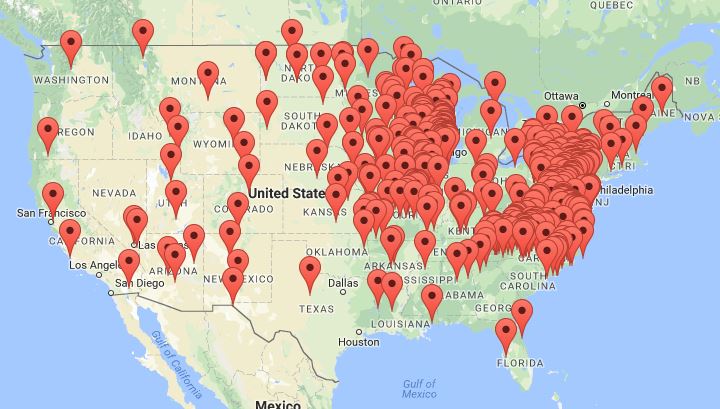
Pressed Penny Machine Map
2026-08-20A new digital mapping project has been launched to track the locations of pressed penny machines worldwide. The database currently includes global locations, with a specific focus on mapping the vast majority of these machines across the United States.
Universality of Gradient Descent Neural Network Training
2026-08-20Researchers have published a new study exploring the universal properties and theoretical guarantees of gradient descent in neural network training. The paper investigates how this fundamental optimization algorithm can consistently and effectively learn across various network architectures and complex data distributions. These findings provide deeper mathematical insights into why gradient descent remains the cornerstone of modern deep learning success.

Xorshift Generators
2026-08-20This technical deep dive explores xorshift generators, the most popular family of algorithms used for generating pseudo-random numbers. The article breaks down the underlying mechanics of these algorithms and highlights their widespread applications in modern software development.

Extensible Software in the age of LLMs
2026-08-20The integration of large language models with solid core architectures and capability-based sandboxes is creating a new paradigm for extensible software. This secure approach allows users to safely customize and extend their applications, effectively granting them superpowers in the AI era.
Air Theremin – A browser theremin you play by waving at your webcam
2026-08-20Air Theremin is a browser-based virtual instrument that allows users to play a theremin in mid-air by waving at their webcam or tilting their smartphone. The application translates these physical gestures to control pitch, volume, and timbre, while also offering built-in features like note snapping, cave reverb, and audio recording.

How do payments work in the US, China, and Brazil?
2026-08-20This piece explores the distinct payment infrastructures in the US, China, and Brazil to highlight the technological differences between these major economies. It challenges the common American assumption that global payment systems mirror the domestic model.

Pacing model development in an era of cyber-critical capabilities
2026-08-20OpenAI is implementing enhanced monitoring, alignment, and security protocols to carefully guide the development of its frontier AI models. These new safeguards aim to responsibly pace innovation as artificial intelligence systems acquire increasingly cyber-critical capabilities.

Remote workers report the highest well-being in study of 7,700 employees
2026-08-20A new study of 7,700 employees reveals that remote workers report the highest levels of overall well-being, dispelling common employer concerns about disconnection. Researchers found that these remote employees are no more likely to experience feelings of isolation than their onsite counterparts.
New paper shows that 37% of workers in US saw real wages decline from 2021-2024 [pdf]
2026-08-19A new paper reveals that 37% of US workers experienced a decline in real wages between 2021 and 2024, with tech workers also facing significant losses in RSU value. Reader discussions highlight that beating inflation largely required job hopping, a dynamic that disproportionately disadvantages less mobile workers. Consequently, commenters advocate for broader systemic reforms, including a stronger social safety net, universal basic income, and untethering healthcare from employment.

Meta's blockbuster trial draws parallels to big tobacco
2026-08-19Meta is facing a major lawsuit from 29 US states over allegations that it intentionally designed Facebook and Instagram features to addict children. Drawing parallels to historic big tobacco litigation, the blockbuster trial focuses on claims that the company deliberately misled the public about the psychological dangers of its platforms.

Cerebras CS-4
2026-08-19Cerebras has unveiled the CS-4, a revolutionary wafer-scale chip that replaces hundreds of traditional GPUs to deliver unprecedented AI performance. This single-chip solution is designed to drastically accelerate complex artificial intelligence workloads while significantly reducing hardware footprints.

OpenLogi
2026-08-19OpenLogi is a new privacy-focused, Rust-based alternative to Logitech Options+ that allows users to manage their peripherals locally without requiring an account or telemetry. The application supports essential device customizations like button remapping, DPI adjustments, and SmartShift control via the HID++ protocol.
A 3D fruit fly on macOS desktop powered by the real FlyWire connectome
2026-08-19A developer has released a macOS project called Desktop Fly that features a 3D fruit fly living directly on the user's screen. The digital insect's movements and behaviors are driven by a live spiking simulation of the actual FlyWire connectome.

The Amazon tax
2026-08-19Marketing expert Seth Godin examines the hidden economic and societal costs of Amazon's market dominance in his latest post, dubbing it the Amazon tax. He argues that the tech giant's relentless focus on convenience extracts a heavy toll on small businesses and creators while eroding genuine consumer connection. Godin urges brands to look beyond algorithmic efficiency and build more respectful, community-driven alternatives.