YC News Updates
This section pulls together recent articles connected to Y Combinator. Coverage ranges from official program news and batch milestones to reporting on the accelerator's most successful graduates, giving a broad view of one of the most influential institutions in startups.
Recent stories in this vein tend to include Demo Day coverage, funding rounds for portfolio companies at every stage, and commentary on how the accelerator's advice and standard deal terms ripple through the wider industry. Occasional deep dives profile the people and decisions behind the program.
Few organizations touch as many corners of technology as a major accelerator does, from fresh graduates to companies now worth billions. Keeping up with this feed is a shortcut to understanding where early-stage tech has been and where its next chapter is likely heading.

A new study reveals that nonprofit hospitals spent $7.8 billion on consulting services over the past decade. Despite this massive financial investment, researchers found no significant improvements in hospital finances, staffing, daily operations, or patient care outcomes. The findings suggest that this heavy reliance on external consultants has yielded little to no measurable value for the healthcare system.
CommentsPC Engine CPU
2026-05-08Community discussions highlight the historically underrated processing power of the PC Engine's 8-bit CPU, noting that its high clock speed and specialized memory transfer capabilities enabled impressive arcade ports that rivaled 16-bit competitors. Enthusiasts also explored the theoretical performance limits of modern 6502-based architectures while praising the system's compact physical design and highly optimized console adaptations of classic Capcom games.
Comments
Recent analysis of the XZ Utils backdoor suggests that the GNU IFUNC mechanism was the fundamental enabler of the exploit, transforming a standard supply chain compromise into a deeply hidden system-level threat. By weaponizing indirect function resolution, the attacker successfully concealed malicious code within the liblzma library, highlighting a critical need to reevaluate the security implications of IFUNC features in modern build systems.
CommentsPrompted by a developer's report of an unexpected UUIDv4 collision, the tech community emphasizes that such failures are surprisingly common due to flawed or poorly understood entropy sources. To prevent this, experts advise against using UUIDv4 in high-reliability systems, recommending instead the aggregation of multiple diverse, non-deterministic data points. Furthermore, modern cryptographic techniques can extract true randomness from these imperfect sources by blending them into a single, unpredictable seed.
CommentsClojureScript Gets Async/Await
2026-05-08ClojureScript has officially integrated native async/await support into its core compiler, overcoming previous community skepticism regarding implementation complexity. Spearheaded by developer borkdude after prototyping the feature in his Squint project, this update provides a modern alternative to the older core.async library. The release has also sparked broader discussions within the community regarding asynchronous error handling and the shift toward minimal JavaScript frontends using server-sent events.
CommentsReader discussions surrounding a recent article highlight ongoing developer frustrations with command-line tools that mishandle stdout, stderr, and exit codes instead of simply fixing underlying problems. While POSIX conventions dictate keeping stdout clean for data piping and using stderr for logging, many tools and brittle system environments continue to violate these expectations. Participants emphasize that adhering to these foundational CLI practices is essential for reliable scripting and automation.
Comments
The Disappearance of the Public Bench
2026-05-08The disappearance of public benches and the trend of making remaining ones uninviting highlights a broader societal debate regarding who belongs in urban public spaces. By eliminating these resting spots, cities are losing crucial communal infrastructure and marginalizing the populations that rely on them.
Comments
Researchers have developed a closed-form polynomial autoencoder that achieves fourfold compression of transformer embeddings while outperforming traditional PCA. By pairing a PCA encoder with a quadratic Ridge decoder, the method delivers superior accuracy without requiring neural networks or iterative training.
Comments
The map that keeps Burning Man honest
2026-05-07Burning Man utilizes mapping technology to measure and track its environmental footprint, transforming its Leave No Trace principle into a data-driven commitment. The resulting maps are made publicly available to ensure the event maintains strict accountability for its cleanup standards.
CommentsDirty Frag: Universal Linux LPE
2026-05-07A newly disclosed Universal Linux Local Privilege Escalation vulnerability named Dirty Frag shares the same root cause in the kernel IPsec module as the previously discovered Copy Fail bug. The overlapping flaws have sparked a debate among security researchers about whether relying heavily on AI for vulnerability discovery hinders the manual code exploration needed to uncover related issues.
Comments
Reliable AI agents handling complex tasks require deterministic control flow encoded directly in software rather than relying on increasingly elaborate prompt chains. Shifting the focus from complex prompting to structured software design will ultimately result in more stable and predictable agent performance.
CommentsSQLite has been designated as a recommended storage format by the Library of Congress, affirming its reliability despite some corporate bans driven by file-based security and tracking concerns. Although enterprise teams sometimes restrict the lightweight database in favor of traditional servers, advocates argue it is a far superior and safer alternative to the widespread misuse of Excel as a shadow database.
Comments
AI slop is killing online communities
2026-05-07Online community managers are struggling to combat the influx of AI-generated content and deceptive bot accounts, which adds significant administrative and financial burdens. To protect their platforms, moderators are deploying rigorous verification methods, including third-party AI detection tools and manual authorship checks. Despite these measures, many community leaders fear that the endless battle against automated AI slop may eventually become unsustainable.
CommentsA new local inference engine for DeepSeek 4 Flash and PRO models has been introduced via the antirez/ds4 project. It allows users to run these advanced AI models locally across multiple hardware platforms by providing native support for Apple's Metal, Nvidia's CUDA, and AMD's ROCm.
Comments
AlphaEvolve is a coding agent powered by Gemini that optimizes algorithms to accelerate scientific progress across multiple disciplines. By applying this technology to complex challenges in genomics, quantum physics, and global infrastructure, the tool aims to solve critical real-world problems at scale.
Comments
Researchers have introduced Natural Language Autoencoders to translate the internal numerical computations of AI models like Claude into human-readable text. This breakthrough allows developers to observe the system's underlying thought processes, offering greater transparency into how these models generate their final word-based outputs.
CommentsProgramming Still Sucks
2026-05-07A recent tech commentary highlights the tiresome, repetitive questions programmers face from non-tech individuals about AI replacing their jobs. Through a brief social anecdote, the author illustrates how this specific inquiry has become an exhausting cliché, proving that the social annoyances and public misconceptions surrounding the programming profession remain unchanged.
CommentsGoogle has removed a privacy statement from the Chrome browser assuring users that its on-device AI features do not send data to company servers. This retraction has prompted immediate privacy concerns regarding how local AI interactions might still be transmitting user information to the cloud.
Comments
I want to live like Costco people
2026-05-07An online culinary magazine recently published a cultural piece exploring the lifestyle and grocery habits of dedicated Costco shoppers. The article reports directly from the front lines of modern meal preparation. It highlights how everyday home cooks navigate daily dinner routines by adopting the bulk-buying strategies of warehouse club patrons.
CommentsPermacomputing Principles
2026-05-07The Permacomputing movement advocates for the sustainable and ecological use of technology, drawing parallels to agricultural permaculture. However, its explicit alignment with anti-capitalist and progressive political ideologies has sparked debate, with some critics arguing this broad framing alienates potential supporters. Proponents counter that addressing systemic societal and environmental challenges is an inherently political act that is fundamental to the practice.
Comments
A new study introduces ProgramBench, a benchmark designed to evaluate whether large language models can reconstruct software programs entirely from scratch. The evaluation tests fundamental code logic and architecture comprehension rather than relying on simple pattern matching or partial code completion. Ultimately, this research provides critical insights into the true programming capabilities and structural limitations of current generative AI models.
Comments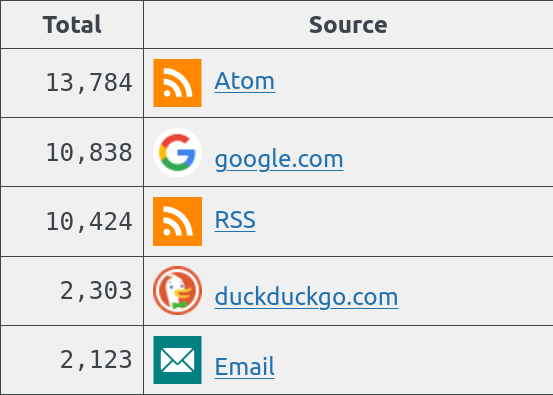
After analyzing their website traffic, a blogger discovered that RSS feeds generate more visitors than Google search. The author attributes this trend to focusing on semantic HTML and metadata rather than pursuing aggressive search engine optimization.
CommentsA new open-source project named TRUST has been shared on Hacker News for its unique approach to coding in Rust like it is 1989. Developers interested in this unconventional programming style can explore the code and contribute to the repository on GitHub.
CommentsA discussion surrounding a 2004 tutorial on TI-83 Plus Basic programming has prompted readers to share how secretly coding on graphing calculators during math classes launched their tech careers. Many current software developers credit their early experiences writing games, chat programs, and math solvers on devices like the TI-83 and TI-85 as the foundational spark for their professional journeys in computer science and engineering.
Comments
The author shares their experience and key takeaways from developing OurCar, a custom utility app designed specifically for their family. This personal project highlights the unique challenges and rewards of building a tailored software solution for everyday household needs from scratch.
CommentsA new community-driven firmware project has been launched for the Xteink X3 and X4 e-paper readers. The open-source software, named crosspoint-reader, is now available on GitHub. Users and developers can create an account to contribute to the project and help enhance the functionality of these devices.
CommentsA recent article highlights that keeping girls in school has significantly reduced child marriage rates in Nigeria. Reader discussions contextualize this success within broader foreign aid strategies, emphasizing that gender-focused interventions and infrastructure projects yield the most sustainable economic benefits. Commenters also debate the practical challenges of maintaining these physical assets in regions lacking effective local governance and security.
Comments
RaTeX is a pure Rust LaTeX rendering engine that ensures KaTeX-compatible math layout across multiple platforms. It offers ready-to-use packages for Web, iOS, Android, Flutter, and React Native to deliver a consistent display list for cross-platform development.
CommentsAn author has published a guide detailing how to set up a diskless Linux boot using ZFS, iSCSI, and PXE to create a dedicated environment for testing AI models. This network-booted setup keeps local NVMe drives free for gaming and prevents Windows updates from breaking dual-boot configurations. Although remote booting introduces minor performance overhead, it provides a clean, isolated Linux workspace without the hassle of managing local partitions or easily lost USB drives.
CommentsTwo Home Affairs officials have been suspended after fabricated information, known as AI "hallucinations," was discovered in their work. This incident highlights the ongoing risks and accuracy challenges associated with relying on artificial intelligence for government administration.
Comments