YC Alumni News
Graduates of the Y Combinator program often go on to build some of the most influential companies in tech. This section follows those alumni, gathering news about their later funding rounds, product milestones, leadership changes, and long-term impact on the startup landscape.
Coverage ranges from late-stage giants announcing new products or public listings to lesser-known graduates quietly reaching profitability. You will also find stories about second-time founders returning with new ventures, alumni becoming investors themselves, and reunions of teams that first met during a batch.
Alumni trajectories matter because they show what happens long after the accelerator hype fades. Watching how graduated companies mature, stumble, or reinvent themselves offers some of the most honest evidence available about which early-stage bets actually compound into lasting businesses.
Lisp's Influence on Ruby
2026-06-14Despite its distinct syntax, Ruby heavily incorporates foundational Lisp concepts through its functional programming features like blocks and higher-order methods. The article highlights how everyday Ruby method chains rely on underlying Lisp principles, such as lambdas, even though traditional elements like parentheses and prefix notation have been removed.

FarOutCompany
2026-06-14FarOutCompany has introduced a new digital platform designed to highlight the work of under-appreciated artists from the 1960s and 1970s counterculture. The service offers users a curated experience to explore and discover hidden creative works from this influential era.
FreeOberon – Open-Source, Cross-Platform, Free Pascal/Turbo Pascal-Like Language
2026-06-14FreeOberon is an open-source, cross-platform integrated development environment designed for the Oberon programming language. It features a classical pseudo-graphic interface that closely mimics the nostalgic look and feel of Free Pascal and Turbo Pascal.
Chaosnet (1981)
2026-06-14Original documentation for the 1981 Chaosnet local area network protocol has recently been archived online for developers and computing historians. The master file for this early networking standard is now available on GitHub under the Chaosnet/amber repository. This release provides valuable insight into the foundational technologies of early local area networking.
Linux 7.1
2026-06-14Linux 7.1 is removing obsolete code, including old ISDN network drivers, to reduce the influx of AI-generated bug reports targeting rarely used hardware. The developer community has widely praised this cleanup effort as a highly beneficial consequence of AI that helps trim unnecessary cruft from the kernel.
Segmented type appreciation corner (2018)
2026-06-14An appreciation post on segmented typography sparked a discussion about using 7-segment displays as practical frontend interview questions that test core skills over abstract algorithms. Readers also shared examples of real-world hardware implementations, ranging from custom Casio watch projects to the specific character designs utilized in public transit systems.
Don't trust large context windows
2026-06-14Discussions surrounding large context windows highlight widespread frustration among traditional software engineers over the inherent non-determinism and anecdotal troubleshooting culture of Large Language Models. While developers struggle with the lack of repeatability and the difficulty of translating vague human prompts into reliable tool calls, many still embrace the transformative power of AI agents. Ultimately, technologists are learning to leverage these unpredictable systems to fundamentally reshape their workflows despite the underlying technical challenges.
Pac-Man, but you're the ghost
2026-06-14Sparked by the concept of playing as the ghost, readers are reminiscing about classic local multiplayer titles like the GameCube's Pac-Man spinoff. Participants celebrate the enduring appeal of couch co-op for families and friends by sharing fond memories of local gaming sessions. However, the community also laments that the broader gaming industry has largely shifted its focus away from local play in favor of remote online multiplayer.

USB Power Delivery: Plugging into the Benefits
2026-06-14USB Power Delivery and USB Extended Power Range represent the next major evolution in connectivity technology. Once these new standards are fully rolled out, users can expect significantly faster device charging speeds and improved data transmission rates.

Building a serial and VGA "everything console"
2026-06-14To eliminate the hassle of carrying various adapters for different projects, a maker has built a unified serial and VGA everything console. The device consolidates multiple connection types into a single portable unit. This provides a convenient all-in-one solution for connecting to and managing serial-oriented systems.

Python 3.14 garbage collection rigamarole
2026-06-14Python 3.14.0 introduced a new incremental garbage collector that was reverted in version 3.14.5 following reports of increased memory usage. The accompanying investigation explores Python's memory management mechanics to determine which workloads perform best and worst under the experimental incremental garbage collection system.
Phoenix LiveView 1.2
2026-06-14Phoenix LiveView 1.2 is a minor release that introduces support for colocating CSS. This feature allows developers to keep their stylesheets directly alongside their component code.
Tribblix: The retro Illumos distribution
2026-06-14Tribblix is a retro Illumos distribution created and maintained by a single developer for over 15 years, standing out for its continued support of legacy SPARC hardware. Originally developed to reverse-engineer OpenSolaris due to a lack of official documentation, the novel operating system prioritizes older, lightweight technologies like traditional SVR4 packaging. While it performs well on older machines and specific legacy systems, users note it currently experiences boot issues on some modern hardware.
Statement on US government directive to suspend access to Fable 5 and Mythos 5
2026-06-13The US government has issued an export control directive to suspend all access to Fable 5 and Mythos 5. This mandate applies to any foreign national, regardless of whether they are currently located inside or outside the United States.
Open source AI must win
2026-06-13The article argues that open source artificial intelligence is essential to ensure foundational technological infrastructure remains freely accessible. It emphasizes that society must be able to study, build, and deploy AI systems without relying on closed, proprietary institutions that rent out access.
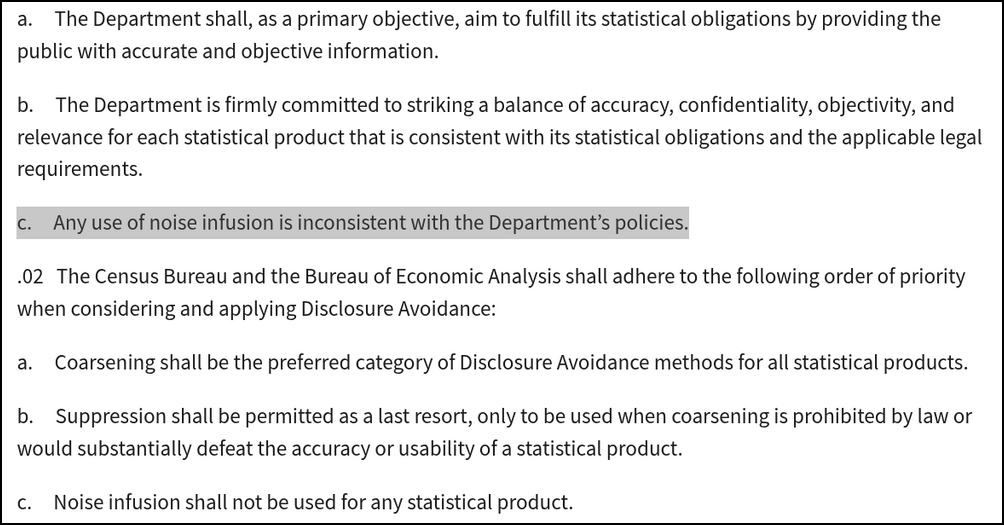
Noise infusion banned from statistical products published by Census Bureau
2026-06-13The Census Bureau has banned the use of noise infusion, a differential privacy technique, in its official statistical products. However, experts warn that removing this disclosure avoidance tool does not resolve the fundamental trade-offs between data accuracy and respondent confidentiality.
Every Frame Perfect
2026-06-13The article Every Frame Perfect examines how imprecise user interface animations can silently erode user trust in digital products. It highlights that even minor visual inconsistencies or clunky transitions make software feel poorly designed, regardless of its underlying functionality. Ultimately, the piece emphasizes that meticulous attention to animation fluidity is essential for delivering a high-quality user experience.
Amazon CEO's talks with U.S. officials triggered crackdown on Anthropic models
2026-06-13Following discussions between Amazon's CEO and U.S. officials, the White House has launched a regulatory crackdown on Anthropic's advanced Mythos AI models over national security concerns regarding their cybersecurity capabilities. While critics argue the intervention is arbitrary given the known vulnerabilities of all large language models, the administration maintains these specific models surpass previous safety thresholds and require mandatory government review. Tech industry observers are heavily criticizing this sudden, opaque regulatory approach as chaotic and detrimental to long-term market investments.

GLM 5.2 Is Out
2026-06-13GLM-5.2 has been released as a fully open frontier AI model, emphasizing that advanced intelligence should remain accessible to everyone. This launch serves as a direct response to the recent sudden restriction of other frontier models for non-technical reasons.

A low-carbon computing platform from your retired phones
2026-06-13A recent proposal suggests repurposing retired smartphones into a low-carbon computing platform to reduce e-waste, but critics warn that outdated proprietary firmware makes the practice highly insecure. Because low-level components like baseband modems and Wi-Fi cannot be patched by custom operating systems, connecting these devices to a network poses severe vulnerabilities unless hardware manufacturers release updated firmware blobs.